
Climate/Resilience/Sustainability

FM Announces Acquisition of FortressFire
Commercial property insurer FM today announced the acquisition of FortressFire, a leading provider of wildfire intelligence that combines machine learning and physics-based modeling. Financial details of the transaction were not disclosed.
Through a data-driven, science-backed approach to wildfire risk modeling, FortressFire helps protect homes, businesses and communities from wildfire loss. Operating as an independent, wholly owned division of FM, FortressFire's platform enables insurers and property owners to better understand and manage wildfire risk down to an individual property level. Its wildfire intelligence solutions include aerial wildfire reports, monitoring, analytics, ground inspections and mitigation assessments to provide actionable, structure-specific insights and mitigation recommendations.
"FortressFire shares FM's core belief in the power of data-driven, location-based risk mitigation and protection measures to help clients better understand and manage wildfire exposure," said Malcolm Roberts, chairman and chief executive officer of FM. "The FortressFire team brings powerful tools to assess and mitigate wildfire risk, and we are excited to welcome them to the FM family."
Farmers Insurance® Encourages Students to Imagine a Fire Resilient Future Through DiscoverE's Future City Competition®
Farmers Insurance® today announced its support of DiscoverE's 2026–2027 Future City Competition® as National Theme Sponsor for "Fire Resilient Future," a nationwide STEM challenge that invites middle and high school students to imagine, design and build future cities that can help prevent, withstand and recover from urban wildfire risk.
The sponsorship reflects Farmers' broader focus on helping people and communities understand evolving risks, take steps to reduce potential damage and plan for recovery when disasters occur.
"Helping communities prepare for wildfire risk is a shared responsibility, and it starts with understanding both the physical and financial factors that help communities become more resilient," said Behram Dinshaw, President of Personal Lines at Farmers. "Through our support of DiscoverE and the Future City Competition, Farmers is proud to help students – our future leaders – think more broadly about resilience — from how future cities are designed to how families, businesses and communities can recover when disaster strikes."
Research

Business Uncertainty Drives Changes in C-Suite Strategy: Sentry
Economic uncertainty—fueled by shifting trade policies, geopolitical instability, and operational disruptions—is driving leaders to rethink planning, risk management, and long-term strategy, according to new research from Sentry Insurance.
New data from a survey of more than 600 executives reveals that C-suite confidence has fallen sharply since the start of 2026, with 82% of U.S. executives more concerned about the future of their business than at the beginning of the year.
News
First-half insured nat cat losses at $42B: Swiss Re
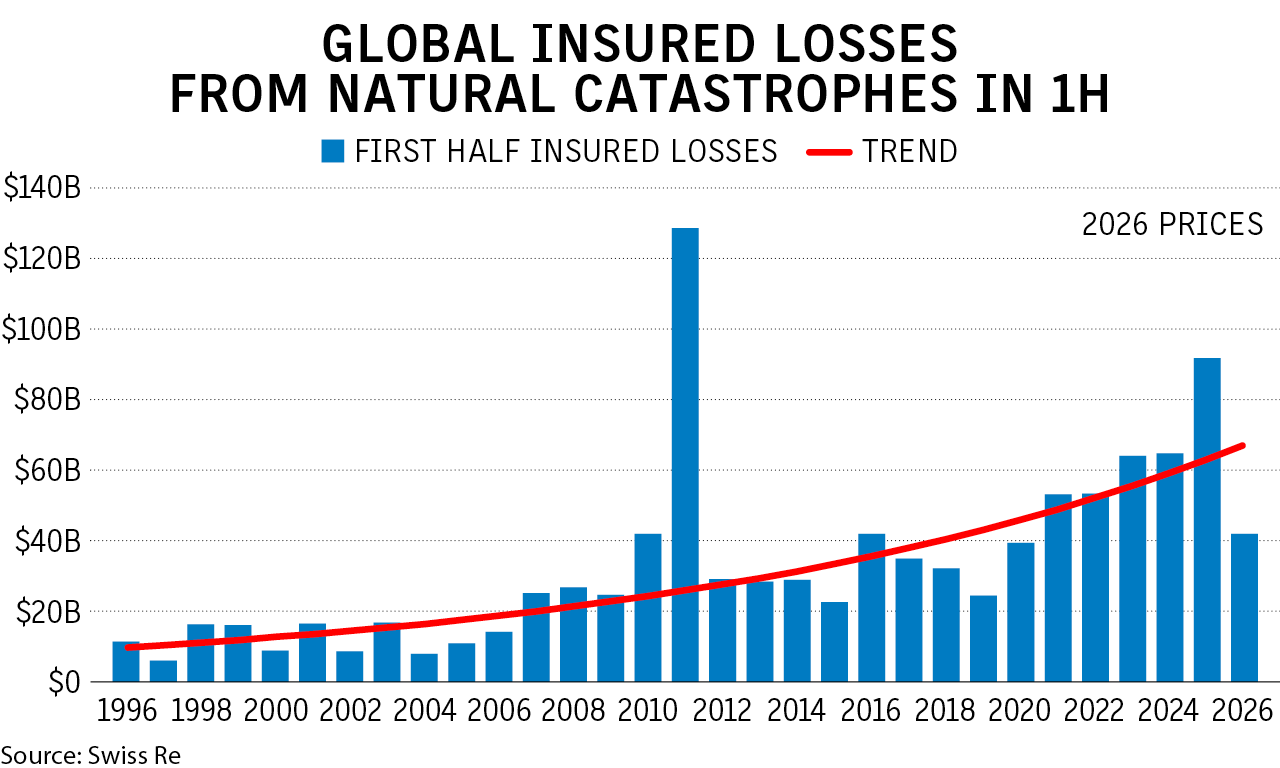
Global insured losses from natural catastrophes totaled approximately $42 billion in the first half of 2026, according to a report Tuesday from Swiss Re.
It was the lowest first-half total since 2020 and below the trend estimate of $66 billion, the report said.
Severe convective storms, mostly in the U.S., were the main driver of claims, causing an estimated $28 billion in insured losses, the lowest since 2021’s inflation-adjusted $21 billion, and below the trend estimate of $36 billion.
Insurance covered approximately 42% of total economic losses, well above the long-term average.
The most destructive natural catastrophe of the first half of 2026 was the Venezuela earthquakes that hit June 24, causing about $20 billion in economic damage. Insured loss estimates are not available. “However, given Venezuela’s low insurance penetration, insured losses will likely represent only a small share,” Swiss Re said.
Record-breaking heat in Europe has given rise to multiple wildfires, but damages have yet to be calculated.
“The insurance tally will depend on whether fires reach settlements and areas with high-value residential or commercial exposure. Europe generally does not combine the extremely high hazard levels and high insured values seen in California,” the report said.

Munich Re CEO says P&C demand will continue to rise as market moves towards balance
Christoph Jurecka, Chief Executive Officer (CEO) of Munich Re, one of the world’s largest global reinsurance companies, has said he expects demand for property and casualty (P&C) reinsurance to continue growing over the medium to long term, supported by rising levels of uninsured risk, emerging exposures, and the increasing impact of climate change.
Last week, the CEO responded to questions about whether recent changes in market conditions had altered the company’s view of the P&C reinsurance sector and what factors could eventually drive a rebalancing between supply and demand.
Addressing the outlook for demand, Jurecka said that his opening comments on market development, in its Q2’26 results call, were focused on the longer-term picture rather than short-term fluctuations. He explained that the company continues to see strong structural reasons for demand to increase in the years ahead.
“If you look at the demand first, there’s plenty of reasons why we are very convinced that the demand can only go up also going forward,” Jurecka said.

Auto Insurers Pay Nothing on 45% of Claims
[Ed. Note: It is tempting to dismiss this report, knowing that "closed without payment" (CWP) ratio is mostly for monitoring claim productivity. Opened claims minus paid claims (CWP) would be unreliable and deficient to gauge fairness in claims settlements or insurer profitability. Metrics such as average net claim payment, reopen rates, claims settled within 30/60/90 days, percentage of attorney representation and reserving accuracy trends are more meaningful to insurers. Either way, sentiments of skepticism and distrust are noteworthy]
Auto Insurers Pay Nothing on 45% of Claims
Auto insurers closed 45% of resolved liability and medical claims without making a payment in 2025, up from 35% a decade earlier, The Wall Street Journal reports.
The figures do not mean every unpaid claim was denied. Insurers said claims can close without payment because another company paid, the customer withdrew the claim, the loss fell outside the policy or damages were below the deductible.
Still, insurers are paying a smaller share of their premium revenue toward claims.
Personal auto insurers paid about 61 cents in claims for every dollar collected in premiums last year, the industry's lowest net loss ratio since 2020, according to S&P Global Market Intelligence.
"The industry uses claim lowballing and denials to wring extra profit out of customers who don't have the resources or, in some states, the rights to fight back," Consumer Federation of America insurance director Douglas Heller told The Journal.
Drivers were more likely to receive money for damage to their own vehicles than for medical expenses or liability involving injuries and damage suffered by other people.
Just under 25% of resolved collision and comprehensive claims closed without payment in 2025, a rate that has remained relatively stable over the past decade. Liability and medical claims, however, have become increasingly likely to close without a payout.
Financial Results
Geico Earnings Plummet 45%—As More Accidents End With Injury Lawsuits
Berkshire Hathaway’s insurance segment drives more than a quarter of its revenue.
Geico, Berkshire Hathaway's largest insurance business, saw earnings decline nearly 45% last quarter as American drivers filed more auto claims and injury costs sharply spiked, delivering a hit to the conglomerate’s most profitable sector.
- Geico's pre-tax underwriting earnings fell to $994 million in the second quarter of 2026, down from $1.82 billion a year earlier—for a decline of nearly 45%, according to Berkshire's quarterly Securities and Exchange Commission filing.
- Geico's loss ratio—the share of premiums paid out in claims—rose to 76.6% in the second quarter and 75.3% for the first half of 2026, up nearly five percentage points from the same periods a year earlier.
- The filing says the number of bodily injury claims rose 5% in the first half of 2026 and injury claim costs on average jumped 10%, both measures worsening when compared to 2025.
- Berkshire's filing reflects a broader trend in the insurance industry where bodily injury claims have surpassed auto physical damage payouts for the first time in history.
Berkshire accelerates buybacks as profit tops forecasts
Berkshire Hathaway said it began reducing its enormous stockpile of cash in the second quarter, investing billions of dollars in stocks such as Alphabet and repurchasing billions of its own, as it reported higher-than-expected profit.
The conglomerate said on Saturday it repurchased $4.5 billion of its own stock between April and June and over $3.3 billion more in July, accelerating repurchases it began in March following a nearly two-year hiatus.
AI in Insurance
Allstate preps Allie platform to drive agentic AI strategy
“We have a technology-driven strategy, not a strategy supported by technology,” CEO Tom Wilson said.
Dive Brief:
Allstate is building a proprietary agentic AI platform to help the insurer advance its strategy and provide better customer service, CEO Tom Wilson said Thursday during a Q2 2026 earnings call. The company did not disclose a specific timeline for the platform’s launch.
“The architecture has eight integrated components that would enable agent-to-agent processing,” Wilson said. “For example, one component will handle all customer interactions. Each component is comprised of multiple agentic agents, which are built to be reused across the enterprise.”
The platform, called Allie, builds on Allstate’s earlier work to boost its analytics engine, Wilson said. Allstate operates 250 analytical models that can generate 100 million quotes while managing “hundreds of millions” of customer interactions.

Why the future of claims performance depends on connected intelligence
Across claims organizations, AI conversations remain largely focused on accelerating decision-making and predictive analytics. But as claims become increasingly complex, many organizations are still grappling with the most time-consuming parts of the process: information gathering and documentation.
When adjusters are still piecing together information across emails, notes, policies, phone calls, PDFs and legacy systems, AI-enabled decision making can only go so far. While decision-making is faster, its accuracy depends entirely on the first two being done correctly.
The biggest opportunity in claims transformation is not replacing adjuster judgment but shortening both the information-gathering process and documentation burden. When systems are already doing that work, adjusters can fully focus on what they do best: making fast, informed decisions on every claim. - Awais Farooq, Chief Claims Officer at Venbrook
Commentary/Opinion

P&C Specialist - How Progressive Became the P&C Industry’s Talent Factory
How Progressive Became the P&C Industry’s Talent Factory
Kate Terry helps insurance companies finish frustrating projects that often stall inside large organizations. Her approach to helping insurers get projects over the finish line reflects many of Progressive's core values, several of which overlap with her own.
That's not a coincidence. The Harvard Business School graduate, who co-founded digital insurance startup Surround Insurance, got her start at Progressive. When she left nearly two decades ago, Terry took its management style with her — including a culture of experimentation and tolerance for failure.
She is part of an ever-expanding group of successful alumni from the Mayfield Village, Ohio-based carrier, which has quietly become a talent factory for the industry, producing executives who now lead insurance companies, startups and consulting firms. ARTICLE, may require subscription
Varada Bhat, P&C Specialist
2026 Outlook/Predictions
Rising Again: Car Insurance Rates Set to Climb in More than Half the Country by Year's End, Insurify Projects
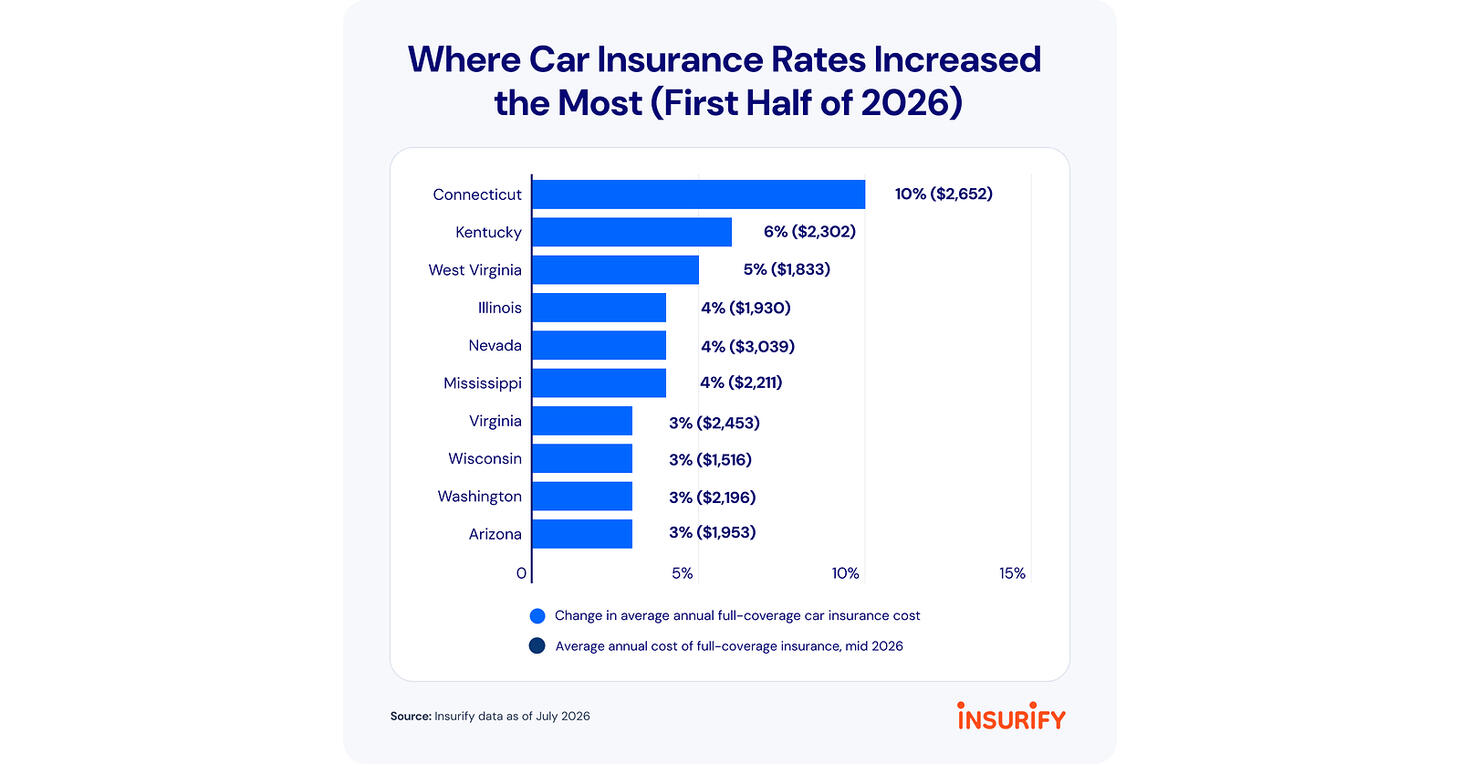
After a 6% national drop in 2025, car insurance rates are projected to climb back in more than half the country, with 27 states posting increases in the first half of 2026, according to Insurify's 2026 Mid-Year Auto Report.
By the end of the year, 32 states will see rate increases, Insurify projects. Connecticut drivers face the steepest year-over-year hike at 15%, followed by Kentucky (+8%), West Virginia (+8%), Nevada (+6%), and Illinois (+6%) round out the top five.
Higher repair costs are contributing to the jump in auto insurance rates. Auto maintenance and repair costs rose 45% over the past five years.
Recommended Events

ITC Vegas | Horizon of Possibilities
ITC Vegas September 29, 2026 - October 1, 2026
The largest insurance innovation event in the world - Predict, Prepare, Progress
From the shore, the ocean can appear calm. Yet, under the surface, tectonic plates shift, pressure builds, and currents redirect—long before we detect movement. That’s insurance right now. Climate, technology, regulation, and human behavior are reshaping risk in real time. Change isn’t coming; it’s already here. The real question is how we move forward.
We set our sights on the horizon and turn insight into action.
‘Connected’ proudly sponsors ITC Vegas 2026. Rate Discounts available for ‘Connected’ followers, please contact Alan Demers