
Climate/Resilience/Sustainability
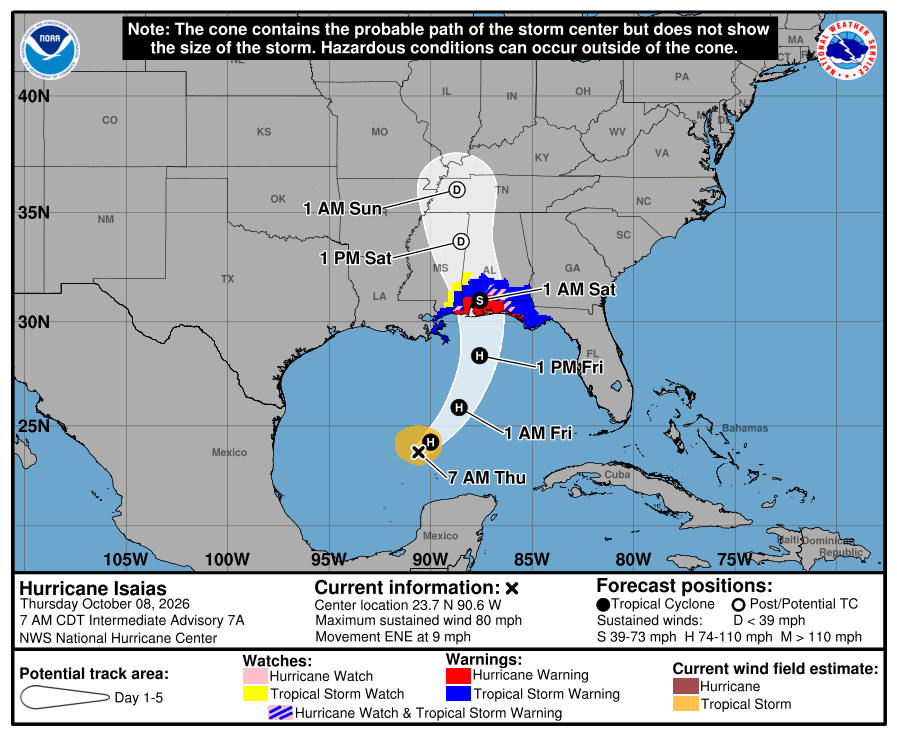
National Hurricane Center
HURRICANE HUNTERS CURRENTLY INVESTIGATING ISAIAS... ...PREPARATIONS TO PROTECT LIFE AND PROPERTY FROM STORM SURGE AND DAMAGING WINDS ALONG THE WARNING AREA OF THE GULF COAST SHOULD BE RUSHED TO COMPLETION TODAY...

Today's businesses take sophisticated approach to climate exposures
But many still need to turn what they know about climate risk into resilience initiatives, Marsh reports.
Businesses are getting more sophisticated in how they evaluate climate exposure, but many still have work to do in turning those assessments into stronger resilience and insurance outcomes, according to the 2026 Climate Adaptation Survey from Marsh.
Now in its third year, the survey draws on responses from more than 120 organizations across eight regions and examines climate risk across assets, operations, suppliers, infrastructure, employees and communities. Its findings suggest that organizations increasingly recognize that climate-related disruptions can extend well beyond damage to a single facility.
Sixty percent of respondents are dealing with multiple climate hazards; flooding, extreme heat and water stress are the three most prominent risks. In some regions (such as Asia), those hazards can occur simultaneously, creating potentially compounding effects on operations and supply chains.
Federal Alliance for Safe Homes (FLASH) Expands with New Leadership Partners and Corporate Members
he nonprofit Federal Alliance for Safe Homes (FLASH) today announced the expansion of its national partnership with two new Leadership Partners—Louisiana Insurance Commissioner Tim Temple and Florida Insurance Commissioner Michael Yaworsky—and two new Corporate Members, James Hardie and CitroTech.
Together, these leaders and organizations bring expertise spanning insurance regulation, resilient construction, building products, innovation, and wildfire prevention. Their participation strengthens the cross-sector collaboration at the heart of the FLASH mission: strengthening homes and safeguarding families from disasters of all kinds.
"Investing in mitigation and strengthening homes before disaster strikes makes a meaningful difference for families, communities, and the insurance market," said Commissioner Temple. "Through efforts like the Louisiana Fortify Homes Program, we are demonstrating how FORTIFIED construction helps reduce risk, strengthen homes, and support a more resilient insurance market. I'm glad to join the FLASH Partnership and work alongside leaders from across the country who share our commitment to advancing real solutions that protect families and property."
Wilmington’s HurriLab is Building an Analysis Layer for Hurricane Decisions – GrepBeat
Wallace Hogsett has spent more than two decades working in weather, from studying hurricane modeling and developing software at the National Hurricane Center to working with insurance companies on weather risk. Across those roles, he has encountered the same problem from a number of angles: There is plenty of weather data, but turning it into a decision can be difficult.
Where hurricanes are concerned, that wealth of data has even helped bring about global forecasting models that have taken decades to develop. But while many public weather services—NOAA, for example—provide information for broad audiences, specific, actionable insights relevant to individual organizations can be harder to come by.
With his new startup, HurriLab, Hogsett aims to provide the analysis layer for those organizations confronting more specific hurricane risks; the company will help them sort through all that available data, pull from the most useful sources, and turn it into actionable information for individual decisions.
Research

Property Claims Are Fewer but Costlier as Labor Costs Keep Climbing
U.S. property claim volume hit a five-year low in Q2 2026 even as severity climbs toward record levels, according to Verisk’s Quarterly Property Report, as reported by Risk & Insurance.
The big picture: Fewer routine claims are being filed, but catastrophe events now make up a larger share of overall volume than they did five years ago. At the same time, rising labor costs are pushing reconstruction pricing higher, even as material costs stay comparatively flat.
By the numbers:
- Volume: U.S. claim assignments fell to about 1.24 million in Q2 2026, down 12.21% from Q2 2025 and 13.05% below the five-year average.
- Severity: Current average severity is $17,085, but Verisk projects it will mature to as high as $19,323, which would be the highest quarterly average in recent years.
- Labor costs: Combined labor and material costs rose 4.0% in the U.S. and 3.2% in Canada year over year, with concrete mason labor up roughly 15.6% in both markets.
News

Industry Reacts to Senators’ Letter for Claims Data and Recent Reports
Senators Elizabeth Warren and Josh Hawley are on the wrong track and misunderstand the influences that can affect claims, the industry said.
The senators have sent letters to some of the largest personal lines insurers in the U.S., asking for data on homeowners and auto claims, particularly those closed without payment. Warren and Hawley said they have “serious concerns,” and wondered whether consumers can trust insurance companies to “hold up their end of the bargain when disasters or emergencies occur.”
Warren and Hawley insinuated that recent reports on claims denials do not look good against recent increases in premiums and hefty profits announced by insurance companies.
Financial Results

Moody’s changes Nationwide’s P&C business outlook to “positive”
Moody’s Ratings announced today that it has changed its outlook for Nationwide’s P&C business to “positive” from “stable.” The global ratings agency also affirmed its A1 rating for Nationwide’s financial services (NFS) business, and A2 rating for Nationwide Mutual Insurance Company and Nationwide’s P&C affiliates.
“Moody’s positive outlook for Nationwide P&C is encouraging recognition of the progress our associates and distribution partners are making together,” said Mark Berven, President & COO, Nationwide Property & Casualty. “Our focus on the claims experience, technical excellence, data-informed underwriting, strong governance and disciplined pricing is helping us improve profitability while delivering the specialized protection and insight our distribution partners and members need. The positive outlook from Moody’s reinforces the value of that work.”
Moody’s specifically notes that Nationwide’s P&C business has “improved its profitability in recent years by enhancing its technical capabilities and governance processes as well as taking pricing and underwriting actions.”
Awards
Ninth annual InsurTech100 spotlights InsurTech leaders
FinTech Global, a specialist research firm, has published its ninth annual InsurTech100, highlighting 100 innovative and influential companies using technology to shape the future of insurance.
The 2026 InsurTech100 arrives as the insurance industry undergoes significant technological change, with AI, automation and increasingly sophisticated data capabilities influencing how insurers create products, evaluate risk and interact with customers. InsurTech companies are increasingly helping insurance providers improve operational efficiency, update legacy systems and adapt to changing customer and market requirements.
The wider InsurTech industry is also experiencing strong growth. Research indicates that the sector is expected to increase from $21.96bn in 2025 to $30.24bn in 2026, representing a compound annual growth rate of 37.7%. MORE
AI in Insurance

P&C Specialist - Allstate Offering Auto Insurance Quotes in ChatGPT
Allstate Offering Auto Insurance Quotes in ChatGPT
Allstate has launched an auto insurance quoting tool inside the ChatGPT platform, which allows customers to shop for coverage through a chat-based experience instead of a traditional online form.
The tool allows policyholders to request an auto insurance estimate by entering personal and vehicle details. Once they receive the estimate, they can continue to Allstate to customize coverage, review the quote and purchase a policy, according to the app's description.
CONTINUES, may require subscription
Varada Bhat
Sapiens Launches Industry-Wide Insurance AI Maturity Index as 67% Predict Full Autonomy Within 2 to 3 Years
Sapiens International Corporation N.V. ("Sapiens") today launched the Inaugural Sapiens Insurance AI Maturity Index, an international study of senior insurance professionals evaluating the current state and future ambitions of AI adoption and use across insurers of all sizes.
Conducted by Research in Finance and launched at Sapiens Ignite 2026, the Index will help insurers plot their progression pathway from automation through to AI and agentic AI adoption. Over two thirds (67%) of respondents believe AI in insurance will be fully autonomous within the next two to three years, underlining that this is an urgent priority for the whole industry.
Only a quarter of insurers are advanced AI users
The Sapiens Insurance AI Maturity Index uses a set of criteria to place insurers in one of four categories: Reactive, Enabled, Operational, and Autonomous. Insurers were scored on their progression in four key areas: cloud adoption, master data strategy, AI governance policy, and HR strategy and policy, with the following findings:
Maturity Index Status
- Autonomous Leaders (25%) On the cloud with some SaaS, master data and HR strategies as well as governance policy in place
- Operational (28%) On the cloud with some SaaS, HR initiatives and governance policy in planning or implemented
- Enabled (23%) On the cloud but not SaaS, early stages of master data strategy and governance policy with HR initiatives in planning
- Reactive (24%) Early stages of cloud adoption, early stages of master data strategy, governance policy and some HR initiatives in place
Cyber Risk

Dimon says AI cyber risk is up tenfold. Cyber insurance prices are still falling
Jamie Dimon has been sounding the alarm about Anthropic's Mythos model since the spring. Earlier today he put a number on it.
In an interview with Bloomberg Television, the JPMorgan Chase chief executive said AI risk "went up 10-fold after Mythos." He said the technology had exposed vulnerabilities the bank hadn't known existed, in an area it already ranked among its biggest worries.
You might expect a warning like that from the head of America's largest bank to show up in cyber insurance premiums. So far it hasn't. US cyber rates fell 2% in the second quarter of 2026, according to Marsh's Global Insurance Market Index. Globally they fell 4%, the twelfth straight quarterly decline. Marsh noted that US cyber pricing has been sliding since the second quarter of 2023.
That gap between the threat being described in boardrooms and the prices being charged at renewal is now the central question for cyber underwriters and the brokers who place their business.
Commentary/Opinion

Consumers trust pizza drivers more than insurers, says CMT's Powers
Drivers will let a total stranger turn up at their door with a pizza, but many still won't let an insurer measure how they drive. According to Bill Powers, co-founder and CEO of Cambridge Mobile Telematics (CMT), this gap in trust has held back insurance telematics.
Powers made the point on stage with Shark Tank investor Daymond John at the recent ITC Vegas conference.
"Most human beings will gladly have a total stranger show up to their house with a box of food or a pizza. No problem, that's totally safe," Powers said. "But if you have someone measuring your driving performance, that's a problem."
The Cambridge, Massachusetts-based company supplies telematics programs to insurers and counts State Farm among its early backers. In March 2026 it secured $350 million from TPG and Allianz, according to Fortune.