
Research

Executive Anxiety Surges As Geopolitical And Economic Shocks Reshape 2026 Outlook -
More than eight in 10 U.S. executives say they’re more worried about their business’s future now than they were at the end of 2025, according to Sentry’s 2026 C-Suite Stress Index: Midyear Report, as reported by Risk & Insurance.
The big picture: Optimism that defined late 2025 has given way to widespread anxiety as geopolitical and economic disruptions compound each other. Executives say events are moving too fast for reliable risk management, prompting many to shorten planning horizons and build in more contingencies.
By the numbers:
- 82% of executives say 2026 events have deepened concern about their business’s future.
- 61% of organizations report negative impacts from international conflicts and geopolitical events.
- 62% cite supply chain and logistics challenges as a top threat, up from 45% in December 2025.
- 74% worry about multimillion-dollar verdicts against companies in their industry.
- 87% have asked employees to work longer hours or take fewer breaks, up from 51%
Average Homeowners Insurance Premiums Have Increased Across The Country—Here’s How To Save – Forbes Advisor
Average homeowners insurance premiums increased across the country from 2018 to 2024, a recent report shows—but some U.S. regions’ prices are rising much more than others.
After adjusting for inflation, average home insurance premiums increased in Western states by 43.3% from 2018 to 2024, according to a National Association of Insurance Commissioners (NAIC) report released July 31.
The Southeast and Midwest average premiums increased by 26.5% and 24.7%, respectively, while the Northeast had the lowest increase of 18.3% for the same period, according to the report.
While home insurance premiums can vary widely by region, the report notes a few reasons why premiums are increasing across the country.
News

It's not just insurance. All of finance is quietly shrinking
Jobs are going – do we have a looming problem?
Talk to people inside insurance about this year's job losses and you'll often hear some version of "well, at least it's not just us." They're right, and the context is important, because it changes the story from "insurance has a problem" to "insurance is caught in something bigger."
According to this week's Employment Situation report from the Bureau of Labor Statistics, financial activities employment is now down 121,000 jobs from its recent peak in May 2025. That category covers a lot of ground: banking, credit intermediation, securities and funds, real estate, and insurance carriers. Nearly every piece of it has been losing headcount at some point over the past year, not just insurance.
A sector-wide retreat, not a single industry's problem
Credit intermediation, essentially bank and lending-related employment, lost 9,000 jobs in July alone, according to the same BLS report, outpacing even insurance's 7,000-job decline that same month. Commercial banking has been a repeat contributor to the losses. The BLS's own Economics Daily writeup of May's numbers pointed to commercial banking cutting 3,000 jobs that month alongside insurance's decline. Go back to January and the same bulletin shows financial activities overall down 22,000 for the month and 49,000 since the May 2025 peak, a decline that has simply compounded month after month since.
Also see Insurers keep saying they're not cutting staff. The payroll data tells a different story
Financial Results
AIG sees GI underwriting income rise 10% in Q2’26 with improved CoR - Reinsurance News
Global insurer AIG has reported underwriting income growth of 10% year over year for its General Insurance (GI) business to USD 686 million for the second quarter of 2026, compared to USD 626 million in Q2’25.
In a strong quarter for the insurer, the combined ratio (CoR) for GI improved slightly to 89%, compared to 89.3% in Q2’25, largely due to higher favorable prior year development (PYD), and an improved expense ratio, partially offset by higher catastrophe-related charges.
The CoR included elevated total catastrophe-related charges of USD 210 million, representing 3.4 loss ratio points, compared to USD 170 million, representing 2.9 loss ratio points, in Q2’25. Additionally, Q2’26 included USD 75 million of net losses related to the Middle East conflict.
2026 Best's Rankings: US Auto Physical Damage Writers See 1.3% Direct Premiums Hike
Most of the top 10 writers of U.S. property/casualty 2025 automobile physical damage direct premiums written retained their positions with little change while one top 10 writer saw a double-digit premium drop, according to a new Best's Rankings.
For the total U.S. P/C industry, auto physical damage DPW rose 1.3% to $177.40 billion in 2025.
The top 100 writers saw DPW rise 1.6% to $172.07 billion. For the top 25 writers, DPW rose 1.4% to $149.50 billion.
State Farm Group retained its top position as its DPW fell 1.7% to $31.76 billion.
Second-ranked Progressive Insurance Group's DPW rose 9.7% to $29.28 billion. For Berkshire Hathaway Insurance at No. 3, DPW rose 3.4% to $18.65 billion.
Liberty Mutual Insurance Cos. retained its No. 7 ranking even as it DPW fell 14.1% to $4.88 billion.
The Best's Ranking measures 2025 DPW; percentage change from the previous year; market share and adjusted loss ratios for the previous three years; and auto physical damage as a percentage of company premiums.
AI in Insurance

Allstate Q2 Earnings Call Highlights
Allstate (NYSE:ALL) reported higher second-quarter revenue, underwriting income and investment income as the insurer continued to expand policies across its auto, homeowners and protection-services businesses. Total revenue rose 11.8% from a year earlier to $18.6 billion, while net premiums written
Wilson also highlighted ALLIE, the company's Large Language Intelligent Ecosystem, which is intended to use agentic artificial intelligence to improve customer service, reduce costs and support growth. He said Allstate has more than 250 analytical models using more than 40 petabytes of data and 1.5 billion CPU compute hours.
Wilson said the company's existing orchestration layer, developed as part of Transformative Growth, should help accelerate ALLIE's deployment by connecting underlying systems. He said Allstate does not use public large language models for its internal work and remains focused on cybersecurity and customer-data protection.

The next generation of AI will not only analyze data. It will help insurers and healthcare organizations make better decisions - Insurtech Israel New
Israeli insurtech company YuviTal has developed BID, a behavioral AI engine that combines artificial intelligence, data, and behavioral science. The technology enables insurers and healthcare organizations to better understand users’ behavioral patterns and personality-related characteristics, anticipate meaningful changes in engagement, select the most appropriate intervention, and improve the effectiveness of health, prevention, engagement, and customer retention programs.
Kobi Berebi, Deputy CEO of YuviTal, explains how the behavioral AI engine emerged from direct collaboration with clients, how YuviTal is moving beyond conventional analytics toward behavioral prediction and real-time decision support, and why the real competitive advantage in AI lies not in access to the technology, but in the quality of its implementation.
In recent years, insurers and healthcare organizations have invested significant resources in data, analytics, and artificial intelligence. The volume of available information continues to grow, and organizations will continue to require more accurate, reliable, and relevant data sources.
Commentary/Opinion

Will AI Be the End of Insurance Agents?
Executive Summary
“AI is not the Internet,” writes Bryan Falchuk. In this counterpoint to an article Carrier Management published last month by Matteo Carbone—Let’s Talk About Insurance Distribution Before ChatGPT Disrupts It—Falchuk argues that AI is not a transaction layer the way ecommerce is.
Like Carbone, Falchuk believes the demand for guidance in making consequential decisions will not change. But the suppliers of that help could include AI agents, informed by patterns across millions of other people and businesses, in Falchuk’s view. In fact, AI agents can understand the need for risk protection from context it holds, without anyone typing a question or request to secure insurance.
InsurTech/M&A/Finance💰/Collaboration
Global InsurTech Report for Q2 2026 | GallagherRe
In the second report of 2026, we focus on the infrastructure that is being built to support AI — sometimes at breakneck speed and remarkable scale. At the heart of this story sit data centers; physical facilities that house the servers, storage and networking equipment.
Key findings for Q2
- Global InsurTech funding reached USD2.44B in Q2 2026, the highest since Q2'22 — much of which was attributable to significant levels of mega-round funding.
- Early-stage funding 51.8% QoQ, from USD548.0M to USD264.19M, although early-stage deal count reached 54 deals.
- A staggering 99.1% of Q2 funding flowed to AI-focused companies, comprising USD2.42B and all deals greater than USD5M. (Re)insurance companies backed 27 tech investments, down from 32 in Q1'26, with 51.9% of them as early-stage deals.

What were the big InsurTech trends in H1 2026?
The insurance market is starting to soften, which could see a shift in the type of innovation projects firms focus on. As the first half of the year ends, what were the trends that shaped the sector?
FinTech Global recently sat down with experts from the InsurTech sector to get their thoughts on the first half of the year. They were all asked to think back over the past six months to anything that surprised them and what developments in the sector people are not talking about enough.
Ido Deutsch, chief revenue officer at Producerflow, offered his insights on the InsurTech sector over the first half of 2026. He noted that while the industry has been focused on AI and the benefits the technology can bring, they have not stepped back to view the whole picture. While AI can do impressive things, it is only as good as its data foundations.
He said, “People are just putting AI models on top of existing data and if the data is not right, the AI just exponentially makes wrong assumptions and suggests wrong outcomes.
“What I didn’t hear about and don’t hear the industry talk about enough is how we make sure our data is right and how our data is correct, both on distribution where we are at but also on underwriting and claims.”
Claims

n2uitive Launches Guidewire Claims Accelerator
n2uitive (Seattle) has launched a cloud-native accelerator for Guidewire (San Mateo, Calif.) ClaimCenter.
The certified accelerator gives claims adjusters access to recorded statement audio, transcripts and claim-ready summaries directly within ClaimCenter, according to an n2uitive statement. Erie Insurance (Erie, Pa.) is among the first carriers to deploy the integration.
n2uitive says the accelerator lets adjusters initiate, capture and access recorded statements from within ClaimCenter. The integration is intended to eliminate manual handoffs, reduce administrative work and return recorded statements, transcripts and summaries automatically to the claim file.
“Recorded statements are the most valuable investigative evidence in a claim—and for too long, the industry has treated them as a filing exercise,” comments Joel Gendelman, CEO and Founder, n2uitive. “With our new cloud-native accelerator, every statement comes back to the adjuster as a structured summary, first draft transcript and actionable record, right inside ClaimCenter.”
Erie’s deployment gives adjusters access to recorded statement workflows directly in ClaimCenter, according to the statement. n2uitive says the implementation is intended to improve investigation quality, efficiency and customer service.
Oil-Related Materials Claims Exposure Varies Broadly Across US
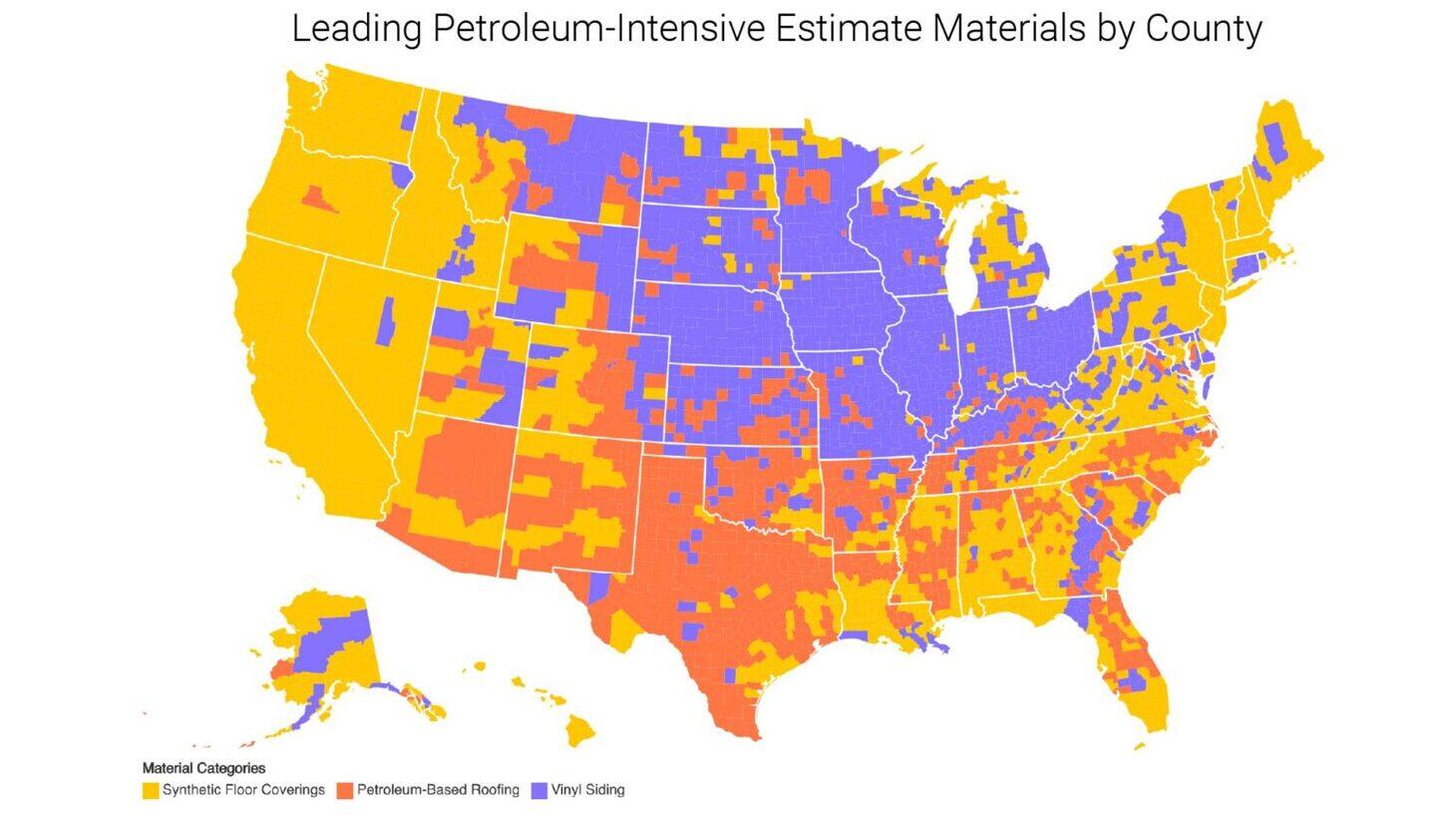
Oil prices are giving claims costs a hit, and depending on the part of the country, the exposure for replacement and repair costs of roofing, synthetic flooring or vinyl siding may be considerable and vary broadly, a new report shows.
Verisk identified three “petroleum-intensive material categories” that account for the largest share of oil-related claims exposure. ARTICLE