
Climate/Resilience/Sustainability

Embers, Not Flames: Why Many Homes Ignite During Wildfires
As communities across the country recognize Wildfire Preparedness Month, Mercury Insurance is encouraging homeowners to focus on one of the leading causes of home ignition during wildfires: wind-driven embers. According to research from the Insurance Institute for Business & Home Safety (IBHS) and CAL FIRE, embers can travel miles ahead of an active wildfire, landing on roofs, vents, decks, and other vulnerable areas long before flames ever reach a structure.
These small burning particles are responsible for many home ignitions during wildfire events, particularly in dry and windy conditions where embers can accumulate in overlooked spaces around a property.
"Many homeowners picture a large wall of flames reaching their home, but embers are often the real threat," said Holly Sacks, Director, Portfolio Underwriting and CAT Management at Mercury Insurance. "A single ember landing in the wrong place can ignite dry debris, enter an uncovered vent, or start a fire on or around the home. The good news is that relatively small maintenance and preparation steps can make a meaningful difference."
Research from IBHS shows that homes are especially vulnerable when embers collect in areas where combustible materials are present. CAL FIRE guidance similarly emphasizes the importance of reducing ignition opportunities around structures, particularly within the first five feet surrounding a home.

IBHS's FORTIFIED Program Surpasses 100,000 Designations
The Insurance Institute for Business & Home Safety (IBHS) today announced its FORTIFIED® program has surpassed 100,000 designations nationwide, marking a major milestone in reducing storm losses and strengthening community resilience. The achievement underscores growing adoption of IBHS's science‑based construction and re-roofing standard as states, insurers, manufacturers, and communities align around proven strategies to break the cycle of disaster losses.
"Reaching 100,000 FORTIFIED designations is a powerful signal of a growing national commitment to make homes stronger before severe weather strikes," said Roy Wright, president and CEO of IBHS.
"This milestone represents families who are better protected, homes better positioned to stand up to Mother Nature, and communities with a stronger chance to recover faster. Resilience at scale begins when science moves from the lab into homes, communities, and policy decisions that help people weather the next storm."
Based on decades of IBHS research, FORTIFIED is a voluntary, beyond-code construction and re-roofing method that strengthens the parts of homes and buildings most vulnerable to high winds and wind‑driven rain.
Research
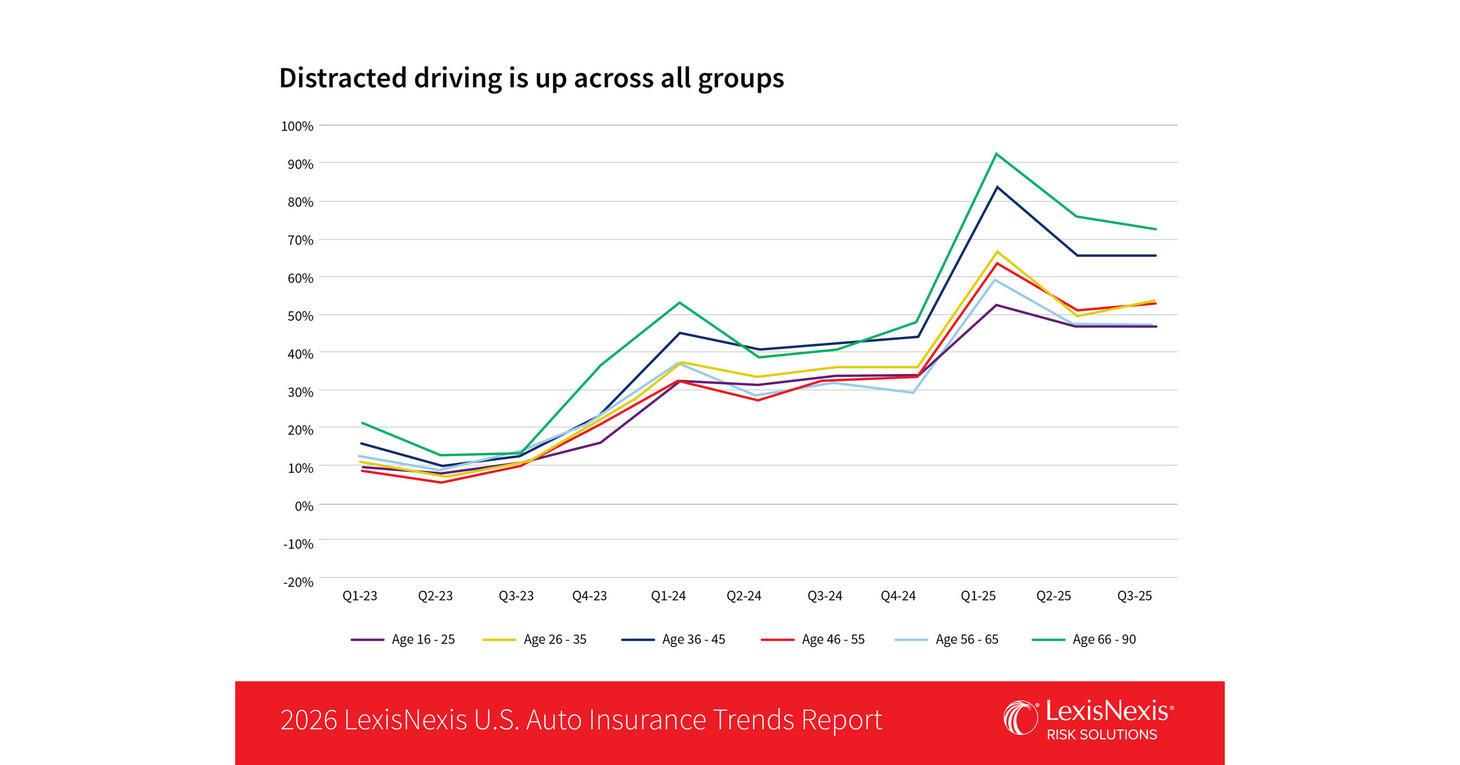
Distracted Driving, Policy Shopping, Bodily Injury Redefine Auto Insurance Risk, according to 2026 LexisNexis U.S. Auto Insurance Trends Report
Today, LexisNexis® Risk Solutions released its 2026 LexisNexis U.S. Auto Insurance Trends Report.
Published annually, the report aggregates and analyzes auto insurance market data from prior years, including driving behavior, policy shopping activity, impact of changing rates, vehicle mix dynamics and key claims metrics.
Key findings from this year's Auto Insurance Trends Report include:
- Distracted driving violations are up 57% since 2022, with increases of 70% or more among drivers aged 36-45 and 66 and older.
- Insurance is now a key factor in vehicle purchase decisions for 56% of consumers, reflecting its growing role in the total cost of vehicle ownership.
- Policy shopping reached historic highs in Q4 2025, with more than 47% of policies-in-force shopped at least once in the previous 12 months.
- The mix of vehicles on U.S. roads is becoming more complex, with 15% of vehicles now more than 20 years old, while newer vehicles (model year 2020 or newer) represent 30% of the insured population.
- Bodily injury (BI) claims now account for more than 26% of total claims dollars, up from less than 20% in 2022, as BI frequency and severity continue to rise.
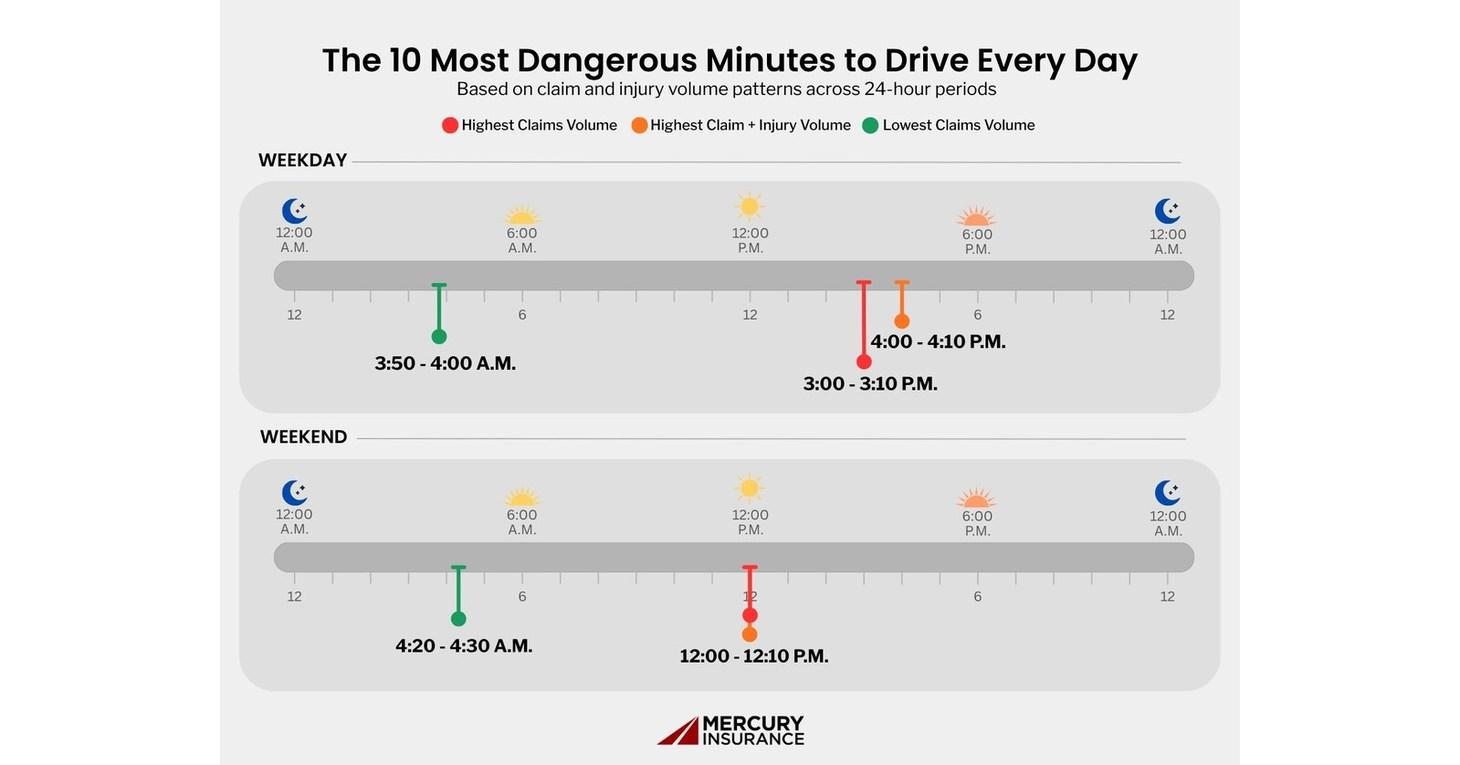
America's Most Dangerous Driving Window Starts at 3pm - and Gets Worse an Hour Later
For the first time in its more than 60-year history, *Mercury Insurance (NYSE/NYSE TX: MCY) *analyzed proprietary claims data to identify the most dangerous moments on America's roads – and the results challenge a common assumption about rush hour driving.
The 10 Most Dangerous Minutes to Drive Every Day.
While crash volume peaks between 3:00 and 3:10pm, the risk of injury rises even higher about an hour later, between 4:00 and 4:10pm., when traffic begins moving faster and collisions become more severe. Over a five-year period, more than 61,000 people were involved in crashes during the busiest 10-minute weekday window alone.
"Rush hour doesn't play out the same way from start to finish, and that shows up clearly in the claims data," said Heather Paull, Manager, Divisional Claims at Mercury Insurance. "Earlier in the afternoon, there's more congestion with school pick-ups and people getting on the road, so you see more low-speed, stop-and-go incidents. As the drive goes on, traffic starts to move more freely, and drivers tend to pick up speed or get a little less attentive. That's when the crashes we see tend to be more serious."
News
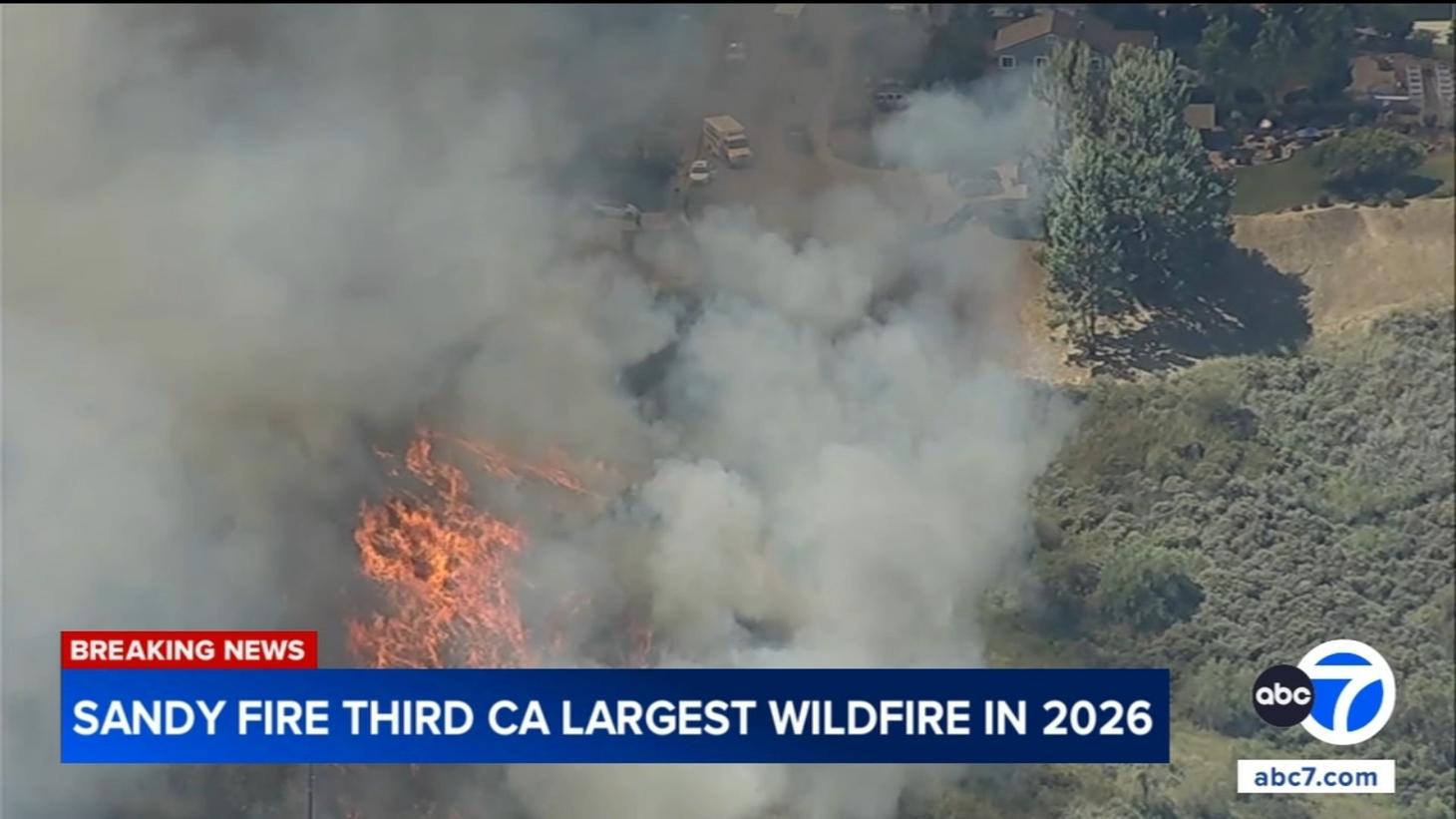
Sandy Fire is 3rd largest wildfire currently burning in CA
The wind-fueled Sandy Fire in Simi Valley has burned 1,386 acres, making it the third largest wildfire in California so far this season.
The Sandy Fire continues to burn in Simi Valley, which has scorched more than 2,100 acres and destroyed at least one home.
More than 17,000 people are under evacuation orders. The fire is 22% contained, and the cause is under investigation.
The wind-driven Sandy Fire erupted on Monday in the hills above Simi Valley, about 30 miles northwest of Los Angeles.

Funeral Details – Chicago Jewish Funerals
Yesterday, our dear friend and 'Connected' co-curator, Stephen Applebaum was laid to rest. You may view the funeral services video HERE
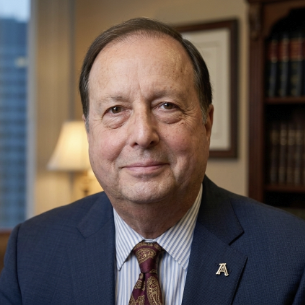
Stephen Applebaum Remembered | Insurance Innovation Reporter
With great sorrow, we note the passing of our friend Stephen Applebaum. Readers will know Stephen as a regular contributor to IIR, often writing with his collaborator Alan Demers. Others will know him as an insurance technology maven and expert on the property/casualty claims ecosystem.
Stephen’s authority came from long experience as a builder, operator, analyst and advisor in the claims technology ecosystem. Across roles with companies and advisory firms including CCC Information Services, ADP Claims Services Group, ClaimForce, Aite Group, StoneRidge Advisors, Waller Helms Advisors and his own Insurance Solutions Group, he developed a practical understanding of how carriers, claims organizations, repair networks, technology providers and investors fit together.
We learned of Stephen’s passing shortly after sending an email asking what he and Alan might have next for IIR’s readers. Stephen and Alan were a great team, providing extremely well researched and well written commentary that we were always excited to receive. When Alan notified us, we were shocked. The news came without warning.
Given the energetic warmth of Stephen’s personality, it was easy to forget his age. I remember being very surprised when he told me how old he was more than 10 years ago. I would never have guessed. He was always youthful and ebullient in his communications, including the last email I received from him about a week ago, when he was already over 80.
Though ours was chiefly an industry friendship, it was as warm a relationship as one can have with the people one feels fortunate to deal with from month to month, year to year. Stephen had outstanding qualities that inspired admiration and affection. In my experience, he was unfailingly kind and solicitous. He always considered your needs and held up his side of the bargain.
He was sharp, witty, morally serious and generous. He had a certain nervous energy, a constitutional impatience, and a certain style—even flourish—in his manners. He had a charming warmth and a delightful irascibility when warranted. He was a man of feeling and a man of character. He was a gent. He was a mensch.
I will miss him personally and professionally, and the industry will feel his loss.
Anthony O'Donnell, Editor, Insurance Innovation Reporter
Financial Results

April 2026 Monthly Release
The Allstate Corporation (NYSE: ALL) today announced estimated catastrophe losses for the month of April of $870 million or $687 million, after-tax, from 10 wind and hail events with approximately 70% of the losses related to two events.
Policy counts are based on items rather than customers. A multi-car customer would generate multiple item (policy) counts, even if all cars were insured under one policy. Lender-placed policies are excluded from policy counts because relationships are with the lenders.
Allstate Protection policies in force have been consistently growing year-over-year since March 2025, and we are increasing market share for auto in 57% of states and homeowners in 83% of states. Therefore, we are changing the frequency of reporting policies in force and next month will be the final inclusion in our Monthly Release. Policies in force will continue to be available quarterly in our earnings release.
AI in Insurance

AI can transform insurance, but humans must stay in the driver’s seat, according to Bryant expert
$50 billion to $70 billion. That’s the estimated amount of industry revenue generative artificial intelligence (AI) could unlock for the insurance...
That’s the estimated amount of industry revenue generative artificial intelligence (AI) could unlock for the insurance industry, according to a McKinsey report from earlier this year.
“Almost all insurance companies are currently using AI,” says Bryant University’s Assistant Professor of Mathematics Jessica Zhai, Ph.D., who teaches Bryant’s “AI Application in Insurance,” course. “It’s an important tool that could help with tedious work like cleaning data and modeling.”
While McKinsey’s evaluation suggested that marketing and sales, customer operations, and software engineering dimensions would see the highest areas of impact, Zhai — who previously worked as a consultant of actuarial science and risk management services for EY, specializing in solvency assessment, actuarial modeling, and product design — notes that AI is fueling dynamic changes throughout the industry.
From companies like Lemonade that use AI to craft customized policies and pay out claims to organizations such as Verisk that launched AI technology to detect photo fraud in claims, the possibilities of implementation seem endless.
But as AI continues to be integrated into the insurance industry, it’s vital that humans remain in charge of making principal decisions, says Zhai.
AI meets flood risk - but underwriting judgment still carries the weight
At the core of transformation is a practical objective: removing friction in how agents and clients interact with flood products. Marissa Skinner (pictured), managing director of Poulton Associates, a division of Wright National Flood Insurance Services, has been advancing a focused transformation agenda across underwriting, data, and client delivery.
Poulton Associates, headquartered in Salt Lake City, Utah, runs the Natural Catastrophe Insurance Program (NCIP), as well as other natural catastrophe insurance offerings. It owns and operates the CATcoverage.com web platform and has been a leader in provisioning risk services since 1989.
Skinner points to a persistent challenge in the MGA space, where many agents write only a handful of flood policies annually. “Learning to navigate a website, understanding a workflow, and retaining that knowledge can be difficult,” she said. “Agents are calling in, needing handholding, regardless of how intuitive the user interface is.”

The Growing Backlash Against AI
As long as everyone has been telling their Ted Turner stories in the wake of his recent death, I thought I'd tell mine, before getting on to this week's business: what I see as a growing backlash among younger generations toward AI that business leaders need to contend with.
My story comes from my friend Marc (a former managing director at Marsh McLennan, as it happens). He was at the helm in a multi-day sailboat race around Long Island in the 1980s and timed the start almost perfectly. In the chaotic way that these races start, you don't know when the horn will blow, so you circle as you try to be at full speed with a clear path to the starting line when the horn sounds. Marc had succeeded — but Ted Turner was bearing down on him, aiming for the same spot on the line that Marc was going to cross.
Marc had the right of way, but this was Ted Turner, recent winner of the America's Cup, in a much bigger, faster boat, with a world class, steely glare as he steered his boat on a collision course with Marc.
Marc never wavered, and at the last possible moment Turner bore off, did a 360, and crossed the starting line a minute or so later. Turner won the class among the biggest boats, while Marc and his crew just did well in his class of smaller ones. Finishing late at night, he and his crewmates headed to a bar to decompress. At 1am, they were getting ready to call it a night, when the bartender set a round of drinks in front of them and said they were sent with the compliments of the gentleman at the door. The gentleman was Ted Turner. He nodded respectfully in their direction. Then he gave them the finger with both hands and stormed out.
The bartender told Marc that Turner said he'd been scouring every bar on the waterfront in search of Marc and his friends. Whatever else you want to say about Turner, the man had style.
Now on to the backlash against AI that we all should be watching. ARTICLE
Paul Carroll, Editor-in_Chief, Insurance Thought Leadership
State News

Florida insurers to benefit from more pronounced June reinsurance renewal softening:
Property insurers in the State of Florida are expected to benefit from a more pronounced softening of reinsurance pricing and rates at the June 1 2026 renewals, which may serve to sustain the positive market momentum being seen since the legislative reforms, AM Best has explained.
Florida’s property insurance market was once deemed dysfunctional due to the proliferation of litigation and issues such as assignment of benefits (AOB), but legislative reforms enacted in recent years have meaningfully changed the picture and served to increase the appetite of reinsurance capital to support catastrophe exposed risks on the Peninsula.
Despite that, alongside improving market conditions and underwriting results, Florida’s property insurers remain among the heaviest users of reinsurance capital, AM Best explained in a new report today.
2024 had marked the first underwriting profit for Florida’s domestic property insurers in more than a decade.
2025 saw the positive momentum accelerate, with a $1 billion underwriting gain, well up on the $235 million in 2024 and the $132 million underwriting loss in 2023.
“The improved Florida property insurance landscape reflects reduced litigation and claim solicitation, attracting new writers to the state while allowing existing writers to recover from losses in earlier years and take advantage of more refined pricing sophistication,” explained Lauren Magro, senior financial analyst, AM Best. “While 2024 marked the first year of an underwriting profit for the segment in over a decade, results in 2025 only further extended this trend and benefited from no named hurricanes making landfall.”
InsurTech/M&A/Finance💰/Collaboration
Weav.ai Joins Guidewire InsurTech Program | Insurance Innovation Reporter
Weav.ai(Palo Alto, Calif.), an AI-native decisioning platform for property/casualty insurance, has joined the Guidewire InsurTech Vanguards program, an initiative created by Guidewire (San Mateo, Calif.) to help insurers learn about InsurTechs and apply their capabilities.
Weav.ai says its platform unifies knowledge, decisions and actions across underwriting, premium audit and claims by embedding AI-driven decision support directly into insurance workflows. The platform integrates with industry-leading core administration platforms, including Guidewire, to deliver AI-generated recommendations and policy decisions inside insurers’ existing workflows, improving quote speed, decision consistency and operational efficiency while maintaining human oversight for critical decisions.
“Insurers using Guidewire need decision intelligence that works inside their existing workflows,” comments Peeyush Rai, CEO and Founder, Weav.ai. “Through the InsurTech Vanguards program, we can bring that capability to more Guidewire customers, helping underwriting, premium audit, and claims teams make faster, more accurate decisions without adding system complexity.”
Claims

New Analysis Finds Modernized Loan Payoff Workflows Can Deliver Over $1 Million in Annual Value for Auto Dealers
The National Loan Payoff Clearinghouse™ (NLPC), powered by EPIC™, today released a new financial impact analysis based on average NLPC participant performance and broader industry benchmarks. The analysis found that dealerships leveraging modernized loan payoff and lien release workflows can realize significant annual value through operational efficiencies, reduced friction, and improved capital velocity.
For many dealerships, loan payoff and lien release remain among the most fragmented and time-consuming parts of the vehicle transaction lifecycle. Manual checks, overnight shipping, varied lender processes, and limited visibility into lien and title status can increase operational expense, delay vehicle turns, and tie up working capital.
"The cost of friction in loan payoff and lien release is easy to underestimate until you see how frequently it impacts margin, working capital, and vehicle turn time," said EPIC CEO, Brandon Hall. "The NLPC helps transform those workflows into a more efficient, reliable, and scalable financial process."