
News

Comp posts 91% combined ratio in 2025, extends underwriting gains
Workers compensation continued its run of underwriting profitability in 2025, posting a 91% combined ratio and marking the 12th consecutive year of underwriting gains, even as claim severity rose and net written premium edged down slightly, according to the National Council on Compensation Insurance’s annual State of the Line report released Tuesday.
NCCI reported that workers compensation net written premium decreased 0.2% in 2025, while the accident year combined ratio was 102%, with prior years continuing to experience downward reserve development. The organization also estimates the industry’s reserve position remains redundant by approximately $14 billion.
Lost-time claim frequency declined by 2% in 2025, continuing a long-term downward trend, although at a slower pace than the long-term average decline. At the same time, both medical and indemnity claim severity increased by 4%, reflecting continued cost pressures across the system.

FEMA Review Council Releases Report to Reform Agency
On May 7, the FEMA Review Council submitted its final report to President Donald Trump. The 75-page report presents a comprehensive set of recommendations for overhauling the federal government’s approach to disaster preparedness, response and recovery.
The report argues that FEMA has become overly slow and bureaucratic and recommends shifting greater responsibility for disaster response and recovery to state and local governments, with the federal government serving in a more supportive role.
Key recommendations include streamlining disaster aid programs, reducing administrative red tape, modernizing and downsizing portions of FEMA, reforming the National Flood Insurance Program (NFIP), and increasing the threshold for triggering federal disaster assistance.
The report also calls for simplifying environmental reviews and grant application processes to accelerate disaster recovery efforts.
In relation to the NFIP, the council recommends “a comprehensive reform plan centered on a strategic shift toward a primary role for the private market, to foster a more resilient and financially stable flood risk management system.”
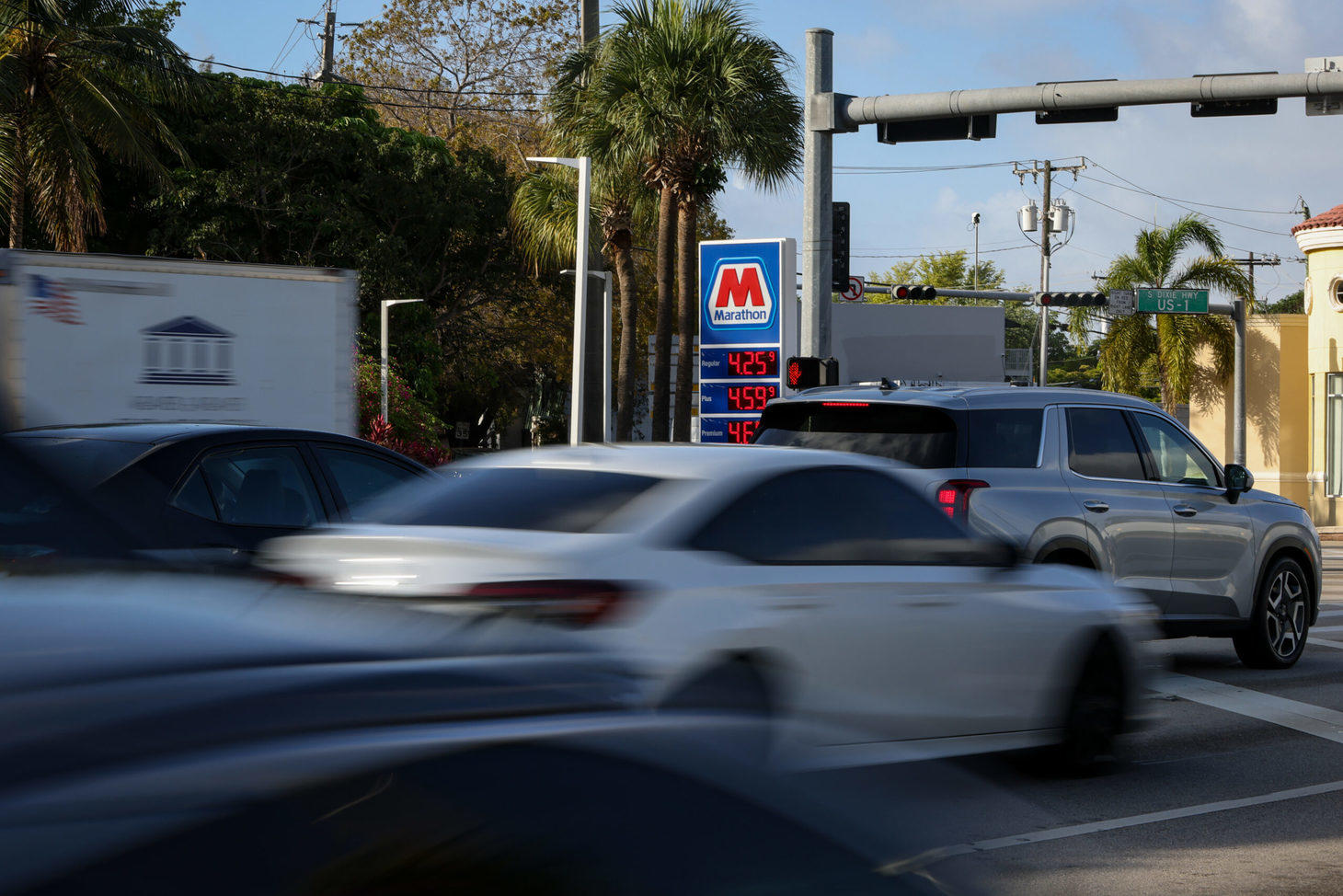
AAA Forecasts Record Memorial Day Drivers Despite High Gas Prices
A record number of people are expected to travel by car over Memorial Day weekend, a sign of resilient demand for fuel amid surging pump prices, at least for now.
Some 39.1 million people are projected to drive at least 50 miles for the holiday weekend and unofficial start of summer, the American Automobile Association said on Monday, while 39 million people took road trips during the same period last year.
A gallon of gas is now holding above $4.50, up from around $3.17 during the same weekend last year, according to AAA data.
Climate/Resilience/Sustainability

As property insurance crisis worsens, some lawmakers target Big Oil
May 13--Desperate to get a handle on rising property insurance costs driven by natural disasters, some state lawmakers are opening up a new line of attack in the effort to force oil companies to bear the cost of climate change effects.
In three states, Democratic lawmakers introduced bills this session that would allow insurance companies or state attorneys general to take action against oil companies to offset the rising costs of insurance.
While none of the measures became law this session, they signal the increasing urgency in states where wildfires, floods and other disasters have driven up the cost of insurance premiums and led some insurers to stop writing new policies.
The proposals follow other state-led efforts to demand payment from fossil fuel producers for the mounting damages caused by climate change. States and municipalities have filed more than three dozen lawsuits over the industry's role in the climate crisis, claiming companies violated a variety of laws, including consumer protection, public nuisance, failure to warn, fraud and racketeering.
Meanwhile, a handful of states have passed or introduced "climate Superfund" bills that use attribution science -- a new field of research -- to calculate the cost of disasters and charge fossil fuel companies for their role in causing them.
Those efforts have drawn fierce opposition and legal challenges from oil companies and conservative groups.
Financial Results
Global multiline insurers’ earnings near peak levels in 2025: S&P - Reinsurance News
S&P Global Ratings, the financial research and credit ratings agency, said the world’s largest global multiline insurers continued to post strong financial performances in 2025, supported by disciplined underwriting, solid investment returns, and resilient capital positions.
In a new report, the company said the 15 global multiline insurers (GMIs) it rates recorded combined net earnings of $84 billion during the year, compared with $68 billion in 2024.
According to S&P, reported earnings rose by 23% year on year, although underlying growth was lower once currency movements and exceptional items were excluded. On a comparable basis, the company said earnings increased by 9%, which it described as being at the upper end of its expectations for the sector.
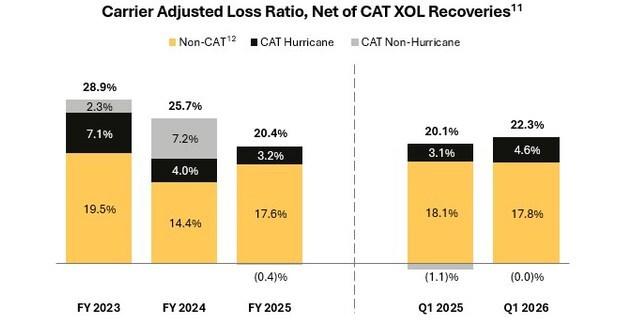
Kin Q1 2026 Operating Income Surges 95% Year-Over-Year; Baseline Operating Margin Expands to Record 50%
Kin opened 2026 with strong profitability momentum, reporting Total Revenue of $56.6 million and a record Q1 Baseline Operating Margin of 50% — up from 42% in the prior year period.
Baseline Operating Income reached $20.2 million, up 37% year-over-year, while Operating Income⁷ grew 96% to $4.5 million, reflecting the expanding earnings power of Kin's growing renewal base. Gross Written Premium² reached $177.6 million, a 20% year-over-year increase, with Gross Profit⁶ Margin remaining strong at 94%. The results reflect growing customer demand for Kin's expanding suite of home insurance, auto insurance, and home finance products.
"Insurance and reinsurance rates are now stabilized after a period of turmoil between 2022 and 2024. That means fewer customers are shopping, which makes customer acquisition more expensive for us," said Kin Founder and CEO Sean Harper. "This quarter we spent about $30M on growth expenses and acquired about $16M of new annual recurring revenue (ARR). That means our customer acquisition this quarter will break even at the first renewal, about a year from now. That's a very fast payback for ARR that has about a 10% net churn rate."
Research

New Survey Reveals Homeownership is Stressful. Most Homeowners Say It's Worth It
Hippo, a technology-native insurance group, today released its 2026 Homeowner Anxiety Report, revealing that for most U.S. homeowners, the pride of ownership and the stress of maintaining a home go hand-in-hand.
The findings accompany a refreshed Hippo website and brand experience built around what the data reveals homeowners need most: a proactive partner in protecting their home.
Of the homeowners surveyed, 84% say homeownership-related anxieties have at least some impact on their overall quality of life, and one in four rate that impact as a 4 or 5 on a 5-point scale. Among homeowners who feel anxious about their home, 32% say they become restless or tense, 28% lose sleep, and 22% report their mental health worsening as a result.
Despite the anxiety, homeownership remains deeply meaningful. Hippo found that 97% of homeowners still find homeownership a worthwhile experience, with many connecting it to feeling a sense of stability and pride. And it's no wonder, 49% of homeowners say their home is their single most valuable financial asset and one they depend on for long-term security.

Hybrid Vehicle Collision Claims Hit Record High in First Quarter
Hybrid Vehicle Collision Claims Hit Record High in First Quarter as BEV Claims Level Off
Mitchell, a leader in the development of innovative auto physical damage technology solutions, today released its Q1 2026 Plugged-In: EV Collision Insights report. The company’s latest publication reveals a shift in electric vehicle claim trends that is introducing new challenges for insurers and repairers related to risk exposure, cycle time and repair complexity.
In Q1, the share of repairable collision claims for battery electric vehicles (BEVs) held steady at 3.33% in the U.S. and 4.94% in Canada. At the same time, claims for mild hybrid electric vehicles (MHEVs) surged to record highs—5.69% in the U.S. and 5.28% in Canada—representing year-over-year increases of 25% and 33%, respectively.
“Electrification isn’t slowing, it’s evolving,” said Ryan Mandell, Mitchell’s vice president of strategy and market intelligence. “Even as BEV sales soften, the number of hybrids on the road is growing, and that is clearly reflected in the rise of hybrid collision claims. For insurers, this affects the types of vehicles and risks they must manage. For repairers, it adds complexity by requiring additional tooling, labor operations and training to ensure a proper and safe repair.”
The Q1 2026 report points to increasing fuel costs and geopolitical instability in the Middle East as key drivers accelerating consumer interest in electric vehicles, primarily hybrids, while supply constraints, import tariffs and the expiration of federal tax incentives have slowed the BEV adoption rate. Despite this near-term slowdown, BEVs are still expected to reach approximately 29% of new vehicle sales and just over 10% of vehicles in operation by 2035. GET THE REPORT
AI in Insurance

P&C Insurance's AI Problem Isn't What You Think | Insurance Thought Leadership
Budgets have grown, pilots have multiplied, and AI is now a fixture in virtually every P&C strategic plan. Yet 42% of insurers track no AI metrics at all, which means they have no way to validate what works, no playbook to scale it, and no mechanism to stop what doesn't work. Insurers' investment pattern confirms that this is an organizational constraint, rather than a technology one: on average, 72% of AI spending goes to technology and only 28% to change management.
Technology creates capability. But change management determines whether that capability becomes performance. That imbalance is the first signal of what Capgemini identifies in the 19th edition of its 2026 World Property and Casualty Insurance Report as an "architecture mismatch." This is a structural gap that runs deeper than the technology stack, and that no amount of additional AI investment will close on its own.
THREE DIMENSIONS, ONE CEILING
The first dimension is a strategy and talent gap. Among the top 20 global P&C insurers, only 35% have explicitly linked their AI strategy to business outcomes beyond efficiency. That narrow framing has consequences: Strategy tends to direct investment toward quick wins rather than the capabilities AI needs to grow over time. In most cases, the result is an incomplete strategy that optimizes the present while leaving the future underbuilt. MORE

insured.io Launches Conversational AI Claims Agent for Carriers
insured.io, a leading provider of omnichannel customer experience solutions for insurers, today announced the launch of Claims AI, a conversational, AI-powered virtual claims agent.
Claims AI is designed to handle First Notice of Loss (FNOL) end-to-end across both voice and chat channels, providing insurance carriers with a future-proof solution for modern policyholder demands.
Built on the robust core of the insured.io platform, Claims AI is a sophisticated omnichannel system that provides real-time policy search and retrieval, as well as real-time claims submission directly into an insurer's core or claims system. Research indicates that such AI-related technologies can increase productivity by up to 80 percent and improve classification accuracy by 30 percent compared to manual processes.
"The innovation built into the insured.io platform doesn't come from an AI company guessing how to do insurance claims. Instead, this AI agent was created by insurance experts who live and breathe insurance processes, and are committed to making the claims experience better for insureds," said Steve Johnson, Chief Product Officer of insured.io. "With Claims AI, we're putting insurers in command of every touchpoint in the policyholder relationship, ensuring a seamless, omnichannel experience that goes beyond simple multi-channel access."
Claims
Surging Negative Equity May Be Reshaping Collision Claim Behavior - Autobody News
Shops say transparent pricing, flexible options, and a good-better-best approach are key to navigating the shift.
Nearly one in three Americans trading in a vehicle today owes more on their loan than their car is worth. Data from Edmunds shows that 30.9% of trade-ins toward new-vehicle purchases carried negative equity in Q1 2026, the highest share of underwater trade-ins for any quarter since Q1 2021. The average amount owed on those underwater trade-ins reached $7,183, up 42% compared with the same period five years ago.
For collision repair shops, that debt load is showing up in claim filing behavior, total loss frequency, and how shops are adapting to a market where insured volume is shrinking and financial pressure on vehicle owners is growing.
That financial exposure is translating into behavioral shifts at the shop level. Patrick Crozat, vice president of G&C Auto Body, cited several forces reshaping how consumers approach claims. He cited increasing insurance rates, used car values dropping since COVID, cost per claim increasing over the last few years due to inflation and ADAS.
“The average consumer has more debt than ever before,” he said. “All of these things have caused consumers to hold onto their cars longer than usual.”
Crozat noted that consumers are also worried that if they turn in a claim that their rates will go up even more, that they will get cancelled by the insurance all together or have their car totaled and still owe money — or just can't afford to buy another car.
Rachel Hutfless, chief client officer at Crash Champions, said the multi-location MSO has seen the same trend across its network. “Over the past 12 to 18 months, we've observed a noticeable shift in customer behavior: more individuals are requesting repair estimates and ultimately opting to pay out of pocket rather than filing insurance claims,” Hutfless said. “This trend has resulted in a significant increase in customer-pay opportunities across our network.” FULL ARTICLE
Predict & Prevent

AXA XL launches dedicated business unit to scale prevention services
AXA XL today announced the creation of a new Business Unit dedicated to prevention.
The new unit, led by Libby Benet, currently the company's Global Chief Underwriting Officer, will accelerate the development and reach of AXA XL's risk consulting capabilities and prevention services.
. The Business Unit will combine advanced data, analytics and technology with AXA XL's risk engineering and advisory expertise to deliver innovative solutions that help businesses address today's most pressing risks, including climate, supply chain disruption, cyber threats and operational resilience.
AXA's 2025 Future Risks Report highlights prevention as a critical strategy for the future, with 86% of experts agreeing that the most concerning risks could be at least partially avoided through preventive measures. As risks become more complex and interconnected, prevention is becoming a key lever to help businesses better anticipate and manage their exposures.
Scott Gunter, CEO of AXA XL, commented: "Prevention must be at the heart of how we support our clients. That is why we are making services a core part of our offering. The launch of this business unit marks an important step. By expanding our services capabilities, we are strengthening how we support our clients and positioning AXA XL for the future.
He added: "Libby's deep underwriting expertise, global perspective and client focus give her a clear vision to shape and scale this business."