
News

Trump announces US naval blockade deepening insurance crisis
When US and Israeli forces launched airstrikes against Iranian targets on 28 February 2026, the Strait of Hormuz - through which approximately 20 million barrels of oil flow each day, representing roughly 20 per cent of global petroleum liquids consumption - did not close because of mines or missiles alone. It closed, in large part, because of insurance.
Within 48 hours of those initial strikes, war risk premiums surged fivefold, major marine insurers cancelled existing coverage, and the Lloyd's Market Association's Joint War Committee (JWC) redesignated the entire Arabian Gulf as a conflict zone. Tanker traffic collapsed by more than 80 per cent before Iran's physical blockade was even formally declared. The strait was commercially unnavigable before it was militarily dangerous. That dynamic - in which insurance architecture rather than kinetic threat became the proximate cause of a global energy disruption - sets the stage for understanding why Sunday's announcement of a US naval blockade represents a further, and unusually complex, escalation for the global insurance industry.
What the Strait of Hormuz Blockade Means for Collision Repair - PartsTrader
What Will the Iran War and the Blockade of the Strait of Hormuz Mean for the Collision Repair Business?
Many observers looking at the current situation in the Middle East would likely point first to the potential impact on the collision repair industry through rising fuel prices. Higher fuel costs typically mean fewer miles driven and a corresponding decline in accident frequency, along with a slight increase in transportation costs for collision parts.
But there are a few other potential impacts worth watching.
While the region is not a major producer of automotive parts, it does supply key resources such as oil, helium, and aluminum. Roughly 20% of the world’s oil passes through the Strait of Hormuz, according to the U.S. Energy Information Administration.
The U.S. imports a significant amount of automotive-grade aluminum, and about 20% of that supply comes from the Gulf region. While that is not the majority of the raw material used domestically, the shortage caused by the blockade will compound existing constraints—especially following the three recent fires at the Novelis smelting and production plant in Oswego, New York.
Additionally, the closure of the Strait of Hormuz by Iran has severely impacted the global semiconductor supply chain by restricting the export of crucial materials, notably helium, sulfur, and aluminum used in semiconductor production. As a key transport route for Middle Eastern resources, disruption in the strait affects semiconductor manufacturing worldwide.
Greg Horn, Parts Trader
Reinsurers better prepared for a softening market than ever before: JP Morgan
A new report from JP Morgan has suggested reinsurers are better prepared than ever for a softening market, though price declines are expected to catch up with the sector eventually, particularly as Q1 2026 is likely to deliver far lower-than-normal catastrophe losses.
JP Morgan anticipates total insured losses from natural catastrophes to be around $10 billion in Q1 2026, well below the historical normal range of $~15 billion and meaningfully lower than the $~45 billion in Q1 2025.
The largest events during Q1 2026 were reportedly Winter Storm Fern in the US in January and Storm Nils in France in February.
Commenting on Winter Storm Fern, JP Morgan said, “The storm caused damage via freezing temperatures, heavy snow and freezing rain across parts of the US.
“While a costly event in total, we assume that Winter Storm Fern is likely not a particularly large event for the reinsurance industry with our expectation that a lot of the loss burden will fall to primary insurers instead.”
Research
Vehicle Configuration Complexity and Strong Used-Vehicle Market Wreak Havoc on Auto Insurance Valuation Models and Carrier Profitability | JD Power
Vehicle configuration complexity has increased exponentially over the last 10 years, primarily driven by a shift from mechanical systems to "software-defined" architectures, with over 600,000 unique vehicle configurations sold in North America in the 2025 model year
Auto insurance actuarial models built on incomplete vehicle identification data could be off by upwards of $15,000 per vehicle
Henry Ford famously said that customers “could have a Model T in any color they want—so long as it was black.” Today’s automotive market could not be more different. Vehicle customization has exploded over the past decade as automakers compete to meet increasingly specific consumer preferences. For example, in the large pickup truck segment, the Ford F-150 currently has upwards of 100,000 unique build configurations and, market-wide, more than 600,000 unique vehicle configurations were sold in the United States in the last year alone, according to JD Power data.
While this level of customization has benefited consumers and automakers, it has created a growing challenge for auto insurers. Many actuarial models used to price and underwrite policies still rely on simplified vehicle identification data that cannot fully capture the configuration and replacement value of modern vehicles. At the same time, volatility in used-vehicle pricing and rising repair costs are further complicating valuation models that were built for a far more predictable market.
This combination of vehicle complexity and market volatility is creating a widening gap between the values insurers assume during underwriting and the costs they ultimately face when repairing or replacing vehicles after a claim.
P&C companies among list of best workplaces for mental well-being
Several property and casualty industry companies have been named to Newsweek's 2026 "America's Greatest Workplaces for Mental Well-Being" list.
In a world where digital innovations are redefining professional roles, Newsweek reports that these organizations are creating holistic support systems that prioritize employees' psychological well-being and cognitive health.
According to data from Gallup, in 2025, global employee engagement dropped for a second year to hit its lowest level since 2020. When employees are disengaged, they note that it translates into lower economic growth, and this lower engagement reportedly cost the world economy approximately $10 trillion in lost productivity last year.
Despite a drop in engagement, employee well-being improved in 2025 for the first time in three years. After a five-year run of consistent improvement in employee well-being from 2018 to 2022, it then began to decline. However, employees who reported thriving in this area increased by one point, from 33% to 34%, from 2024 to 2025. Half of the world's regions saw a rise in this metric, with Latin America and the Caribbean and Europe seeing the largest increases
Announcements
Allstate Launches “Just Enough” Auto In Three States
Allstate filed to introduce a “Just Enough” auto endorsement in three states—Maryland, Mississippi, and Nebraska. The endorsement lowers premiums by limiting coverage: it excludes undisclosed drivers, restricts permissive drivers to statutory minimum liability, and removes physical damage coverage in those scenarios.
The carrier is already promoting the concept publicly, with a Facebook post positioning “Just Enough Auto” as a customizable option that allows customers to skip protections they do not want.
Allstate also filed a trademark for “Just Enough” on February 17, 2026, as previously reported.
Taken together, the filings and marketing point to a broader push toward modular, stripped-down coverage paired with digital identity and account management tools.
AI in Insurance
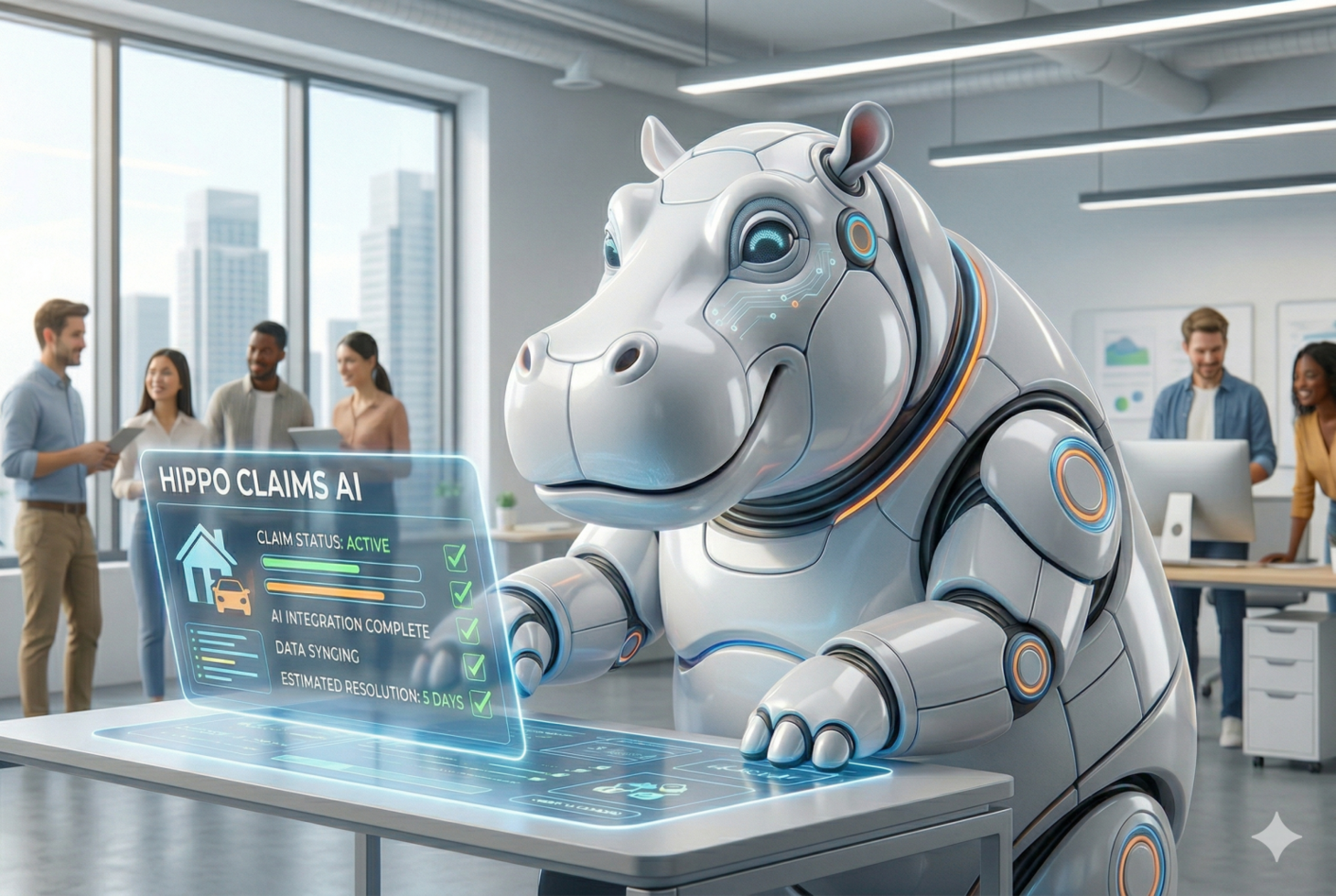
Hippo Builds Unified Claims Platform with Embedded AI | Insurance Innovation Reporter
Claims sits at the intersection of operational complexity and customer expectation, where speed, accuracy and communication converge under often difficult circumstances. As insurers explore broader applications of artificial intelligence, the focus is shifting from automating individual tasks to rethinking how the claims function operates as a whole. Hippo (San Jose, Calif.) is reflecting that shift in a unified, AI-enabled claims platform designed to support the full lifecycle of a claim while changing how work is distributed between systems and adjusters.
“We’ve delivered a new unified claims platform that serves as a single operating system for our adjusters, a single source of truth for claims data,” says Kyle Ramsay, Chief Product Officer, Hippo.
The platform provides “end-to-end AI assistance across the claims lifecycle, from intake to flagging to document generation and more,” Ramsay says, describing a system with AI embedded directly into workflow rather than deployed as a separate tool.
AI becomes top priority for insurance execs in 2026
Among insurance industry executives, 71% say AI is now their top priority, according to the International Insurance Society's 2026 Global Priorities Report.
The survey, which drew responses from nearly 20,000 C-suite insurance executives and senior leaders, found that AI has shifted from a future ambition to an immediate operational focus for industry leaders. However, 17% of executives said their firms are still unprepared to address AI's full implications.
Most leaders (51%) said technological advancement is their top social and environmental priority, surpassing climate risk for the first time in the study's history. Among 57% of firms, technology modernization is a priority in order to improve operational efficiency and address workforce and talent shortages.

AI liability emerges as “the new cyber” for SMEs
A new frontier of liability risk is rapidly taking shape as small and mid-sized businesses (SMEs) accelerate their adoption of artificial intelligence. Experts have flagged a new wave of “silent” AI liability exposures, echoing the early days of cyber risk.
According to HSB, part of Munich Re, widespread AI adoption among SMEs is already outpacing both risk awareness and insurance clarity. Internal data show that 74% of small businesses use AI tools today, while 91% expect to adopt them in the near future.
Timothy Zeilman (pictured), global head of product ownership at HSB, said the parallels with cyber risk are hard to ignore. One of the defining features of early cyber risk was its “invisibility” within traditional insurance policies. Zeilman believes AI is now following a similar trajectory.
“We’re seeing the same pattern we saw with cyber 15 or 20 years ago,” he said. “Adoption is happening very quickly, but the understanding of how that translates into insured risk is still catching up.”
State News
California Lawmakers Push New Fire Insurance Rules After Wildfire Claims Crisis
California is considering a package of bills that would add requirements to home insurance providers, after state leaders criticized the industry's response to the state's devastating wildfires last year.
The state Senate held hearings on three bills generally aimed at improving the consumer experience with fire insurance in California. State Sen. Steve Padilla, a Democrat who chairs the Senate Insurance Committee, said the state has been deluged by complaints from homeowners that their insurance companies are slow to pay out claims.
That continues even 15 months after the Palisades and Altadena fires in January 2025.
"Decades old insurance laws, practices are no longer sufficient to meet the moment," Padilla said at a Senate hearing in Sacramento on Wednesday. "We are attempting to take a lesson from this situation."
Fire insurance reforms
SB-876 would add new requirements for insurers to handle claims more quickly in a declared emergency. It would also increase penalties for violations of fair claims practices. Insurers would need to formulate a "disaster recovery plan" for how to handle major disasters and meet timelines while handing claims.
Two additional bills are pending as well. SB-877 is aimed at speeding the times for insurers to provide documents related to claims. SB-878 requires those insurers to provide compliance data on their payouts, starting in 2028.
InsurTech/M&A/Finance💰/Collaboration
COVU Launches COVU OS, the AI-native Operating Layer Rebuilding How Insurance Work Gets Done
COVU today announced the launch of COVU OS, the core operating layer of its AI-native operating stack for insurance distribution. COVU OS is not AI added to existing workflows. It is the workflow rebuilt: a task-native orchestration layer that converts every inbound service request into a structured task and routes it to the right execution layer, whether AI, licensed agents, or offshore support based on cost, compliance, and complexity.
"Insurance agencies have been trying to modernize for more than 20 years," says Ali Safavi, Founder & CEO of COVU. "The missing piece was never smarter software or better AI. It was an operating layer that actually runs the work. COVU OS is that layer."
The average independent agency spends 50 to 70 percent of its resources on service work while operating at 20 to 25 percent EBITDA. A mid-size agency with 10,000 policies processes up to 100,000 service transactions per year, still managed through email, manual triage, and fragmented handoffs. None of it is designed to be routable, measurable, or improvable.
Webinars/Podcasts/Interviews
AI Is Helping to Hire the Future Workforce. What Are the Risks?
- Produced by: Carrier Management
- Format: Webinar
- Date: Tuesday, Jun 2, 2026
- Time: 10:00 AM (Pacific) / 1:00 PM (Eastern)
- Topics: AI and Recruitment
Overview
Imagine spending time crafting a resume to apply for a job only to realize it may never be seen by human eyes. Instead, an algorithm decides whether to accept or reject the application in seconds. Now imagine another twist: candidates are using AI to write their resumes, while companies are using AI to screen them.In today’s hiring landscape, the question isn’t just who gets the job, it’s who (or what technology) is making the decision.
This episode of Between the Lines examines the rapidly evolving and increasingly complex world where artificial intelligence meets hiring. As the insurance industry faces a growing talent gap driven by an aging workforce, companies are seeking to modernize recruitment. But with innovation comes a new layer of ethical, legal, and financial risk.
This episode unpacks the rising use — and misuse—of AI in the hiring process, from the controversial practice of ghost job listings and fake job candidates to the hidden consequences of automated resume screening.
Join experts as they explore where AI enhances hiring and where it crosses the line. Gain practical guidance on building responsible, human-centered recruitment systems, while also understanding how insurers can underwrite and advise on these emerging risks.