
Research

J.D. Power: Vehicle complexity, strong used-vehicle market ‘wreak havoc’ on auto insurance valuation models
A new Insurance Intelligence Report from J.D. Power has found that auto insurance actuarial models built on incomplete vehicle identification data due to individual customizations could be off by nearly $15,000 per vehicle.
From advanced driver assistance systems (ADAS) and upgraded powertrains to premium interiors and specialty paint packages, two vehicles with the same year, make, model, and trim can have vastly different original values, the report states.
For example, in the large pickup truck segment, the Ford F-150 currently has 100,000 unique build configurations and, market-wide, more than 600,000 unique vehicle configurations were sold in the U.S. in the last year alone, according to J.D. Power data.
“While this level of customization has benefited consumers and automakers, it has created a growing challenge for auto insurers,” J.D. Power states. “Many actuarial models used to price and underwrite policies still rely on simplified vehicle identification data that cannot fully capture the configuration and replacement value of modern vehicles. At the same time, volatility in used-vehicle pricing and rising repair costs are further complicating valuation models that were built for a far more predictable market.
“This combination of vehicle complexity and market volatility is creating a widening gap between the values insurers assume during underwriting and the costs they ultimately face when repairing or replacing vehicles after a claim.”
Without having the full 17-digit VIN, as vehicle configuration complexity continues to increase, reliance on simplified vehicle identification methods can introduce significant pricing inaccuracies into underwriting models, the report states. MORE
News
Editor's Note
Over the last week, the Curated platform has experienced technical problems and 'Connected' daily issues were not sent to all email subscribers. Our apologies as this situation is being resolved.
All previous Issues can be found here Connected Archives in case you missed any.
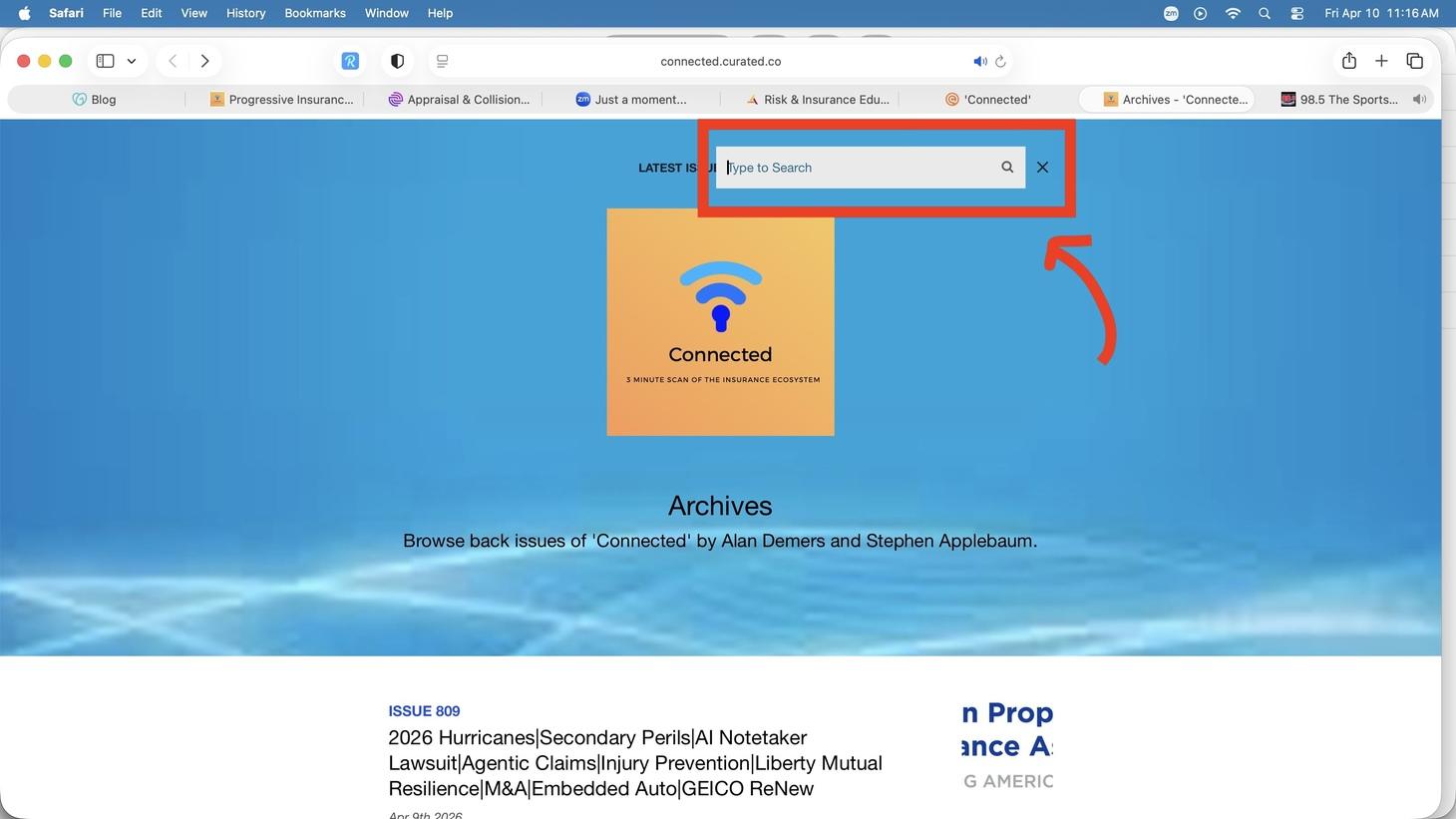
Did you know you can search content for specific topics?
Go to the Archives page and use the search bar by clicking the "magnifying glass" icon

A ceasefire won't reopen the insurance market – not yet
When President Trump announced a two-week ceasefire with Iran on Tuesday evening, energy traders exhaled, stock markets surged and oil fell 12% in a single session. But in the underwriting rooms of Lloyd's of London, the reaction was considerably more measured.
The reason is simple, if little understood outside the specialized world of marine insurance: the economic blockade of the Strait of Hormuz was not imposed solely by Iranian missiles and sea mines. It was also imposed, with surgical precision, by a handful of insurance companies filing paperwork.
Within 48 hours of the United States and Israel launching coordinated strikes on Iran on February 28, war risk premiums for vessels transiting the strait surged fivefold. By March 5, seven of the 12 clubs belonging to the International Group of Protection and Indemnity Clubs - mutual insurers that collectively cover 90% of the world's ocean-going tonnage - had issued 72-hour cancellation notices for war risk coverage across the Persian Gulf, the Gulf of Oman and Iranian territorial waters. Tanker traffic through the strait collapsed by more than 80 percent. In many respects, the commercial shutdown preceded the physical blockade.
A ceasefire, however welcome, does not automatically undo that calculation.
Sentry Shifts To The General Brand - ERRRA
Sentry Insurance has completed its $1.7 billion acquisition of The General from American Family Insurance, marking the largest deal in the company’s history and expanding its position in the non-standard auto (NSA) market.
As part of the integration, Sentry is consolidating its NSA presence under The General brand, replacing the Dairyland name across personal auto, motorcycle, and powersports products. The move combines Dairyland’s independent agent network with The General’s direct-to-consumer model to create a unified distribution strategy.
A recent filing in New Mexico confirms the rebranding will roll out beginning June 17, 2026 for new business and August 6, 2026 for renewals, with updates spanning policyholder communications, underwriting materials, and marketing assets. The change is cosmetic, with no impact to rates, underwriting, coverage, or policyholder obligations.
The General will remain Sentry’s primary brand for NSA insurance, which serves drivers who may not qualify for standard auto coverage. The business will continue operating from its Nashville office, and its approximately 1,300 employees joined Sentry’s workforce at the start of 2025.
AI in Insurance
ICE-Tech launches Alice FNOL with OpenDialog, a 24/7 AI claims agent improving accuracy and reducing cost - The Enterprise
ICE-Tech, a global insurance technology partner, has launched Alice FNOL, a 24/7 AI claims agent designed to transform first notification of loss (FNOL) for insurers.
Powered by OpenDialog’s conversational AI platform for regulated industries, Alice FNOL is embedded directly into FNOL journeys, capturing and validating claims in real time to reduce manual handling and improve data accuracy from the outset.
FNOL is one of the highest cost, highest friction and most emotionally sensitive moments in the insurance journey. Alice FNOL replaces traditional claims intake with intelligent, structured journeys that guide claimants step-by-step, adapting in real time to each situation. By validating data at the point of entry, claims are prepared for downstream processing from day one, reducing rework, eliminating delays and accelerating resolution.
The result is faster, more consistent claims handling, improved operational efficiency and a better customer experience at the point of need. Built for measurable business impact in claims automation

AI Adoption in Property Claims Remains Fragmented Despite Rapid Growth
The gap between ambition and execution in artificial intelligence continues to challenge property insurers.
While as many as 82% of carriers now use AI tools somewhere in their operations, just 7% have managed to scale the technology successfully, according to a Sedgwick report on the state of AI in property claims.
Nearly two-thirds of carriers acknowledge a disconnect between their AI vision and current reality, the report said, even as the insurance industry’s AI investments are expected to grow from $10 billion in 2025 to nearly $80 billion by 2032.
The findings underscore a growing tension for risk managers and insurance buyers: insurers are investing heavily in AI-powered claims technology, but fragmented implementation may be limiting the improvements policyholders actually experience.
Fragmented Systems Limit AI’s Potential
Much of the challenge stems from legacy infrastructure. Most claims systems were not designed for the API connectivity that modern AI tools require, according to the report. Rather than being embedded into core workflows, AI is frequently layered on top of existing platforms, which creates operational friction, inconsistent data and diminished performance at scale.
This fragmentation means that AI’s benefits often remain confined to individual steps in the claims process rather than compounding across the full lifecycle, the report said. Ninety percent of property insurers surveyed believe AI must be orchestrated across business processes to maximize their investments.
Commentary/Opinion
Why the NFIP keeps struggling — and why that matters to the entire industry
The National Flood Insurance Program's (NFIP) headline problems are well known: $22.5 billion in debt, 35 short-term reauthorizations since 2017, and a recurring cycle of borrowing and political uncertainty. Too often, these are dismissed as political problems, things that will resolve themselves the next time Congress acts.
That framing misses the point. The NFIP's challenges are structural, baked into the program's design. And their consequences ripple outward into real estate transactions, mortgage lending, agency operations and the broader P&C market.
The NFIP was established in 1968 to fill a genuine void. It brought flood insurance to more than 22,000 communities, established floodplain management standards and built foundational awareness that flood is a distinct and insurable peril. That history matters.
But the program's financial model broke in 2005. Hurricanes Katrina, Rita and Wilma pushed NFIP borrowing past $18 billion. The 2017 season added $10.2 billion in claims. Congress cancelled $16 billion of debt (the only time that has happened), yet the program has since accumulated $8.1 billion in new obligations, including $2 billion following the 2024 storm season.
The current total outstanding balance is $22.5 billion, accruing nearly $2 million in interest daily.
Telematics, Driving & Insurance
Telematics and Trust: The UBI Revolution
What if your car insurance reflected how you actually drive, not just who you are?
That question is no longer hypothetical. In 2024, more than 21 million U.S. policyholders shared telematics data with their insurer, according to IoT Insurance Observatory research. That reflects a 28% compound annual growth rate since 2018. Usage-based insurance (UBI) is no longer a niche; it’s a mainstream strategy reshaping our industry.
For years, competitive pricing drove adoption. But today, something deeper is at play: Trust and perceived value are fueling the next wave of growth. This isn’t just about saving money; it’s about believing the insurer will use sensitive driving data responsibly and deliver tangible benefits in return.
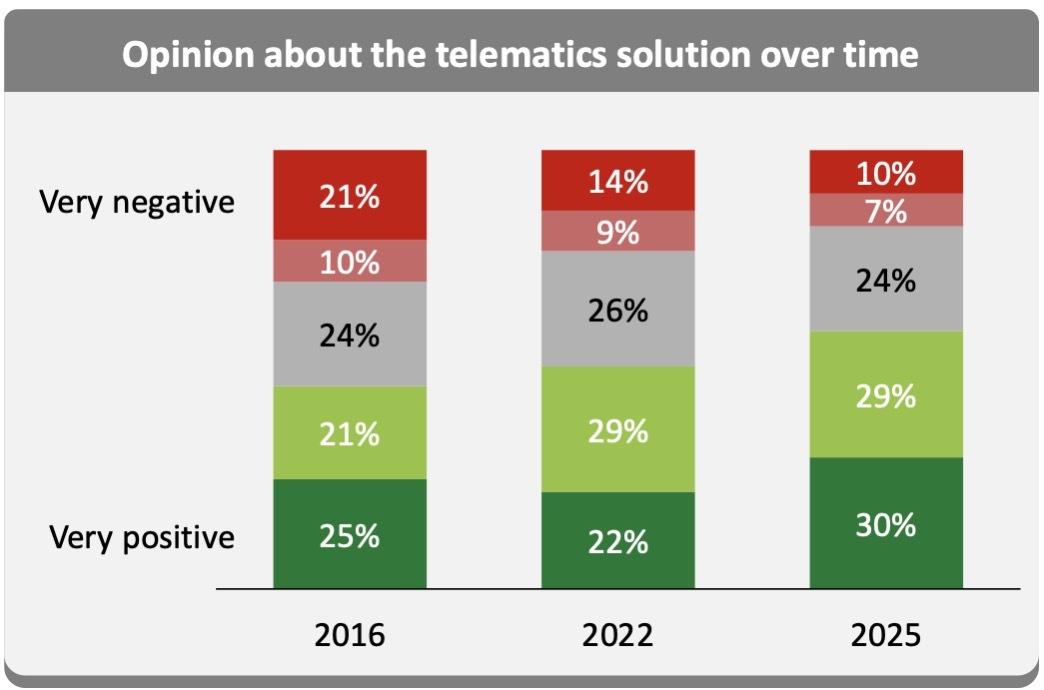
According to a recent consumer survey by Arity and the IoT Insurance Observatory - sampling 2,059 personal auto policyholders representative of the U.S. market - 82% of policyholders would recommend a telematics app that rewards safe driving, offers feedback, provides crash assistance, and delivers other valued services. Among drivers under the age of 53, that number exceeds 90%. Positive sentiment toward telematics has steadily increased over the past decade, as shown in the chart above.
Trust isn’t a buzzword here, it’s the foundation of adoption. Consumers share data only when they believe insurers will protect it and use it to create real value. In fact, 53% of respondents expressed high trust in insurers’ handling of personal data, ranking insurers second only to banks. That trust translates into action: willingness to switch plans, share driving scores, and pay for connected services.
The willingness to adopt UBI is strong: 60% of policyholders are open to switching, rising to 72% among younger drivers. This level is consistent with the evidence from recent TransUnion surveys showing that 60% of people reported being offered telematics opted-in.
When consumers see clear benefits, privacy concerns fade. They want pricing that reflects lifestyle, rewards for safe driving, and features like automatic crash assistance. Three-fourths are open to sharing their driving score for a personalized quote. More than half of those willing to switch prefer pricing models that offer bigger potential savings, even if it means some risk a surcharge.
Fraud

AI Escalates Fraud Risk and Detection Arms Race | Insurance Innovation Reporter
The rise of AI is simultaneously strengthening insurers’ fraud defenses and enabling more sophisticated schemes, raising the stakes for detection and governance.
Stephen Applebaum and Alan Demers
Fraud is a perennial problem, but its scale, complexity, and persistence continue to challenge insurers. While detection and prevention efforts have improved over time, fraud remains widespread, costly, and often underreported.
These dynamics are now intersecting with a new force: artificial intelligence. AI is enhancing insurers’ ability to detect fraud—but it is also equipping fraudsters with more powerful tools, accelerating an ongoing arms race.
Artificial intelligence is rapidly becoming integral to insurance operations, including underwriting, claims processing, and fraud detection. Predictive models and machine learning enable insurers to analyze large datasets, identify anomalies, and improve decision-making.
At the same time, these capabilities are increasingly accessible to bad actors. AI can be used to generate convincing synthetic identities, manipulate images and documents, and automate large-scale fraud campaigns. Open-source large language models (LLMs), operating outside platform guardrails, introduce additional vulnerabilities, including the generation of phishing content and disinformation. ARTICLE
Claims
Progressive Insurance® Extends Relationship with Mitchell
Mitchell, a leader of auto physical damage technology solutions, today announced that Progressive Insurance, the nation’s largest commercial vehicle insurer and second largest personal auto insurer, has signed a long-term contract renewal. The renewal provides Progressive with continued access to Mitchell’s comprehensive software solutions used to support collision claims, damage appraisals, total loss valuations, and interactions with repair facility partners.
“Mitchell’s open platform has supported our ability to integrate solutions that align with our claims operations,” said Progressive’s Physical Damage Claims Process Leader, Gino Banco. “Over many years, our teams have worked together to support claims handling at scale. We value the relationship and look forward to continued collaboration as we focus on meeting the needs of our customers.”
Progressive selected Mitchell as its primary auto physical damage technology provider in 2010.
“Progressive has experienced significant growth and continues to invest in its claims operations,” said Mitchell’s Executive Vice President and General Manager, Debbie Day. “We value our long-standing relationship and look forward to continuing to work together to support Progressive’s claims technology needs.”
People
Chubb Names Kevin Rampe Global Head of Claims
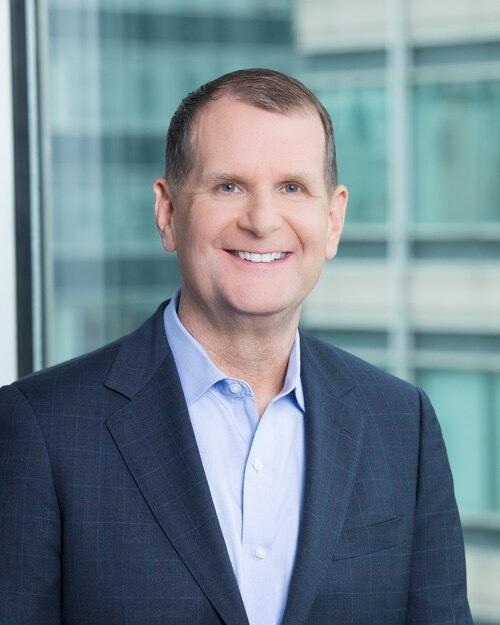
Chubb Limited (NYSE: CB) today announced that Kevin Rampe has been named Senior Vice President, Chubb Group, Global Claims Officer, responsible for global claims management. The appointment is effective immediately. Rampe will also retain his responsibilities as Head of North America Claims.
In his expanded role, Rampe will lead the company's claims organization globally and be responsible for all aspects of executive claims management, service and administration for Chubb through its worldwide network of claims offices.
He will report to Evan G. Greenberg, Chairman and Chief Executive Officer, Chubb Limited & Chubb Group and John Keogh, President and Chief Operating Officer, Chubb Group, and in his North America capacity to Juan Luis Ortega, Executive Vice President, Chubb Group, President, North America Insurance.
"Kevin is an outstanding leader with a deep command of claims strategy, a proven ability to innovate, and an unwavering commitment to delivering exceptional outcomes for clients," said Greenberg.