
News
Gallagher Re report warns traditional insurance is failing to cover AI-related liabilities
Gallagher Re, the global reinsurance broker, has released a new white paper in partnership with Massachusetts Institute of Technology and Testudo stating that existing insurance frameworks are not equipped to deal with risks arising from artificial intelligence (AI).
Gallagher Re states that as businesses integrate AI systems into everyday operations, they are creating exposures that fall outside the scope of conventional insurance products. The firm describes a growing mismatch between the risks generated by AI and the protection currently available, leaving organisations vulnerable to gaps in cover.
In the report, Smart Systems, Blind Spots: Rethinking Insurance for the AI Era, Gallagher Re sets out guidance for insurers, brokers, reinsurers and risk professionals on how to respond to these developments. The company highlights that liabilities linked to AI systems, including inaccurate or fabricated outputs, biased decision-making, model degradation over time and flawed training data, are often not clearly covered under standard policies.
Announcements

Vortex Weather Insurance Launches Direct Access to HailSafe Parametric Hail Insurance
Vortex Weather Insurance,* a leading provider of parametric weather insurance solutions, is pleased to announce the formal launch of direct sales for its HailSafe parametric hail insurance product.
Previously available only through third-party vendors, HailSafe can now be purchased directly from Vortex by brokers and weather‑exposed businesses, including open car lots, solar farms, commercial roofs, and agricultural operations. HailSafe policies placed through Vortex rely on an independent third‑party hail measurement source, utilizing a combination of radar, National Weather Service data, storm reports and expert meteorologists.
Financial Results
One Inc Closes 2025 With Record Growth, Expanding Its Role as the Insurance Industry's Payments Network
One Inc, the leading digital payments network for the insurance industry, today announced 2025 results reflecting strong growth and deepening partnerships across the P&C ecosystem. The company surpassed 300 enrolled carriers, achieved 37% revenue growth, and signed 112 new agreements, bringing its unified network to $245 billion in annual payments volume.
One Inc and its partners are transforming the traditionally paper-based insurance industry by connecting carriers, policyholders, and over 1.2 million enrolled additional participants across all major insurance use cases, including premiums, claims disbursements, total loss settlements, mortgagee payments, and subrogation. This unified network enables seamless transactions, where carriers and vendors gain instant access to all participants, driving efficiency and collaboration across the ecosystem.
"Insurance payments have always been a network problem approached as a platform problem," said Ian Drysdale, CEO of One Inc. "We're building the infrastructure to fulfill the promise of insurance. Every network participant increases the value ultimately for the policyholder and all other participants as well. That shared vision increases both the pace and the positive impact of the entire industry."
AI in Insurance

Scaling AI with confidence: the smart approach to unlocking business value
The opportunities from Artificial Intelligence (AI) are profound and far-reaching – and yet businesses remain cautious. With concerns about security and reliability persisting, few organizations have moved beyond the experimentation phase. How can insurers leverage AI to responsibly drive value at scale?
This article is based on a discussion between Penny Seach, Chief Underwriting Officer at Zurich, and Ericson Chan, Group Chief Information and Digital Officer at Zurich at Zurich’s Global Risk Management Summit 2025.
The use cases are almost limitless and vary across industries. In commercial insurance, for instance, Zurich has identified underwriting, distribution, claims and resilience solutions as the most promising areas for extracting value, and it has deployed proprietary AI-powered platforms across these areas to improve customer outcomes.
For example, Zurich uses AI to help extract information from unstructured email data and feed it into submission and pricing systems to speed up response times. Meanwhile, underwriters are supported by bespoke chatbots that provide instant access to relevant documentation and guidance, enhancing both efficiency and accuracy.

The next phase of InsurTech: From disruption to durability
Artificial intelligence may dominate the current conversation around insurance technology, but the story of InsurTech itself has followed a different trajectory. A decade ago, the sector was defined by the promise of disruption, as venture capital flowed into startups promising to rebuild insurance from the ground up. This swell of momentum saw funding surge to record levels, peaking at more than $15bn globally in 2021, according to CB Insights.
Yet insurance has always been a business defined by capital, regulation and disciplined risk management. As the early wave of InsurTech matured, the reality of those constraints began to temper the disruption narrative. The sector did not disappear, but the pendulum began to swing.
Today, the focus has shifted away from replacing insurers and toward strengthening the infrastructure that allows them to operate more efficiently and profitably.
Ido Deutsch, Chief Revenue Officer at Producerflow, believes that change reflects a deeper understanding of how the insurance industry actually works.
“Early InsurTech was driven by the idea that startups could replace incumbents across the value chain. Capital flowed heavily into growth, especially consumer-facing carriers, often at the expense of unit economics. That wave delivered meaningful innovation, but also exposed how complex, regulated, and capital-intensive insurance really is.
Awards
InsurTech America Announces 2026 Making Waves Honorees
[Ed Note: As a prior Making Waves Award recipient, congratulations to the 2026 honorees for outstanding work in Thought Leadership, Entrepreneurship and Excellence within the insurance ecosystem. Each are making a difference, recognized by their peers and previous honorees.]
InsurTech America is proud to announce the 2026 honorees of the prestigious Making Waves Awards, recognizing leaders, innovators, and entrepreneurs who are driving meaningful change across the insurance ecosystem.
Each year, the Making Waves Awards spotlight individuals who are pushing boundaries and redefining how the industry approaches risk, technology, and customer experience. This year’s honorees represent a powerful cross-section of leaders shaping the future of insurance.
2026 Making Waves Award Honorees, Industry Thought Leader Category
– Amber Wuollet, Director of Product & Life Cycle Marketing, Cowbell
– Awais Farooq, Chief Claims Officer, Venbrook
– Bob Frady, CEO and Co-Founder, Property Lens
Most Innovative Entrepreneur Category
– Aman Gour, CEO and Founder, FurtherAI
– Arvind Sontha, CEO and Founder, Kyber
– Ngozi Nnaji, Founder and Managing Partner, Ako Insurance Consulting
– Scott Sutter, President, Strategic Risk Transfers
Innovation Excellence Category
– Colby Tunick, CEO and Founder, ReFocus AI
– Samuel Broomer, President, Parametric Solutions, NormanMax
– Alex Martin, CEO, Clearspeed
“The insurance industry does not need incremental change. It needs disruption, speed, and people willing to challenge everything we have accepted for decades,” said Stacey Brown, President, InsurTech America. “The Making Waves Awards recognize the builders, operators, and thinkers who are actually moving the industry forward. This year’s honorees are not simply talking about the future. They are creating it.”
Attend InsurTech America Symposium, April 13 & 14 - register HERE
Telematics, Driving & Insurance

TPG and Allianz Lead USD 350 Million Strategic Investment in Cambridge Mobile Telematics to Accelerate AI-Driven Road Safety
Partnership to Expand Global Road Safety Platform and Real-Time AI Risk Models Accompanied by New Long-Term Commercial Agreements Between Allianz and CMT
Cambridge Mobile Telematics (CMT), the world’s largest telematics and AI company for safer mobility, today announced a USD 350 million strategic investment led by TPG and Allianz X, with participation from State Farm. The new investors will accelerate CMT’s expansion in three key areas: scaling its global road safety platform, advancing AI models for real-time driving risk assessment and crash detection, and growing adoption of the new Universal Driving Score.
“Today’s investment strengthens our work to create safer roads, stronger communities, and a better future, and we’re energized by our partnerships with TPG, Allianz, and State Farm,” said** William V. Powers, Co-Founder and CEO of CMT**.
The strategic investment is accompanied by long-term commercial agreements with various Allianz Group operating entities, including Allianz Partners and Allianz Versicherungs-AG, to collaborate on data-driven insurance and service offerings across Europe for retail customers, automotive original equipment manufacturers (OEMs), and mobility partners. The partnership with CMT will enhance Allianz’s strategic capabilities, foster innovation, and promote safer mobility by combining telematics solutions with Allianz's global expertise as a leading motor insurer and assistance services provider.
State Farm, whose Drive Safe & Save program is one of America’s most widely used telematics platforms, sees CMT’s real-time risk platform as a natural extension of its broader strategy of applying AI and data to improve outcomes for the customers and communities it serves.CONTINUES
Predict & Prevent

IBHS and APCIA launch comprehensive new toolkit to help communities reduce wildfire risk
The Insurance Institute for Business & Home Safety (IBHS) and the American Property Casualty Insurance Association (APCIA) today released a new resource to help local governments, fire services and other community organizations come together to implement coordinated wildfire mitigation programs in their communities. The Community Wildfire Risk Reduction Program Framework outlines how communities can organize, launch and sustain effective wildfire risk reduction efforts.
The Toolkit Provides:
- Step-by-step guidance to plan, design and launch a local wildfire risk reduction program.
- Science-based home mitigation standards, including structure hardening measures and defensible space requirements such as the 0–5 foot noncombustible safety zone.
- Assessment and training resources, including materials to train home assessors and support consistent property evaluations.
- Implementation tools and templates, such as program checklists, sample forms, funding considerations and administrative guidance.
- Outreach and coordination strategies to engage homeowners, local partners and supply chain providers.
"Communities are learning how to live with wildfire because in many areas it's no longer a distant threat — it's a reality," said Steve Hawks, senior director for wildfire at IBHS and retired assistant deputy director at CAL FIRE. "This toolkit provides a consistent, research-based program neighbors can implement in their communities to reduce the risk of home ignition and strengthen their neighborhoods, which also supports insurability."
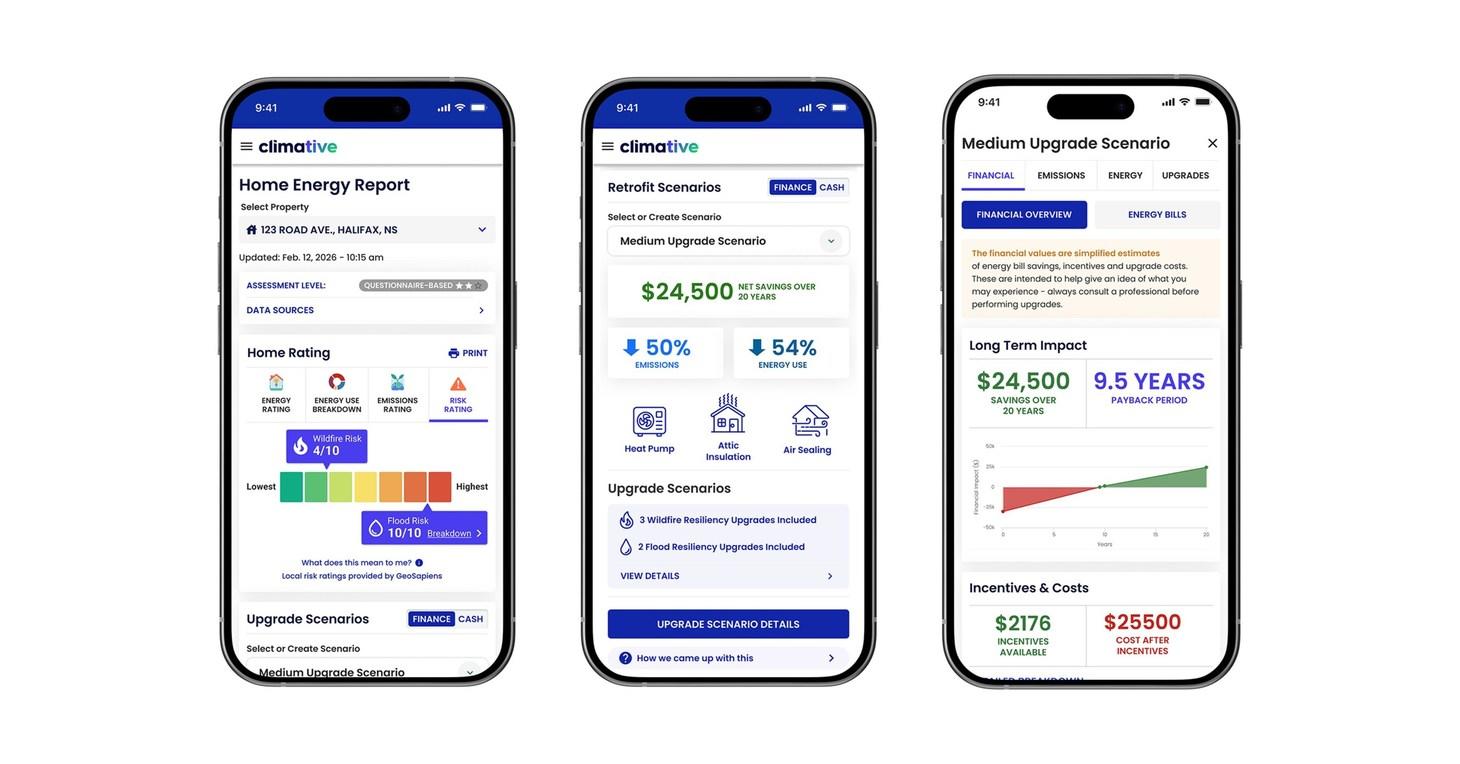
Climative Launches Insurance Data Platform that Helps Insurers Turn Climate Risk Insight into Homeowner Action
Climative, a property-level climate intelligence firm, today announced the launch of its insurance-focused platform, designed to help insurers communicate climate risk to homeowners in a clear and actionable way. The platform offers step-by-step plans to help homeowners make their homes more prepared for climate risks, while saving energy and keeping costs down.
Across North America, insurers are facing escalating losses from wildfire, flooding, and severe storms. In 2024 alone, natural disasters generated approximately $140 billion in insured losses globally, with 27 billion-dollar events in the United States totaling $182.7 billion, according to NOAA. As these events become more frequent and costly, insurers are under growing pressure to better understand and manage risk at the individual property level.
Climative's platform provides address-level climate risk insights alongside clear, property-specific adaptation plans. By translating complex risk data into practical guidance, insurers can better understand portfolio exposure while giving homeowners a straightforward path to reduce risk.
Regulation & Public Policy

Using Aerial Imagery in Insurance and Related AI: Emerging Regulatory Themes
As more insurers integrate aerial imagery into underwriting, rating and claims workflows, state insurance departments are responding with a growing body of guidance. While each insurance department bulletin reflects local law and priorities, a fairly consistent regulatory narrative is emerging—one that accepts the technology but insists on disciplined, fair and transparent use.
Insurers’ Uses of Aerial Imagery
On the underwriting and pricing side, insurers use imagery to get a clearer picture of the risk without always dispatching an inspector. Underwriters use this information to refine eligibility decisions, adjust coverage terms and set more risk‑appropriate premiums. Insurers can confirm building footprints, number of stories, outbuildings, additions and other structures on the parcel. That helps correct misreported or outdated information, align coverage limits with actual exposure and improve rating accuracy. MORE
InsurTech/M&A/Finance💰/Collaboration

What Wawanesa hopes to gain by acquiring Everest Canada
Canada’s P&C insurer M&A train keeps rolling with Wawanesa Mutual Insurance Company today announcing it's acquiring Everest Canada
In a press release today, Wawanesa says the transaction will bring an “extensive portfolio of specialty commercial insurance products” that’s expected to add around $305 million in commercial lines premiums annually. That’s roughly a 30% increase over Wawanesa’s current commercial premium volume.
At present, says Evan Johnston, Wawanesa’s president and CEO, the company’s current commercial book is about $1 billion. “There’s very little overlap between commercial businesses at Wawanesa and at Everest….Wawanesa would participate in the small- to mid-market space, Everest would participate above that and in the specialty space,” he tells Canadian Underwriter.
People

Crawford names W. Bruce Swain president and CEO - Business Insurance
Crawford & Co. on Monday named W. Bruce Swain as president and CEO.
Mr. Swain, who has served as interim president and CEO since Jan. 1, succeeds Rohit Verma, who left at year end to become CEO of Alight, a cloud-based employee benefits administration company.
Mr. Swain, who joined Crawford in 1991, was previously executive vice president and chief financial officer. He will continue to serve on the company’s executive leadership team and board of directors.