
News

Global InsurTech Report for Q4 2025 | GallagherRe
Specifically, we will explore the transformative impact of AI on the LAH class of business. We look at InsurTechs collaborating with incumbent carriers to enhance the development of insurance products, as well as examining those innovative businesses offering their own standalone solutions in the LAH space.
The report also provides insights into the performance of the InsurTech market both for Q4'25 and for the year as a whole. 2025 saw a notable rebound in InsurTech funding, with investment into the sector rising 19.5% year on year to USD5.08B, marking the first annual increase since 2021.
This was driven in part by Q4 global InsurTech funding surging by 66.8%, from USD1.01B in Q3'25 to USD1.68B in Q4'25. P&C led with a 90.5% quarter on quarter increase to USD1.31B, while L&H climbed 14.9% to USD361.52M.
It's also worth noting over 100 InsurTechs raised funding for the first time since Q1'24, with deal count up 34.2% quarter on quarter to 102 and average deal size up 20.0% to USD18.84M in Q4'25.
The points below show a summary of InsurTech funding activity.
Key findings for Q4
- Global InsurTech funding was USD1.68 billion in Q4 2025
- Global InsurTech funding rose 19.5% year on year from USD4.25B in 2024 to USD5.08B in 2025, marking the first annual increase since 2021
- P&C InsurTech funding rebounded from 2024's low, increasing 34.9% year on year to USD3.49B in 2025
- 77.9% of Q4'25 InsurTech funding went to AI-centered companies -** 2025 saw 162 venture investments in tech among (re)insurance companies — a record high**. VIEW REPORT
Announcements
The Institutes RiskStream Collaborative Launches RAPID X With Leading Auto Insurers
The Institutes RiskStream Collaborativetoday announced the production launch of RAPID X, a blockchain-powered auto claims data exchange platform that enables insurance carriers to instantly share critical accident information — dramatically reducing claim costs while accelerating customer support. Leading U.S. auto insurers have become the first to go live with the system as early implementation partners.
RAPID X solves a costly industry problem: when drivers insured by different companies collide, each insurer typically learns about injuries and complications days or weeks after the crash. By the time claims are reported, costs can escalate dramatically. RAPID X changes that by enabling insurers to transmit secure, permissioned claims information to one another immediately after a loss—alerting both carriers within hours of an accident and creating critical opportunities for proactive customer assistance before legal complications arise.
“This production launch represents the culmination of seven years of dedicated work by The Institutes and RiskStream Collaborative, and we’re proud to be first to successfully bring blockchain-based data exchange to life in insurance,” said Pat Schmid, President of RiskStream Collaborative. “While others in various industries have attempted blockchain solutions without success, we’ve worked alongside leading national auto insurers to deliver a system that’s live and delivering value today. These early implementation partners are demonstrating that even competitors can pioneer new ways of working together when it ultimately benefits customers and creates a more responsive claims environmen
Financial Results
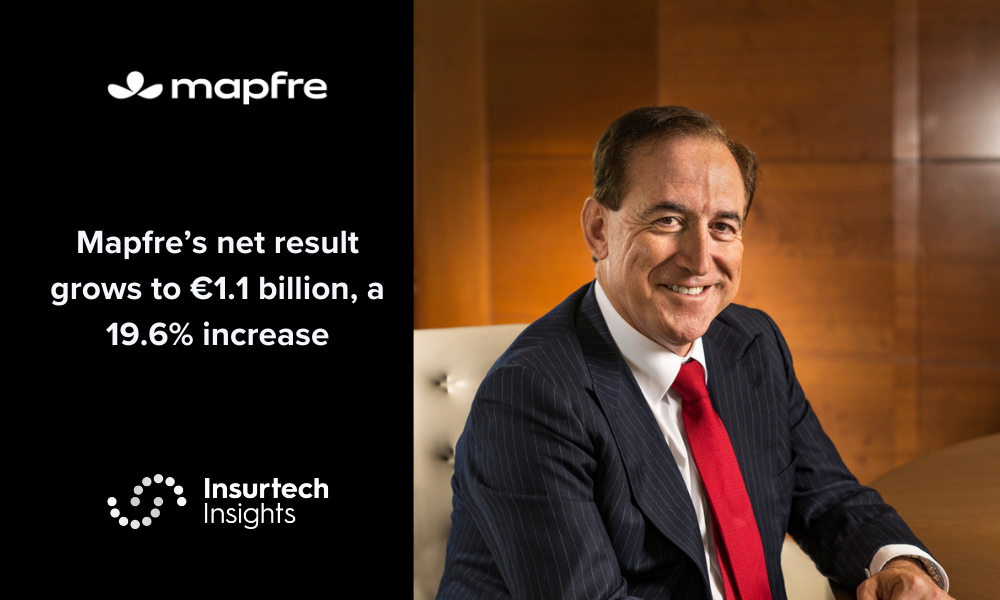
Mapfre’s net result grows to €1.1 billion, a 19.6% increase
Spanish insurer MAPFRE has reported net profit of €1.1 billion for 2025, surpassing the €1 billion mark for the first time in its 90-year history, as strong technical performance across its global operations drove a 19.6% increase year-over-year.
Result before tax and minorities exceeded €2.4 billion for the first time, while premiums grew 3.6% to a record high of more than €29 billion. At constant exchange rates, premium growth would have reached 7.8%, reflecting the impact of currency depreciation in Latin America and the United States.
The combined ratio improved to 92.2%, down 2.3 percentage points, marking the best level in the company’s history. Return on equity (ROE) stood at 12.4%, or 13.3% excluding extraordinary items, while shareholders’ equity increased 5.3% to nearly €9 billion. Under IFRS standards, attributable profit reached €1.1 billion (+17.1%), with shareholders’ equity exceeding €9.4 billion.
Strategic plan ahead of schedule
The results place MAPFRE ahead of its 2024–26 Strategic Plan targets. With one year remaining, the group has already exceeded its ROE target of 11% for 2026 and achieved a combined ratio well below its 95–96% objective.

Ryan Specialty reports revenue growth, announces restructuring - Business Insurance
Ryan Specialty Holdings Inc. reported double-digit revenue growth in the fourth quarter of 2025, driven by its underwriting management business, though profits declined.
The specialty intermediary said it expects further revenue growth in 2026, despite sharp decreases in property rates.
It also announced a restructuring program to improve efficiency and its first share repurchase program since it went public in 2021.
Revenue rose to $751.2 million, up 13.2% from the same period in 2024. On an organic basis, which excludes the effects of mergers and acquisitions and foreign exchange fluctuations, revenue grew 6.6%, down from 11% in the prior-year quarter, the company said. Net income for the quarter fell to $31.2 million, down 26.6%.
Adjusted earnings before interest, taxes, depreciation, amortization and coronavirus increased to $222.3 million, up 2.9%.
Within Ryan Specialty’s business segments, wholesale brokerage revenue rose to $385.7 million, up 2.9%, binding authority revenue increased to $84.0 million, up 12.6%, and underwriting management revenue climbed to $268.3 million, up 34.2%, reflecting continued growth in delegated authority programs.
On an earnings call with analysts Thursday, CEO Timothy W. Turner said property pricing weakened significantly late in the quarter.
AI in Insurance

Experian Launches Insurance Marketplace App on ChatGPT
Experian today announced the launch of the Experian Insurance Marketplace[i] app on ChatGPT, introducing its trusted insurance comparison platform to OpenAI’s audience of millions of consumers. This debut represents a significant advancement in Experian’s AI strategy, leveraging conversational technology to simplify everyday financial choices and create a more intuitive and helpful consumer experience.
Finding the right auto insurance policy has traditionally involved lengthy forms, multiple websites and unclear comparisons. Many consumers spend hours navigating options without confidence they have secured the best rate. The trusted Experian Insurance Marketplace app transforms that process into a streamlined conversation. Within ChatGPT, users can review coverage options, compare estimated rates from more than 37 top-rated carriers and ask follow-up questions in real time.
“Consumers are increasingly using conversational AI to learn, ask questions, explore and solve meaningful financial challenges,” said Dacy Yee, President of Experian Consumer Services. “Making our insurance marketplace available through ChatGPT allows people to evaluate their choices naturally and potentially save more than $1,000[ii] annually on auto coverage.”
The Experian Insurance Marketplace app offers:
- Access to 37 or more leading insurance carriers for competitive rate comparisons
- Customized recommendations aligned with individual needs
- Experian’s data expertise built on decades of helping millions make informed financial decisions
Instead of presenting static content, the app guides users through a dynamic exchange that turns questions into actionable answers within minutes.

AI Agents Are Now Running the Back Office at Insurance Giants
Insurance companies are beginning to deploy agentic artificial intelligence (AI) systems that do more than summarize documents or answer customer questions. They are orchestrating entire workflows across claims, underwriting and policy servicing functions, touching legacy policy administration, billing and claims systems that were never designed for autonomous coordination.
Unlike earlier automation waves that focused on robotic process automation or narrow machine learning models, agentic AI systems are designed to ingest unstructured emails, scanned PDFs and intake forms, extract relevant coverage and risk information, apply policy rules and route exceptions to human adjusters. In many cases, these systems can trigger downstream actions such as payments, documentation requests or customer notifications.
Claims Intake and Triage at Scale The most immediate impact is emerging in claims operations, where first notice of loss intake and triage represent both cost centers and customer experience flashpoints. In a Monday (Feb. 9) blog post, Microsoft wrote that collaborations between insurers and technology providers are focusing on embedding AI agents across claims workflows rather than layering tools onto individual steps. These systems are designed to interpret incoming loss reports, classify severity, verify coverage and assign cases dynamically, reducing manual review bottlenecks.
Commentary/Opinion

Is the world becoming uninsurable? - Insurance News
Back in 2024, Swiss Re warned that some areas were becoming “uninsurable,” after the industry significantly underestimated the impact of natural disasters across Europe. At the time, they pointed to events such as the Turkey earthquake, floods in Germany and hailstorms in Italy, where loss estimates were off not by 10% or 20%, but by entire factors. The problem, they said, was systemic: Their models were struggling, and the industry lacked up-to-date data on exposure and current risk values.
Two years in, those concerns haven’t faded. In conversations with insurers and reinsurers today, I hear the same urgency. Global insurance losses from natural catastrophes continue to grow at an annual rate of 5 to 7 percent, a trend that shows no sign of slowing. According to the Swiss Re Institute, 2025 marked the sixth consecutive year in which insured losses from natural catastrophes exceeded 100 billion US dollars.
As weather extremes intensify and asset values continue to rise, the gap between modeled risk and actual loss is only growing, and so are the questions around what still makes economic sense to insure. Naturally, the industry is looking for ways to build resilience into portfolios and reduce impact. That means improving prevention, reducing the workload when claim volumes surge, and rethinking how weather intelligence is used to structure products and price risk.
One of the key challenges remains the limitations of traditional weather models and services. Their spatial resolution is often too coarse to capture hyperlocal risks like hail or flash flooding. And even when data exists, it’s rarely delivered in a way that integrates cleanly into underwriting or claims workflows. That’s where there needs to be a shift in the industry.

Insurance Industry Shifts to Membership Economy | Insurance Thought Leadership
KEY TAKEAWAYS
- The membership economy is reshaping insurance by replacing transactional, annual renewals with continuing, affinity-driven relationships rooted in trust and shared identity.
- Subscription-based services offer insurers a sustainable growth path by embedding protection as a seamless benefit of membership rather than a standalone product shopped for based on price.
- The future of the insurance industry depends on shifting from policy-centric models to member-centric experiences that deliver continuous, visible value beyond claims.
- Affinity organizations hold a competitive advantage because their existing trust and engagement dramatically reduce churn and customer acquisition costs.
- Scalable insurance technology solutions are essential to enable frictionless self-service, personalization, and real-time engagement that modern members now expect.
For decades, insurance has been a transactional, "set it and forget it" chore tied to an annual renewal. But this episodic approach is increasingly out of step with how people actually live.
Today, the most successful protection models are built on affinity. Consumers aren't looking for another disconnected vendor; they want to leverage the memberships and associations they already trust. They make purchases within these trusted circles because of the value and identity those groups provide.
For the insurance sector, this means shifting from a passive contract to a seamless, value-added benefit of belonging, turning insurance from a standalone bill into a core advantage of the affinity relationship.
Jill Fecher is the executive director of PIMA, an association advancing thought leadership and collaboration in the affinity marketing industry
State News

Calif. bill would create first smoke damage standards
The act would establish science-based rules for the inspection, testing and restoration of smoke-damaged homes.
A new California bill aims to be the first in the nation to establish public health and insurance claims standards for smoke-damaged homes.
Insurance Commissioner Ricardo Lara and Assemblymember Mike Gipson introduced AB 1795, the Smoke Damage Recovery Act, yesterday.
The act would establish science-based standards for the inspection, testing and restoration of smoke-damaged homes. It would also create uniform insurance claims-handling practices for insurers, including required restoration protocols.
"Smoke contamination has left families uncertain about whether it's safe to return home, parents worried about their children's health, older residents displaced from their homes and entire communities caught in limbo," Gipson said in a statement. "AB 1795 gives survivors what they have been pleading for: real standards, real protections and real urgency. Strong, science-based rules are the only way to ensure families get a fair and safe path back home."
Even as wildfires have become more severe in many states, there are currently no state or national standards for testing, cleaning or restoring homes contaminated by wildfire smoke.
2026 Outlook/Predictions

Factors impacting insurance economics in 2026
The U.S. property and casualty insurance industry demonstrated notable resilience throughout 2025, navigating a landscape marked by significant regional catastrophes and shifting economic pressures, according to the Insurance Information Institute.
As the industry moves into 2026, the data shows, it does so from a position of historical strength yet faces an increasingly nuanced outlook shaped by market softening and lingering macroeconomic uncertainties.
"Overall, the P&C insurance industry and the broader U.S. economy remain stable," said Michel Léonard, Ph.D., CBE, chief economist and data scientist at Triple-I.
"However, despite stronger-than-expected GDP growth in the third quarter, a closer look at the data suggests the U.S. economy may be increasingly vulnerable to rising economic, political, and geopolitical uncertainty," he added. "In particular, P&C replacement costs could still see significant increases in 2026, weighing on overall P&C performance."
Meanwhile, workers' compensation remains the strongest performing major line, with NCRs forecast to stay in the high 80s to low 90s through 2027. This sustained success is attributed to disciplined risk management and favorable prior accident year development.
At the same time, "NCCI's latest loss ratio trends continue to show declines," said Donna Glenn, NCCI chief actuary. "In the current environment, modest year-to-year decreases are still expected, while there have been a few rate increases filed in NCCI states, every state has its own story, and based on the latest data, NCCI does not anticipate any imminent reversal of current trends."
InsurTech/M&A/Finance💰/Collaboration

Marsh McLennan Agency adopts ZestyAI analytics
Marsh McLennan Agency (MMA; White Plains, N.Y.) has adopted risk analytics from ZestyAI (San Francisco) to enhance risk assessment for a segment of high-net-worth clients with catastrophe-exposed properties.
MMA says its Private Client Services division is using three ZestyAI models—Z-FIRE, Roof Age and Z-PROPERTY—to evaluate wildfire exposure, analyze property-level characteristics and loss history, and assess roof age and condition using aerial imagery. The brokerage says the analytics are designed to provide property/casualty carriers with more detailed underwriting information for high-value homes.
“Safeguarding the lifestyles and legacies of our clients requires a forward-looking approach to risk,” says Robert Pritula, SVP, National Placement, Solutions Leader, Private Client Services division, Marsh McLennan Agency. “We are always looking for new ways to leverage cutting-edge technologies that will allow us to offer clients tailored and effective solutions to mitigate the threats facing their most valuable assets, including their homes.”
How Geospatial Fusion is Redefining Underwriting Certainty
For years, the commercial insurance industry has operated under a compromise. We accepted that the more “precise” an underwriting decision needed to be, the longer it would take to make. High-fidelity risk assessment required manual intervention—underwriters scouring satellite imagery, cross-referencing flood maps, and digging through public records to validate a single submission.
Our partnership with Altitude Intelligence is designed to break this cycle by replacing manual research with automated intelligence fusion.
The Shift to High-Fidelity Underwriting
The industry is moving past the era of “flat” data. A standard hazard map might tell you a building is in a high-wind zone, but it cannot tell you how that specific asset interacts with its unique environment.
By integrating Altitude’s specialized GEOINT (Geospatial Intelligence) and multi-source fusion capabilities into the Cytora platform, we are providing carriers with a high-fidelity view of risk at the point of submission. This approach fuses Open Source Intelligence (OSINT) with high-definition geospatial analysis, allowing underwriters to see:
- Micro-level environmental vulnerabilities that regional models miss.
- Real-time structural context derived from multiple intelligence streams.
- Infrastructure dependencies that could exacerbate a climate event.