
News

Presidents' Day 2026 - Date, Holiday and History
Presidents' Day is a federal holiday celebrated on the third Monday in February; Presidents' Day 2026 will occur on February 16.
Originally established in 1885 in recognition of President George Washington, the holiday became popularly known as Presidents' Day after it was moved as part of 1971’s Uniform Monday Holiday Act, an attempt to create more three-day weekends for the nation’s workers. While several states still have individual holidays honoring the birthdays of Washington, Abraham Lincoln and other figures, Presidents' Day is now popularly viewed as a day to celebrate all U.S. presidents, past and present.
The story of Presidents' Day date begins in 1800. Following the death of George Washington in 1799, his February 22 birthday became a perennial day of remembrance.
At the time, Washington was venerated as the most important figure in American history, and events like the 1832 centennial of his birth and the start of construction of the Washington Monument in 1848 were cause for national celebration.
While Washington’s Birthday was an unofficial observance for most of the 1800s, it was not until the late 1870s that it became a federal holiday. Senator Stephen Wallace Dorsey of Arkansas was the first to propose the measure, and in 1879 President Rutherford B. Hayes signed it into law.
Research
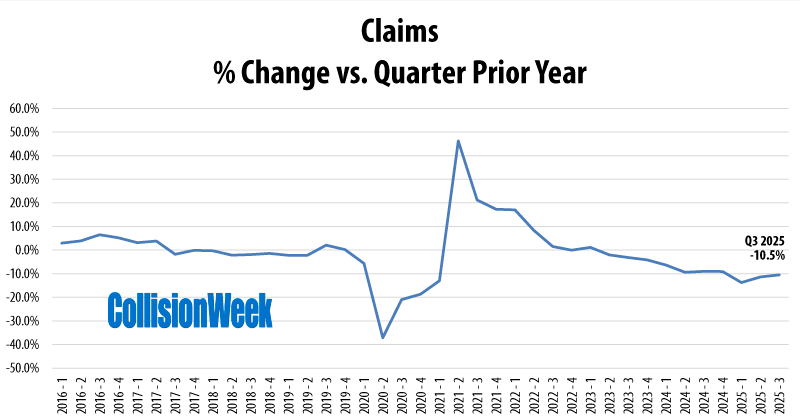
Collision Coverage Claims Were Down Over 10% in Third Quarter of 2025 Compared to the Previous Year
While down, the rate of decline was lower than both the first and second quarter. Quarterly collision claim counts have been down versus the previous year for ten consecutive quarters.
The latest available Fast Track Monitoring system data from the Independent Statistical Service Inc. (ISS) showed that the year-over-year rate of decline in quarterly collision coverage claims continued to slow in the third quarter of 2025. Claims on a quarterly basis were down year-over-year for the tenth consecutive quarter. Losses were also down on a quarterly basis compared to the same quarter last year for the ninth quarter in a row.
Collision coverage claims for the third quarter of 2025 were 1.294 million, down over 151,000 or 10.5% from the third quarter of 2024. The third quarter result is an improvement from the second quarter of 2025 that was down over 165,000 or 11.3% and the first quarter of 2025 that was down over 218,000 or 12.9% from the first quarter of 2024.

Auto insurance rates fell in 2025, but affordability gap between states is widening
After two years of punishing increases, car insurance prices finally eased for many U.S. drivers in 2025. But relief has been uneven, and insurers expect the gap between the most and least expensive states to widen further in 2026.
The average annual cost of full-coverage auto insurance declined 6% nationwide in 2025, falling to $2,144, according to a new report from Insurify. Rates dropped in 39 states, including eight where premiums fell at least 15%.
The decline marked a sharp reversal from the previous two years, when auto insurance costs surged 46% between 2022 and 2024. Those increases were driven in part by post-pandemic risky driving behavior, inflation, higher repair costs and elevated claims severity.
For insurers, the spike in premiums significantly improved financial performance. With stronger margins, many carriers were able to cut rates in 2025 to retain existing policyholders and attract new customers.
“Insurers’ margins are now high enough to absorb some costs without immediately raising prices,” Insurify said in the report, noting that competitive pressures also played a role in driving prices down.
Drivers appear to be noticing the change. The share of motorists who said their car insurance was unaffordable fell from 38% in May 2025 to 32% in December, according to Insurify survey data.
Still, the nationwide average masks large regional differences, and in many of the most expensive states, premiums continued to climb.
Commentary/Opinion

Sam Hanmer: The next big thing for insurance isn’t what you’d expect (Viewpoint)
What matters in the end is that your claim gets processed quickly and to your satisfaction, and there is no question that AI tools and partners are facilitating both. It just takes some getting used to.
By Sam Hanmer | Rush Insurance Group Inc.
Be it personal or commercial insurance lines, everybody has their eye on the AI ball in 2026. The publicly owned providers are already aggressively pushing premium increases to create shareholder value, but artificial intelligence’s true potential is to reduce costs across the board, and that will be one of the primary uses in the coming year.
For consumers and business owners, that means no real cost relief in the foreseeable future, but also that the digitalization of claims processing, including “straight through processing,” promises greater speed as manual intervention is eliminated. That also means call centers will be reduced, and working with AI agents or automated attendants will be normalized for many insurance transactions at the carrier level. For many, the 24/7 availability of AI agents, such as chatbots, means added convenience for routine tasks like billing and getting basic questions answered.
AI will hyper-personalize insurance for both commercial and personal lines. Telematics pricing will track how personal lines’ customers actually behave, and businesses that invest in cybersecurity monitoring might see lower premiums.
Other tools, such as smart-home technologies, will help consumers avoid problems associated with leaks or frozen pipes. Drivers already are reducing their costs with safe-driving monitors, and our business customers are frequently using AI tools to manage the risks that drive premium increases.
Announcements

CIECA CONNEX 2026 Annual Conference | Sept 29 - Oct 1 | San Antonio,, TX
The CIECA CONNEX conference is an excellent opportunity to meet and network with leaders from some of the most influential companies in the industry.
Why attend?
Tuesday, Sept. 29: CIECA Open Board Meeting, Tour of The Toyota Texas Experience Center (Group 1 - 11:30 am / Group 2 - 1:30 pm), evening reception for all attendees
Wednesday, Sept. 30: Full day of presentations, NABC Recycled Rides® vehicle gifting and CIECA reception
Thursday, Oct. 1: Half day of presentations, lunch and Tour of The Toyota Texas Experience Center (Group 3 - 1:30 pm)
Tours of the Toyota Texas Experience Center have limited availability and will require separate registration at a later date.
Join leaders from across the collision industry for an engaging conference to discuss the intersection of business and technology to ensure the collision industry is prepared for the future.
With ADAS and autonomous features growing with every model year and new EV models being added, technology is at the forefront of automobile design and the driving experience. All of this technology translates into data, and new repair methods, supply chains and repair procedures.
CIECA members and non-members are invited to join us for two days of presentations and discussions on these emerging technologies, their impact on the collision industry, and how we are preparing for a rapidly changing business environment.
AI in Insurance
Competing for the AI-Empowered Insurance Customer | BCG
In a few years, the first step in buying insurance might not be a phone call or a web search but a conversation with an AI assistant. Insurers need to prepare for a world where AI tools are the front door to their business and guide, or even make, consumers’ purchasing decisions.
This shift is an opportunity, not an existential threat. Agentic AI—systems that act and decide on behalf of consumers—can make insurance more intuitive, personalized, and accessible. Insurers that adapt early by gaining visibility in AI-driven journeys and enhancing the AI capabilities of traditional distribution partners will be best positioned to capture growth in this new age.
Consumer Behavior Is Changing
The next big transformation of consumer behavior is underway. By 2030, digital natives will make up more than a third of the market, bringing with them habits shaped entirely online. At the same time, AI is rewiring how people move through the internet. AI browsers and conversational assistants are replacing the old practice of typing a query into a search bar; instead, users are letting large language models (LLMs) guide the journey for them. Simple answer engines are quickly evolving into AI agents that influence or determine what people buy.
The shift is already apparent. A YouGov survey found that more than 90% of consumers now use GenAI tools weekly, and about 40% say they trust the information these systems provide. Roughly 20% of purchasing decisions are already influenced by AI. The result is that customer journeys are increasingly steered by an AI adviser.
Although insurers have been slower than many industries in adopting new customer-facing technology, they will soon feel the effects of the growing share of digital-native and digitally confident customers who embrace AI-driven journeys. Not every customer will make this shift, but agentic AI will reshape how a growing portion of customers discover, compare, and choose products across every sector—including insurance.
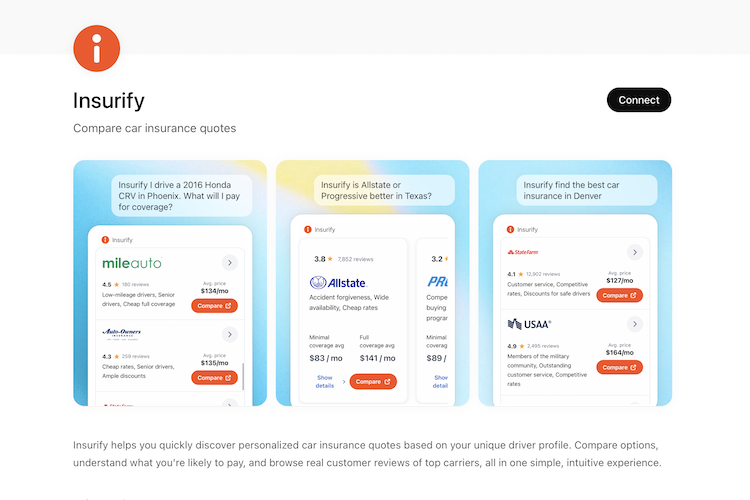
What Insurify’s ChatGPT App Means for Brokers
Last Monday, February 9, Insurify (a well-known insurance price comparison site) announced “the insurance industry’s first ChatGPT app, allowing users to browse, research, and compare car insurance directly through the AI platform’s new app library.”
This announcement had an immediate, sizable negative impact on the share prices of leading brokers (Marsh, Aon, WTW).
I am not a securities analyst. I am definitely not offering any advice on how prices of these or any other shares may change in the future. That said, it is reasonable to ask how disruptive the Insurify/ChatGPT (and no doubt similar announcements yet to come) will be on the business of large and established brokers?
Marsh, Aon and WTW are complex organizations with minimal revenue from individuals’ purchase of auto or homeowners insurance. Rather, their revenue is based on a variety of broking, advisory, and other services they provide to businesses and other organizations. So the real mid-term and long-term questions are the nature of the threat of ChatGPT (or Claude or Gemini) to:
- The established ways these firms do business
- And the value these firms provide to their customers
Donald Light // Donald Light is a veteran insurance technology analyst whose coverage areas include: technology and business strategy; transformative technologies such as digital, the Internet of Things, and driverless cars; core systems; and insurance technology M&A due diligence.
InsurTech/M&A/Finance💰/Collaboration

US Insurance Tech Spending 2026: From Modernization To Intelligence
Forrester projects that industry technology spending will increase by $173 billion in 2026 — up 7.8% relative to last year. For insurers, technology is no longer only about modernization; it’s about intelligence, efficiency, and differentiation.
In our report US Tech Forecast 2026: What It Means For Insurance, Forrester projects that industry technology spending will increase by $173 billion in 2026 — up 7.8% relative to last year. After several years of rapid change driven by digital adoption, rising risk complexity, and shifting customer expectations, insurers are now moving into a new phase. Technology is no longer only about modernization; it’s about intelligence, efficiency, and differentiation. Insurance will represent 6% of US total tech spending in 2026, underscoring the industry’s reliance on digital capabilities to drive results.
Why Insurance Tech Spending Continues To Accelerate
Insurers operate in a volatile environment. Climate change is increasing the frequency and severity of catastrophic events. Cyberthreats continue to expand in scale and sophistication. Social inflation and regulatory pressures are driving loss ratios higher. At the same time, customers increasingly expect seamless, digital-first, and personalized experiences comparable to those offered by leading consumer brands.
These forces are pushing insurers to shift technology from a back-office cost center to a strategic enabler of growth, efficiency, and resilience. Advanced analytics, artificial intelligence, cloud platforms, and modern core systems are becoming fundamental to improving underwriting accuracy, accelerating claims processing, and delivering differentiated customer experiences.
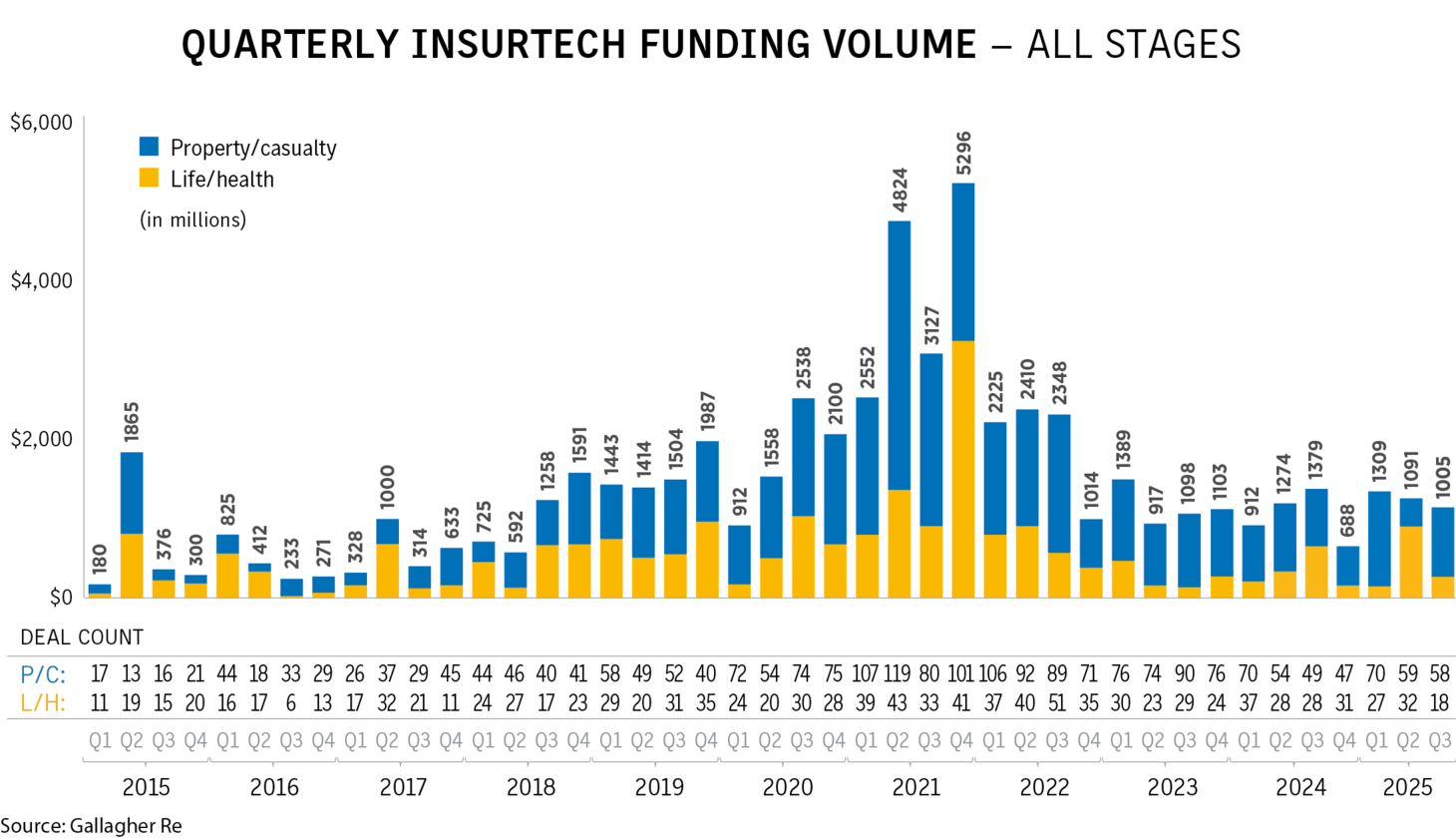
Insurtech funding jumps in fourth quarter
Global fourth-quarter insurtech funding jumped 66.8% from the third quarter to $1.68 billion, the highest quarterly total since $2.35 billion in third-quarter 2022, according to a report Thursday.
Funding for all of 2025 rose 19.5% from 2024 to $5.08 billion, according to the report from Gallagher Re, the reinsurance business of broker Arthur J. Gallagher & Co.
The fourth-quarter deal count rose 34.2% from the third quarter, to 102, and the average deal size grew 20% to $18.8 million. There were 77 property/casualty deals and 25 in life and health.
The United States again dominated fourth-quarter funding, accounting for 51%, followed by the U.K. at 8% and India at 6%. That aligned closely with historical percentages, with the U.S. making up 50% of fourth-quarter funding from 2012 through 2025, followed by the U.K. at 8% and India at 5%.
Interest in artificial intelligence appears to be driving a renaissance in insurtech, according to the report, which says more than $1 trillion has been invested in data centers and other infrastructure.
“There seems to be no lack of optimism in the power of AI,” the report said.
Millennial Shift Technologies (mShift) and Loss Scan Introduce Real-Time Loss Scan Integration to Accelerate Insurance Workflows
Millennial Shift Technologies (mShift), an intelligence insurance services and solution provider that helps brokers quote, bind, and issue commercial lines of business, today announced a partnership with Loss Scan to integrate its Loss Scan technology directly into the mShift Marketplace.
The integration delivers real-time document data-extraction and makes additional AI-based parsing capabilities available within the mShift platform, allowing brokers and carriers to extract, organize, and with Loss Scan's newest functionality, the partnership will bring deep claim analytics to a level never seen before, along with in-depth stewardship reports from loss runs in seconds. This new capability removes one of the most manual steps in the insurance workflow and complements mShift's existing AI-powered email quoting, AI data enrichment services, submission clearing, and bulk processing capabilities.
Loss Scan is a proven solution for transforming unstructured insurance documents into usable, structured data. The platform supports more than 12,600 loss-run formats and has scanned over 2.5 million pages, extracting millions of individual claims. Using proprietary AI technology, Loss Scan automates data entry from loss runs, certificates of insurance, and other documents—resulting in faster processing, improved accuracy, and streamlined underwriting workflows.
Zurich secures more time for Beazley takeover
Regulatory hurdles and antitrust scrutiny still threaten to complicate the mega-deal
Zurich Insurance Group has secured an extension to finalize its proposed acquisition of Beazley plc, pushing the deadline to announce a firm offer to March 4, 2026, as the Swiss insurer navigates regulatory approvals and due diligence on the London-based specialist insurer.
The Takeover Panel granted the extension following a request from Beazley's board. Under UK takeover rules, Zurich had faced a February 16 deadline to either announce a firm intention to make an offer or withdraw from the process.
The agreement in principle announced on February 4 values Beazley at approximately £8 billion. Under the proposed terms, shareholders would receive up to 1,335 pence per share, comprising 1,310 pence in cash plus up to 25 pence in permitted dividends.
The offer represents a 62.8% premium to Beazley's closing price on January 16, and a 34.6% premium to its all-time high of 973 pence recorded on June 6, 2025.