
Research

Costs, exposure, and the geography of loss: auto market outlook in enhanced competitor analysis
Insurance Business has released a newly enhanced edition of its Competitor Analysis: Private Passenger Auto Insurance, delivering the most granular market outlook yet on America’s most volatile personal lines segment.
The upgraded report expands macro-cost and exposure analysis, showing how inflation, litigation, and shifting driver behavior pressure underwriting results. New figures track long-term premium, loss, and combined-ratio trends from 2014 to 2024, alongside inflation data revealing a 65% rise in vehicle repair costs, far outpacing broader service inflation. Updated exposure charts show changes in written auto liability over more than a decade.
The Auto Competitor Analysis introduces new state-level performance intelligence. New maps and tables identify the top five states by private passenger auto market share (California, Florida, Texas, New York, and Georgia), and rank states’ combined ratios over a ten-year period. Nationwide maps reveal how profitability diverges sharply by jurisdiction, driven by repair inflation, drivers' market and legal exposure.
A major enhancement is the inclusion of defense-to-loss ratio analysis, with new state-by-state maps exposing where private passenger auto litigation costs function as a hidden tax on underwriting firms. These visuals clarify why combined ratios alone no longer tell the full story.

LA Fire survivors rude surprise could hit more Americans | Digital Insurance
Since the 1990s, American homes have been systematically underinsured in the event that they are completely destroyed.
(Bloomberg) --A year after the Los Angeles wildfires, many survivors face the same problem: Their insurance policies aren't paying out enough to cover the cost of rebuilding.
It's a tragic predicament. And it will happen again when the next disaster hits.
Since the 1990s, American homes have been systematically underinsured in the event that they are completely destroyed. Study after study shows that, counter to the public's understanding, many home insurance policies are not required to cover total replacement of homes.
The trend, though decades old, has been somewhat hidden. But climate-driven events that cause massive destruction, especially wildfires, are revealing just how pervasive and severe the problem has become.
"Climate change did not cause underinsurance, but it does expose it and amplify it," said Kenneth Klein, a professor at the California Western School of Law specializing in the topic.
Global warming is creating a hotter and drier world. Combined with more construction in areas with lots of flammable vegetation — the wildland-urban interface — it's led to a rise in damaging fires in the US. Researchers at the University of Colorado Boulder in 2023 found that wildfires in Western states destroyed 243% more buildings in the decade between 2010 and 2020 than in the previous decade. The fires in LA claimed in excess of 15,000 structures.
Announcements
NEXT Insurance Rebrands as ERGO NEXT Insurance, Reflects Next Phase of Growth as a Leading Small Business Insurance Provider
NEXT Insurance, now operating as ERGO NEXT Insurance, today announced a new brand identity that reflects the company’s next phase of growth as a leading small businesses insurance provider for more than 750,000 entrepreneurs.
The updated identity marks an important milestone following NEXT’s integration with ERGO, the primary insurance company of Munich Re, as part of the group’s international expansion strategy.
“By visually aligning our brands, we’re ensuring our identity reflects both the strong foundation of ERGO and Munich Re and the digital-first experience that NEXT brings to small commercial insurance,” said Joon-Soo Kim, VP of Marketing at ERGO NEXT.
Backed by Munich Re, one of the world’s largest reinsurers, ERGO NEXT is positioned to deliver the fast, fully digital quoting and binding experience, while placing greater emphasis on predictability and long-term collaboration.
Commentary/Opinion
Executive Brief: Winning the AI Fraud Arms Race - Kaenan Hertz
Subject: Why your Claims AI and Underwriting AI need to start "dating" 💍
Remember Groundhog Day? Bill Murray trapped in an endless loop, making the same mistakes until he finally gets it right. That's exactly where most regional P&C carriers are stuck in 2026... catching the same fraudsters in Claims on Tuesday, then binding their policies in New Business on Wednesday.
Winning the AI Fraud Arms Race
We've officially moved past the "AI pilot" phase. Welcome to the AI Production Era, complete with its inevitable plot twist: The Fraud Arms Race. Bad actors aren't just padding repair estimates anymore. They're running Fraud-as-a-Service platforms, generating photorealistic deepfake accident scenes and synthetic identities that would make Industrial Light & Magic jealous.
The 2026 Reality Check:
The Deepfake Explosion: Carriers are reporting triple-digit increases in manipulated claim images and videos—everything from staged accidents to AI-generated damage that never happened. The Coverage Gap: Cyber policies renewed after January 1, 2026, are now excluding deepfake fraud from social engineering coverage. Translation: you're on your own. The Bleeding: Industry analysts project AI-facilitated fraud losses could reach $40B+ by 2027, with regional carriers bearing a disproportionate share because they lack enterprise-scale defenses. Deep Fake Claims
⚔️ The Strategy: From Goldfish Memory to Closed-Loop Intelligence
Here's the absurd part: we catch "Deepfake Dave" red-handed in Claims today, but that same Dave waltzes through New Business tomorrow because our systems have the memory span of a goldfish. We're bringing knives to a machine-gun fight.
The good news? This is entirely manageable. You don't need a $100M war chest or a complete systems overhaul. What you need is a Closed-Loop strategy that makes your data work defensively across the entire policy lifecycle.
Here's the playbook we're deploying with regional carriers
2026 Outlook/Predictions
Why 2026 is the year of smarter insurance
The expectation for insurance has changed. Paper forms, manual approvals, and siloed spreadsheets now feel as archaic as dial-up phones.
In their place, customers and businesses alike demand speed, foresight, and a touch of intuition; systems that don’t just respond but anticipate. In 2026, the insurance industry is no longer just digital; it is smarter, more agile, and more connected than ever before.
FinTech Global spoke with industry experts to explore what that shift truly means, and why it will define the winners in the years to come.
InsurTech/M&A/Finance💰/Collaboration
Zurich submits improved proposal to acquire 100% of specialist insurer Beazley - Reinsurance News
On January 4th, 2026, Zurich submitted a proposal of 1,230 pence in cash per Beazley share to acquire 100% of the London headquartered insurer, but this was rejected by Beazley’s Board of Directors on January 16th.
Today, Zurich has confirmed its initial, and its revised and improved proposal of 1,280 pence in cash per Beazley share, which represents a premium of 56% to Beazley’s closing share price of 820 pence on January 16th, 2026, the last business day prior to submission of the proposal.
This new offer price also represents a premium of 56% to Beazley’s volume weighted average share price of 822 pence for the 30 day period ended on January 16th, 2026; 27% to the median of sell-side analysts’ price targets for Beazley of 1,010 pence on the same date; and, 32% to Beazley’s all-time high share price of 973 pence on June 6th, 2025.
After this news of the increased offer emerged today, Beazley’s share price jumped by around 40% to as high as 1,192 pence, although this is still below Zurich’s latest proposal to acquire 100% of the carrier.
Global InsurTech funding doubles YoY in Q4 - InsurTech Analyst
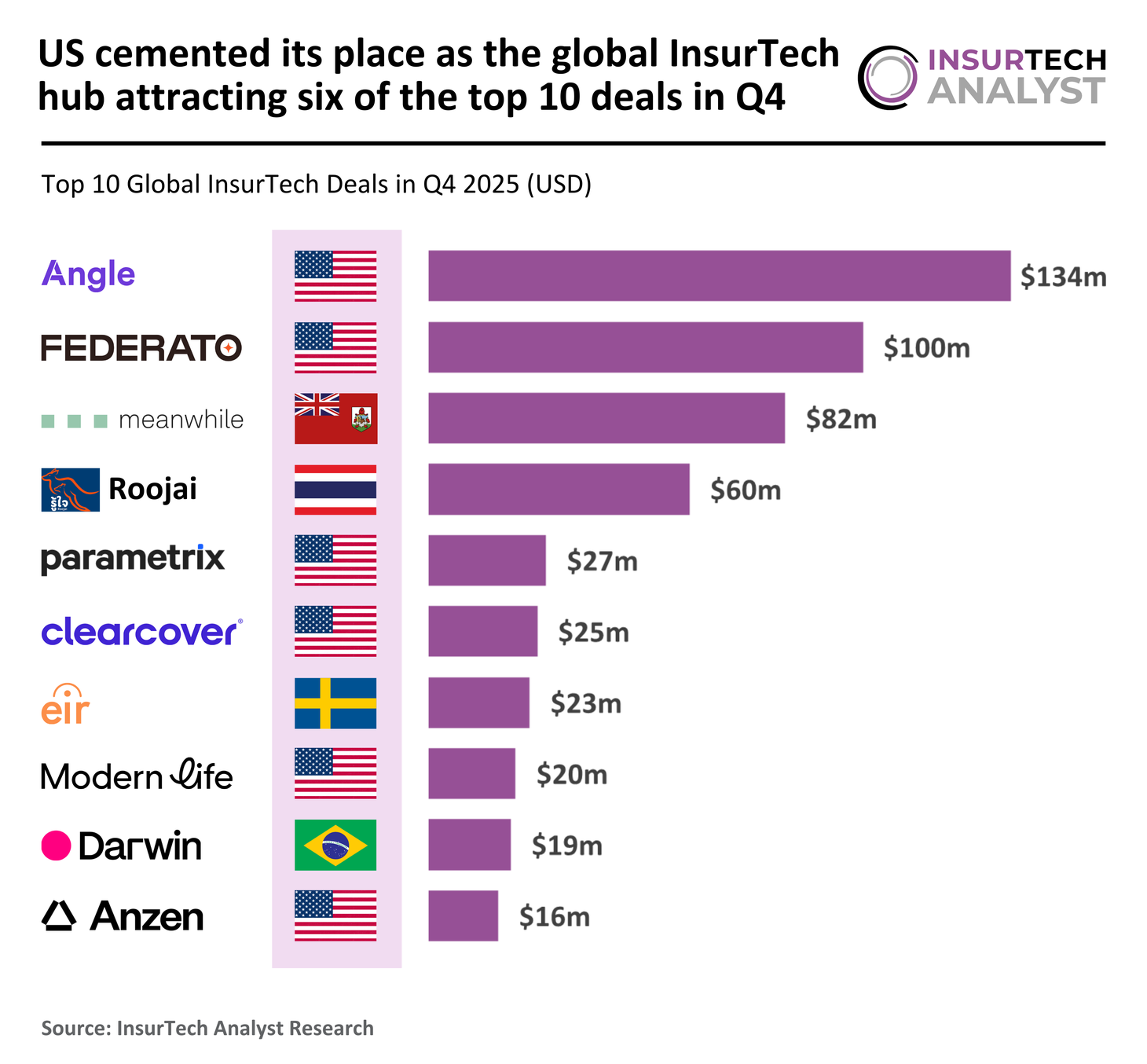
US cemented its place as the global InsurTech hub attracting six of the top 10 deals in Q4
Key global InsurTech investment stats in Q4 2025:
- Global InsurTech funding doubled YoY in Q4
- US companies secured six of the top 10 deals to cement the country’s position as the leading InsurTech hub globally
- Federato, a Californian InsurTech specialising in AI-native software for insurance underwriting and policy administration, secured one of the biggest global InsurTech deals of the quarter with a $100m Series D capital raise
Global InsurTech funding doubled YoY in Q4
In Q4 2025, the global InsurTech sector raised $961.1m across 46 deals, representing a substantial increase compared with the $444.4m secured from 39 transactions in Q4 2024.
This reflects a 2.2x growth in total funding alongside a 17.9% increase in deal volume, indicating that the rebound was driven both by larger individual rounds and by a higher number of completed transactions.
The divergence between the much stronger growth in capital raised relative to deal count suggests that average deal sizes expanded materially, pointing to a renewed appetite among investors to deploy larger cheques into InsurTech towards the end of 2025.
US companies secured six of the top 10 deals to cement the country’s position as the leading InsurTech hub globally
The composition of the top 10 deals also evolved between the two periods.
In Q4 2025, the US continued to lead with six of the largest transactions, although this was slightly down from the seven secured in Q4 2024.
However, the remaining four deals in 2025 were far more geographically diversified, with Brazil, Sweden, Thailand and Bermuda each contributing one top transaction.
By contrast, Q4 2024 was more concentrated, with France accounting for two of the top 10 deals and India for one, alongside the dominance of the US.
This shift from a Europe-and Asia-focused secondary group in 2024 to a broader mix including Latin America and offshore financial centres in 2025 highlights an expanding international footprint for large InsurTech investments.
InsurTech Analyst Research
Confianza Announces Completion of Series Seed 2 Funding to Accelerate Growth and Platform Expansion
Confianza, a comprehensive data and predictive analytics company, today announced the successful completion of its Series Seed 2 round of funding.
The funding will support the continued execution of Confianza's growth strategy, focusing investment on the expansion of client-facing resources, and advanced AI/ML analytics and predictive modeling capabilities to accelerate its growth within the insurance ecosystem. These investments will further strengthen Confianza's position in the insurance market while enabling expansion into additional industries and use cases with the proven value of its comprehensive data and analytics assets.
"This funding reflects confidence in our strategy, our data assets, and the value we deliver to customers," said Greg Johnson, CEO of Confianza. "It allows us to continue investing responsibly while expanding the impact of our solutions."
Founded in 2020, Confianza serves organizations seeking data-driven solutions to improve risk selection, segmentation and profitable growth.
People
Covr appoints Sam Barnett as CEO
Covr Financial Technologies has appointed industry veterans Sam Barnett as Chief Executive Officer and Bob Klein as Chief Distribution Officer.
Barnett brings more than 20 years of insurance and insurtech leadership experience, with senior roles spanning distribution, strategy, and growth at Lincoln Financial, Global Atlantic backed by KKR, and most recently VIBE Insurance. Klein, a long time distribution and product leader, is best known for developing Lincoln Financial’s MoneyGuard solution and has held senior roles across carriers and BGAs including Global Atlantic, Sun Life, John Hancock, and Ash Brokerage.
As part of the transition, Covr will acquihire the VIBE Insurance Services team, which Barnett and Klein co founded, integrating its independent agency expertise into Covr’s platform. The appointments follow Covr’s recent merger with Optifino, which combined Covr’s compliance and operational infrastructure with Optifino’s AI driven planning technology.
CES Las Vegas 2026
China Dominated CES, Detroit Stayed Home - by Michael Dunne
What A Takeover Looks Like
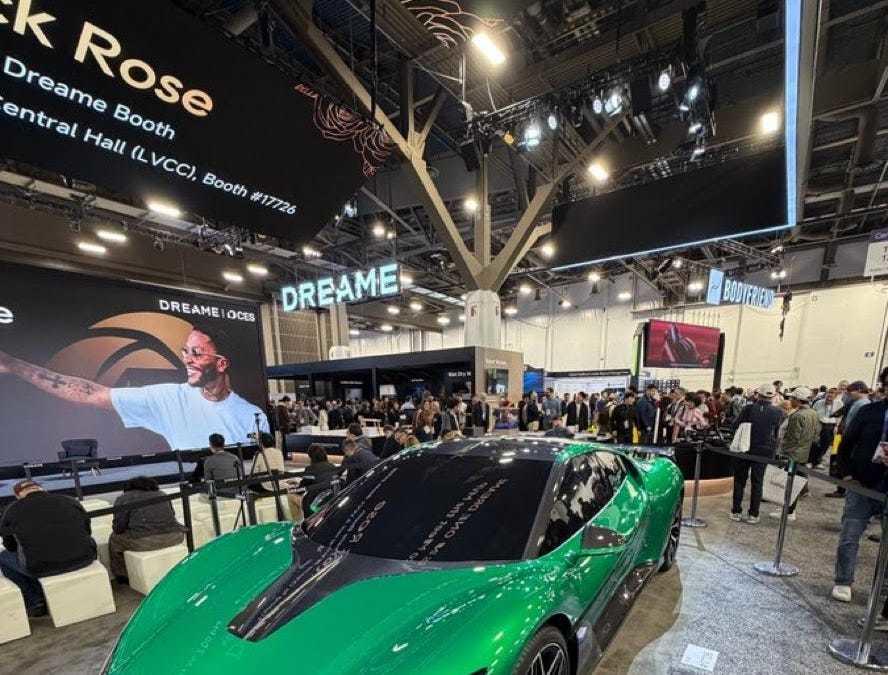
If you want to understand what happened at CES 2026 in Las Vegas last week, a good place to start is Dreame.
This 8-year-old Chinese maker of robot vacuums drew massive crowds jostling to lay eyes on its 1,876-horsepower supercar.
Dreame has never manufactured an automobile. Yet there it was at CES 2026, presenting the Kosmera Nebula 1, a supercar promising a 0-60 mph time under two seconds.
Vanishing Western Automakers
CES has always been global, with attendees showing up from over 150 different countries. But 2026 felt like the Chinese Electronics Show. Nine hundred Chinese firms exhibited at this year’s show. Not ninety. Nine hundred.
I got behind the wheel of products from seven Chinese car brands: Dreame, Geely, Great Wall, Lynk & Co, Wey, Xiaomi, and Zeekr.
The competition? Hyundai focused on robotics and industrial automation, but showed no cars. BMW offered test drives of its Neue Klasse via the iX3. Sony Honda Mobility showed the Afeela (again).
That was it. I did not see exhibits for GM, Ford, Stellantis, Rivian, Mercedes-Benz, Volkswagen, Renault, Toyota, Honda, Nissan, or Subaru. Beyond Chinese brands, the automaker bench was nearly empty.
Martin Luther King Jr. Day

Martin Luther King Jr. Day
Martin Luther King Jr. Day is a U.S. federal holiday celebrated on the third Monday of January (January 19 in 2026) to honor the life and legacy of the slain civil rights leader, marking his January 15, 1929 birthday with national days of service, marches, and reflection on justice and equality.
Established by President Reagan in 1983, it's a day when government offices, banks, and post offices close, while many retail stores and restaurants remain open, with events focusing on community service and King's nonviolent activism.