
News

Is AI to blame for finance and insurance sector job cuts?
Friday's jobs report surprised a lot of economists who'd been thinking there was no way this economy created more than a 160,000 jobs in August. But that's exactly what the report showed.
At the same time, jobs disappeared from a couple of sectors, including what the Bureau of Labor Statistics calls finance and insurance. That category shed 11,000 jobs in August; so far this year it's lost 99,000. Artificial intelligence has been a major reason for these cuts.
The conversation about jobs in the insurance industry reminds University of South Carolina finance professor Robert Hartwig of the early days of the internet boom.
“If I went back to 1999, I could have been doing this exact same interview with ‘Marketplace,’” he said. The first online sales portals for insurance worried the industry, he said. People thought insurance agents would become obsolete. “Now here we are, 30 years later, and we still have insurance agents,” Hartwig said.
He thinks that’ll continue. Probably fewer claims adjusters working on fender benders — an AI could handle those. But Hartwig said the industry will still need people to handle more complex situations.
Financial Results

US P&C Insurers Post $31.7 Billion Underwriting Gain In First Half Of 2026
The US P&C industry's net underwriting gain nearly tripled in the first half of 2026, up from $11.6 billion in the first half of 2025, according to Verisk and the AAPCIA.
The U.S. property & casualty insurance industry posted an estimated net underwriting gain of $31.7 billion in the first half of 2026, up from $11.6 billion during the same period in 2025, when results were heavily affected by catastrophe losses from the Los Angeles wildfires, according to a report from Verisk and the American Property Casualty Insurance Association (APCIA).
The improvement came even as net written premium growth slowed to 2.1%, reflecting more competitive market conditions and moderating rate increases, the organizations found. Policyholders’ surplus grew to $1.3 trillion in the first half of 2026, up from $1.13 trillion at midyear 2025, strengthening insurers’ capacity to absorb future catastrophe losses, according to the report.
Premium Growth Slows As Market Softens
Net written premium growth fell to 2.1% in the first half of 2026, compared with 5.2% during the same period in 2025 and a recent peak of 10.8% in the first half of 2024, according to the report. Net earned premiums rose 3.3%, down from 7.3% growth in the first half of 2025.
Climate/Resilience/Sustainability
Guidewire HazardHub Finds 1M+ California Homes at Risk For Extreme Wildfires
New wildfire analysis from Guidewire HazardHub classifies over one million California homes as "very high risk," while showing that property-level mitigation can cut expected losses by up to 70%. The comprehensive dataset reveals evolving exposure across suburban and wildland-urban interface (WUI) zones nationwide, giving insurers parcel-level visibility to better price and manage catastrophe risk.
While California continues to lead the nation in total high-risk properties, with more than one million homes receiving HazardHub's highest "F" wildfire risk designation ("very high risk"), the study revealed additional key findings, including:
- Top 10 states by total homes at "very high risk" (F-rated): California, Arizona, Colorado, Oregon, New Mexico, Washington, Nevada, Montana, Texas, and Idaho. (Note: Pure exposure drops significantly after California)
- Texas enters the top 10 with 31,106 "F-rated" homes, highlighting growing wildfire exposure outside traditionally recognized Western markets
- Top 5 states by percentage of homes at "very high risk": Montana, California, New Mexico, Wyoming, and Oregon
- The findings indicate that wildfire exposure is expanding alongside population growth, suburban development, and the growth of the wildland-urban interface (WUI). However, analysis shows that exposure in California remains highly concentrated as approximately 98% of wildfire-related property damage occurs within roughly 10% of the state's highest-risk properties.
Research
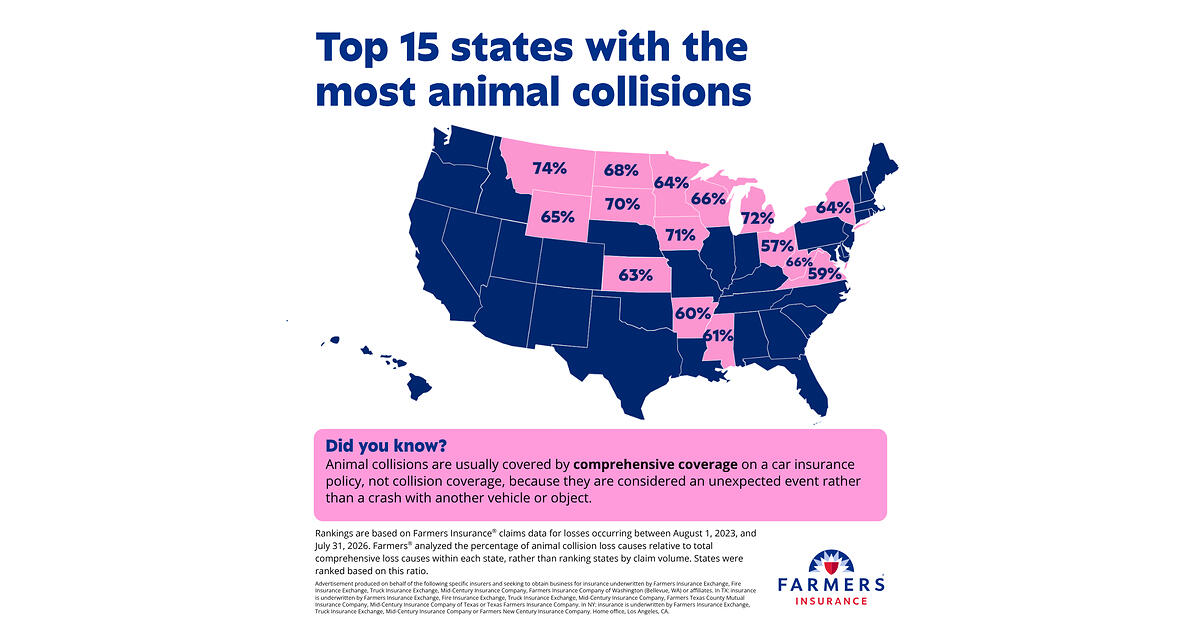
Looking beyond raw numbers: Farmers Insurance® reveals where animal collisions make up the biggest share of comprehensive losses
As drivers prepare for peak deer season this fall, Farmers Insurance® analyzed three years of claims data to identify where animal collisions make up the largest share of comprehensive loss causes. Rather than focusing on claim volume alone, the analysis examined the percentage of animal collision losses compared to all comprehensive losses within each state, revealing where wildlife plays a big role in roadway risk.
Rankings are based on Farmers Insurance® claims data for losses occurring between August 1, 2023, and July 31, 2026. Farmers analyzed the percentage of animal collision loss causes relative to total comprehensive loss causes within each state, rather than ranking states by claim volume. States were ranked based on this ratio.
"Looking at the percentage of animal collisions relative to other comprehensive losses gives us a clearer picture of where wildlife is having the greatest impact on drivers," said Jonathan Hart, Head of National Auto Physical Damage & Regional Claims at Farmers. "In some states, animal collisions aren't just occasional incidents. They're a significant roadway risk. As animal activity increases during the fall months, it's a good reminder for drivers to stay alert, especially on rural roads and during low-light hours when wildlife is most active."
New Insurance Affordability Index Lists Repair Costs Among Drivers of Premium Pressure
New index lists repair cost trends among several factors Triple-I says contribute to premium pressure, a data point relevant to shops navigating cost conversations with insurers.
A new data tool from the Insurance Information Institute (Triple-I) lists vehicle repair cost trends among several factors tied to auto insurance premium pressure.
Triple-I launched the tool, called the Insurance Affordability Index, on Sept. 2. It weighs what households typically pay for personal auto and homeowners coverage against median income figures in their state.
The index rests on three components: an affordability methodology the Insurance Research Council (IRC) has used in its own research, underwriting knowledge Triple-I brings to the partnership, and up-to-date figures reflecting current conditions. Combined, they produce affordability results current through 2025.
Of the two coverage types, homeowners' insurance takes up the bigger and faster-growing share of household budgets nationally: 2.4% of median household income, a jump of 24% since 2020. Auto insurance is comparatively lighter, at 1.7% of median household income, up 9% over the same span, according to the Triple-I release.
AI in Insurance

When it comes to AI adoption most re/insurers are leaving value on the table: Accenture
While most insurers are using artificial intelligence (AI) to improve today’s performance, many are “leaving value on the table,” according to Accenture’s new report, ‘How Insurers Drive Revenue by Deploying AI with Intent.’
Accenture surveyed 263 senior insurance executives with direct accountability for AI, data, technology, and business transformation across the Americas, Europe, and Asia-Pacific.
The survey involved conducting in-depth interviews with 15 executives from leading global carriers to understand the current state of AI transformation across Property & Casualty and Life insurance.
The report revealed that more than four in five (81%) insurers are seeing real revenue gains from AI, achieving at least a 5% improvement in gross written premiums from AI and data initiatives, driven by better pricing, personalisation and cross-selling.
Additional data from Accenture’s latest 2026 Pulse of Change survey reflects this momentum with 86% of insurance employees stating that AI tools have increased their overall productivity.
State News
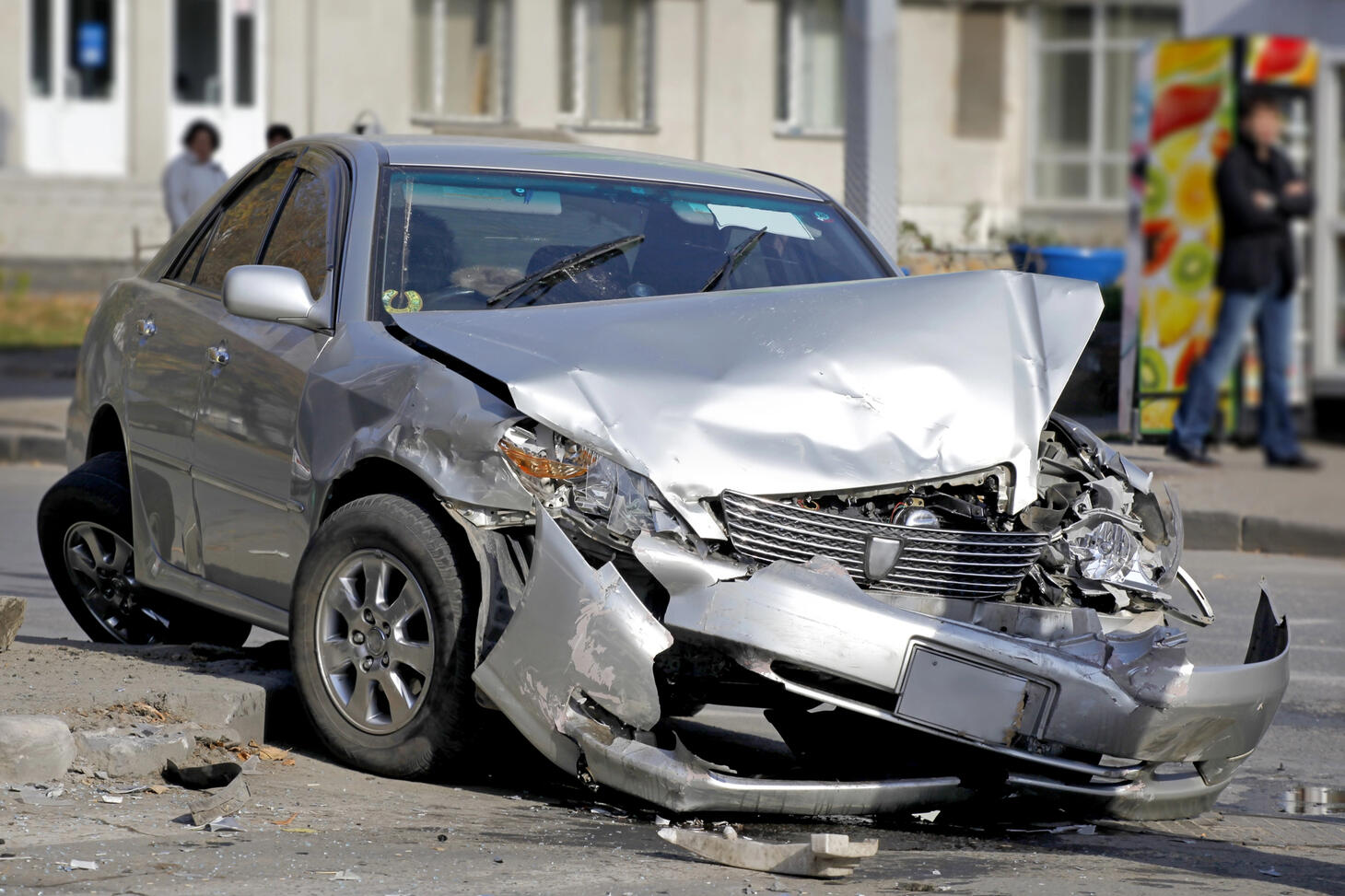
GEICO Avoids Class Action Over Totaled Vehicle Payouts in New Jersey
A federal judge has declined to approve a class action lawsuit accusing GEICO of underpaying losses for totaled vehicles in New Jersey. The court declined to approve the class after concluding that individual issues outweighed the commonality of the proposed class.
The purported class action sought to challenge GEICO’s use of a factor, also used by other insurers, that adjusts the actual cash value (ACV) of a vehicle to account for the condition of the vehicle based on factors such as options and mileage, or as otherwise explained “to bring the ACV from retail to private party condition.”
InsurTech/M&A/Finance💰/Collaboration

Orion180 Insurance targets $1.7 billion valuation in US IPO as fall window starts | Reuters
Orion180 Insurance is targeting a valuation of up to $1.68 billion in its U.S. initial public offering, the company said on Wednesday, as the fall IPO window gains momentum.
The Melbourne, Florida-based firm is seeking up to $340 million by offering 20 million shares priced between $15 and $17 apiece.
The listing comes as the IPO market shakes off its summer lull and dealmakers rush to bring offerings to capitalize on the post-Labor Day fall window, traditionally one of the busiest for new deals.
Fraud
Insurers back new bill to make staged car crashes a federal crime
The American Property Casualty Insurance Association (APCIA) has issued a statement commending Reps. Laura Gillen, D-NY., Troy Nehls, R-TX., Josh Gottheimer, D-NJ, and Vince Fong, R-CA, for introducing the bipartisan Stop Auto Fraud Act of 2026, which would make staging or fabricating a motor vehicle crash to file a fraudulent insurance claim a federal crime for the first time.
Sam Whitfield, APCIA's senior vice president of federal government relations, tied the bill directly to rising premiums.
"Auto claims fraud, including intentional crashes, staged accidents, fabricated medical bills, and AI-altered photo evidence, drives up costs throughout the system and ultimately raises auto insurance premiums for everyone. States that have enacted targeted anti-fraud and staged accident reforms have strengthened enforcement, disrupted organized fraud rings, and helped stabilize auto insurance markets, with some states even experiencing premium reductions," Whitfield said.
Recommended Events

ITC Vegas | Horizon of Possibilities
ITC Vegas September 29, 2026 - October 1, 2026
The largest insurance innovation event in the world - Predict, Prepare, Progress
From the shore, the ocean can appear calm. Yet, under the surface, tectonic plates shift, pressure builds, and currents redirect—long before we detect movement. That’s insurance right now. Climate, technology, regulation, and human behavior are reshaping risk in real time. Change isn’t coming; it’s already here. The real question is how we move forward.
We set our sights on the horizon and turn insight into action.
‘Connected’ proudly sponsors ITC Vegas 2026. Rate Discounts available for ‘Connected’ followers, please contact Alan Demers

2026 Top P&C Insurance Company Performance Rankings |
Join us for the 2026 annual rankings of the top-performing property and casualty insurance companies in the United States. Each year, we evaluate the performance of the top 100 net written premium writers from the prior year, providing distinct rankings for companies focused on personal lines and commercial lines within this elite group.
During this live event, we will reveal the complete 2026 rankings and host an exclusive fireside chat with a senior executive from one of the year's top-performing insurers. Attendees will gain firsthand insights into the strategies, market conditions, and business decisions that contributed to exceptional performance and industry-leading results.
Don't miss this opportunity to gain valuable insights on what sets the industry's strongest performers apart and what their success may signal for the future of the insurance market.