
Climate/Resilience/Sustainability
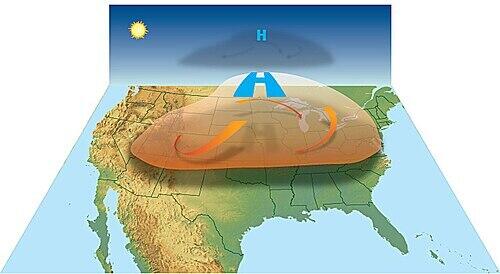
A widespread, searing heat dome settles over the US this week
A heat dome will bring dangerously hot and humid conditions to the eastern half of the United States this week in the region's most widespread heat wave of the summer so far.
The heat dome is building in response to a large shift in the jet stream that's also bringing a big cooldown to the West. Powerful winds will accompany the cooldown and intensify already dangerous fire weather conditions in Utah, where a large, destructive fire is ongoing, and in neighboring states.
The cooler temperatures in the West the past few days will be coming to an end. Beginning Monday, temperatures will rise across portions of Utah, Colorado, and Arizona, further complicating firefighter's ability to fight ongoing wildfires.
Major cities including Chicago, Detroit, St. Louis, Dallas and Nashville could see thermometers climb to their highest level yet this year early this week. Conditions will be made more oppressive by a big surge of humid air spreading out of the South into the Midwest. The sultry weather pattern will then expand eastward to the Northeast by midweek.

Heat Records Fall as Europe Heat and Power Impacts Move East
The deadly heat wave that’s set temperature records across western Europe for more than a week has shifted east to scorch Hungary, Romania and the Balkans.
Budapest is expected to top 40C (104F) on Tuesday, according to models from the European Centre for Medium-Range Weather Forecasts. Belgrade and Bucharest will reach 38C and 37C, respectively, on Monday.
Red warnings for extreme heat have been issued in Poland, Hungary, Romania, Croatia, Bosnia and Herzegovina, Serbia and Slovakia. Similar alerts are still in place for parts of southern and western Switzerland.
News

3.1TB of NAIC data dumped on to the dark web
The notorious cybercriminal group ShinyHunters has just posted 3.1 terabytes of data it claims was stolen from the National Association of Insurance Commissioners on its dark web leak site, hours after the NAIC confirmed for the first time that data taken in a June breach had been "published online by the group responsible." The NAIC did not name ShinyHunters directly, but the attribution has been confirmed by Google's Mandiant unit.
The publication follows a warning ShinyHunters had issued earlier in the month: contact them by June 22 or the data goes up. The NAIC did not pay. The breach was first confirmed by NAIC on June 17, after it identified unauthorized access to its Oracle PeopleSoft systems on June 11, when the FBI and outside cybersecurity experts were brought in.
HUB International Confidentially Submits Draft Registration Statement for Proposed Initial Public Offering
Hub International Holdings, Inc. ("HUB"), a leading North American insurance brokerage, today announced that it has confidentially submitted a draft registration statement on Form S-1 with the U.S. Securities and Exchange Commission (the "SEC") relating to the proposed initial public offering of its common stock.
The timing, number of shares of common stock to be offered and the price range for the proposed offering have not yet been determined. HUB expects to use the proceeds from the offering for general corporate purposes, which may include the repayment of indebtedness.
This press release is being made pursuant to and in accordance with Rule 135 under the Securities Act of 1933, as amended, and does not constitute an offer to sell or the solicitation of an offer to buy securities, and shall not constitute an offer, solicitation or sale in any jurisdiction in which such offer, solicitation or sale would be unlawful prior to registration or qualification under the securities laws of that jurisdiction.
Soft market conditions persist at mid-year supported by capital growth and product innovation: Guy Carpenter
In its July 2026 reinsurance renewal report, Guy Carpenter, a global risk and reinsurance specialist and a business of Marsh, has suggested that abundant capacity and growing reinsurer appetite kept the global property reinsurance market competitive at the mid-year renewals, with attractive terms and coverage options encouraging buyers to explore supplemental solutions to complement traditional catastrophe programmes.
Dean Klisura, President & CEO, Guy Carpenter, commented, “In the current market conditions, cedents have secured competitive pricing and terms on their reinsurance programs, but many are also exploring alternative options, such as parametric solutions and sidecars, as ways to complement their traditional protection. We expect this trend to continue as we move through the remainder of the year.”
Guy Carpenter observed that attractive catastrophe bond rates drove record-level activity, reaching over $61 billion in total outstanding limit for the first half of 2026.
AI in Insurance

What is a token - and why does it matter to your brokerage's AI budget?
A token is roughly three-quarters of a word. The sentence "the policy excludes flood damage" contains six words and approximately eight tokens. Every time you send a message to an AI - and every time it responds - the platform counts up the tokens on both sides and charges you accordingly.
That's it. Tokens are units of text, and AI is billed by the unit.
The reason it matters is that for most of the past three years, businesses didn't pay per token - they paid a flat monthly subscription. A broker could run an entire policy wording through ChatGPT a hundred times and pay the same $20 a month as someone who used it twice. That model is ending. Anthropic, OpenAI and others are now moving enterprise customers to usage-based billing, which means the token count is no longer academic. It's a line on someone's budget.
ognise.

AI Is Starting To Bind Insurance Policies On Its Own
Software can now carry an insurance risk to a bind-ready quote. A Nasdaq-listed carrier is the test case, and the combined ratio is where to look.
Insurance was born in a coffee house. In the 1680s, merchants and ship-owners gathered at Edward Lloyd’s place near the Thames to wager on which voyages would come home and which would not, and the modern industry grew out of those bets. Three and a half centuries on, the trade still rests on a single human act which is that an underwriter looks at a risk and decides whether to take it, and on what terms. A New York firm called Sixfold now says a machine can do most of that work, right up to the quote a broker can sign.
On June 15, Sixfold opened its AI Underwriter to property and casualty insurers, a launch first reported by the trade title The Insurer from a company statement. The pitch is straightforward enough. The software learns one carrier's book and its appetite for risk, reads each new submission as it arrives, and recommends what to do next. Set up for what the trade calls straight-through processing, it can take a case all the way to a quote-ready and bind-ready state, the point at which a broker or client can simply say yes. A human underwriter still signs off and still carries the can. The novelty is how far the machine now travels before the human is needed.

Hippo Deploys Devin, Cognition's AI Software Engineer, to Drive Faster Software Development Across the Insurance Lifecycle
Hippo Holdings Inc. (NYSE: HIPO), a technology-native insurance group, today announced the engineering-wide deployment of Devin, Cognition's AI software engineer, to drive faster software development across the insurance lifecycle. From rate filings and underwriting to distribution and customer experience, Hippo's adoption of Devin enables its engineering team to move faster on the work that matters most — supporting faster, more reliable software delivery across distribution, risk management and customer experience.
Devin is designed to take on multi-step development tasks — planning, writing, and testing code across complex systems — working alongside Hippo's engineers. For Hippo's engineers, that capability translates directly to one of insurance's most persistent challenges: rapidly building software that works correctly across fifty states, each with its own regulatory requirements.
"Building software that works correctly in fifty states, each regulated differently, is complex and time intensive. With Devin, we can automate through that complexity instead of around it," said Kyle Ramsay, Hippo's Chief Product and Artificial Intelligence Officer. "Devin gives our engineers more time to focus on the innovative engineering work behind our products, data, operations, and risk management."..
Commentary/Opinion

3 Key Questions for Boards on AI | Insurance Thought Leadership
In the past two years, I have sat in on more board-level reviews of AI deployment proposals than in the previous 10 combined. The dollar amounts have gone up, as have the strategic stakes. What has not gone up enough is the quality of the questions board members ask before approving these proposals.
Most board reviews follow a predictable script. Management presents a use case, a vendor, a timeline, and an ROI model. Board members ask about the vendor's track record, the integration risk, and the projected savings. The proposal gets approved or sent back for revisions on the basis of those answers.
Those questions are not wrong. They are insufficient.
Across 20 years of building insurance software and watching deployments succeed or fail, I've seen three other questions matter more for the long-term success of an AI decision-making deployment. Most board members are not asking them yet. The ones who do are the ones whose organizations end up with AI in production rather than stuck in pilot.
QUESTION 1: WHAT IS THE DATA FOUNDATION WE ARE BUILDING THIS ON? CONTINUES HERE
Piotr Biedacha is the CEO and head of delivery at Decerto

The Insurance Crisis Is Quietly Killing Performance Car Ownership
Rising and more restrictive insurance quotes are really starting to affect the performance market. This may be bad news for future enthusiasts.From a purely practical, transportation-led point of view, it’s always been a bit of a stretch to justify a performance car. After all, buyers have to accept additional costs and complications right from the start. They’d need to deal with worse fuel economy, pricier consumables, more expensive tires, and the occasional repair bill that made a middling crossover look like the more sensible pick.
Insurance costs have always factored into the equation, but they are now starting to get out of hand for aspiring performance car owners. Insurers aren’t formally removing the likes of a Corvette Z06 or a Mustang GT from their rate sheets, but they’re increasingly looking at high-performance trims as a more concentrated risk.
Across the US, automobile insurance costs have been rising steadily. Insurance data sets suggest that average full-coverage premiums now range from $2,300 to $2,500 annually. That’s starting to make buyers look more closely at performance cars, wary of those rising baselines and steeper premiums. Now the conversation extends beyond the vehicle's purchase price and whether a particular buyer could justify the jump from a "sensible" 330i to an M3.
The False Economies in Insurance Claims
Sometimes an industry paper comes along that simply confirms what many of us have known for years but were never willing to say loudly enough in the boardroom.
This is one of those moments.
Claims professionals, executives, reinsurers, brokers, regulators, and every person worried about the future of this industry — we need to talk.
Chantal Roberts recently released a white paper based on claim audits I did titled The ROI of Claims Staffing and Education. The message is neither subtle nor comfortable. We did not write another polite industry memo suggesting “operational improvements.” We held up a mirror to the insurance industry and forced leadership to confront a reality many organizations have spent years rationalizing away:
- Claims staffing is not an expense line item.
- Claims staff, and their ability to resolve claims objectively and efficiently, ARE the product.
- To quote Chantal, “The claims department is the only place where the product is produced.”
To quote another colleague, Heather Blevins: Claims “is the operational engine, the reputational foundation, and the financial heartbeat of every insurance organization.”
Recommended Events

ITC Vegas September 29, 2026 - October 1, 2026
ITC Vegas | Horizon of Possibilities
ITC Vegas September 29, 2026 - October 1, 2026
The largest insurance innovation event in the world - Predict, Prepare, Progress
From the shore, the ocean can appear calm. Yet, under the surface, tectonic plates shift, pressure builds, and currents redirect—long before we detect movement. That’s insurance right now. Climate, technology, regulation, and human behavior are reshaping risk in real time. Change isn’t coming; it’s already here. The real question is how we move forward.
We set our sights on the horizon and turn insight into action.
‘Connected’ proudly sponsors ITC Vegas 2026