
News

Bayer wins Supreme Court preemption ruling that caps a decade of Roundup liability
A federal-preemption decision could neutralize tens of thousands of cancer claims
The US Supreme Court ruled 7-2 on Thursday that federal pesticide law bars state-law claims accusing Bayer of failing to warn that its Roundup weedkiller causes cancer, a decision that could cap one of the largest mass-tort liabilities in corporate history.
The court threw out a $1.25 million jury verdict won by a Missouri man who blamed Roundup for his non-Hodgkin lymphoma, ruling that consumers cannot sue over the absence of a cancer warning when federal regulators concluded none was required, Bloomberg reported. The case, Monsanto v. Durnell, turned on whether the Federal Insecticide, Fungicide and Rodenticide Act preempts failure-to-warn claims brought under state tort law

Insured losses from Venezuela quakes likely to be a 'fraction' of total multi-billion economic loss: Aon
Insurance industry losses related to the two major earthquakes that hit Venezuela this week are anticipated to represent only a small portion of the billions of dollars in economic losses expected from this catastrophe, according to broking group Aon’s recent Weekly Cat Report.
Northwestern Venezuela, specifically the area west of Caracas, was recently impacted by two successive strike-slip earthquakes with magnitudes of 7.5 and 7.2.
These seismic events resulted in extensive casualties and widespread structural damage.
This specific type of activity, known as a doublet sequence, involves two tremors of comparable magnitude occurring in close temporal and geographical proximity.

NAIC Says Data Taken in Hack Has Been Published Online
The National Association of Insurance Commissioners (NAIC) now says the data taken earlier this month from its information technology systems has been published online by the hackers responsible.
In a short note on it’s website, NAIC said it is “actively working with an external cybersecurity partner to compare the scope and type of data the group posted with our own analysis.”
Updates will be posted when available, the NAIC said. READ ON

Farmers facing lawsuit over cookies
A California man claims he rejected tracking but was tracked anyway.
Farmers is being sued by a California man who says he rejected tracking cookies on the company's website — but was tracked anyway.
The proposed class action suit was filed in federal court on June 19. The suit says when Stacy Penning went to Farmers.com to get an auto insurance quote, a cookie notice popped up. According to court documents, the pop-up said that the website uses cookies and other tracking technologies, and that users "may accept or reject targeting cookies that sell and/or share your personal information."
Penning says he rejected the cookies but was tracked anyway. He alleges that Farmers still placed cookies from two third-party companies, Adobe Inc. and Qualtrics, and sent them his data. According to the filing, data sent to Adobe that included his ZIP code, that he was seeking personal auto insurance, and that he had previously visited a Hyundai website, revealing the type of car he was trying to insure.
The suit says the incident violates California's Invasion of Privacy Act and brings six counts: invasion of privacy, intrusion upon seclusion, wiretapping, use of a pen register, common law fraud and unjust enrichment.
Financial Results

Big ‘I’ Releases 2026 Market Share Report
The 2026 Big "I" Market Share Report found the independent agency channel maintains a strong position amid improving underwriting results.
Based on 2025 data, this year’s report found that the independent agency channel places 62% of all p&c insurance written in the U.S. This is an increase from 61.5% in 2024 and steady with the five-year average of 62%, demonstrating the channel’s stability through the challenges of the hard market.
The independent agency channel maintained its share of commercial and personal lines. Independent agencies wrote 87.7% of commercial lines written premiums, consistent with 87.9% in 2024. Its share of personal lines continued to grow, at 39.5% in 2025 compared to 39.2% in 2024—continuing its trajectory from 36.7% in 2021. REPORT
AI in Insurance

Inside the AI modeling race reshaping catastrophe risk |
Actuarial AI is advancing faster than most carriers' pricing infrastructure can keep up - and the carriers falling behind are mispricing risk as a result.
Peggy Brinkman, a principal actuary at Milliman, maps the trajectory: from univariate actuarial techniques, through generalized linear models, to gradient boosted machine models, and now to explainable boosting machines - a class of model that delivers gradient boosting accuracy with the interpretability that state regulators require for rate filing approval. The shift is happening across the industry, but at very different speeds.
"New modeling techniques can extract more value from the same data in terms of risk understanding," Brinkman said. "Advances in methodologies are as important as bringing in new data sources."

How AI Can Rewire Organic Growth In Insurance
When everyone has access to similar capabilities, what matters is how your producers use the time AI gives back to them.
Organic growth in insurance is at a breaking point. From what I've seen in the industry, the traditional playbook, which includes acquiring businesses or hiring experienced producers, no longer works.
Acquisitions are slowing under today’s rate environment and private credit constraints. Training new producers is increasingly a losing bet: Validation rates, which track whether producers hit their goals, are under 50%, and for agencies under $1.25 million in revenue, the producer success rate is just 21.3%, according to the 2025 Best Practices Study published by Big “I” and Reagan Consulting.
Hiring is even tougher: The pool of experienced producers is finite, and payouts for talent have become extreme. I've found that training new producers is increasingly a losing bet. Meanwhile, the industry faces a demographic cliff: 50% of the insurance workforce wants to retire by 2028, and industry hiring has slowed.
As a result, individual books of business are ballooning, and producers are forced to manage more customers than ever. Today, they spend over 60% of their time on service work, administrative tasks and renewals instead of client-facing work that drives growth.
This is not just inefficient—it’s a direct threat to the health of the business. Experienced brokers are so busy servicing existing accounts that they can’t pursue new business, and organic growth stalls.
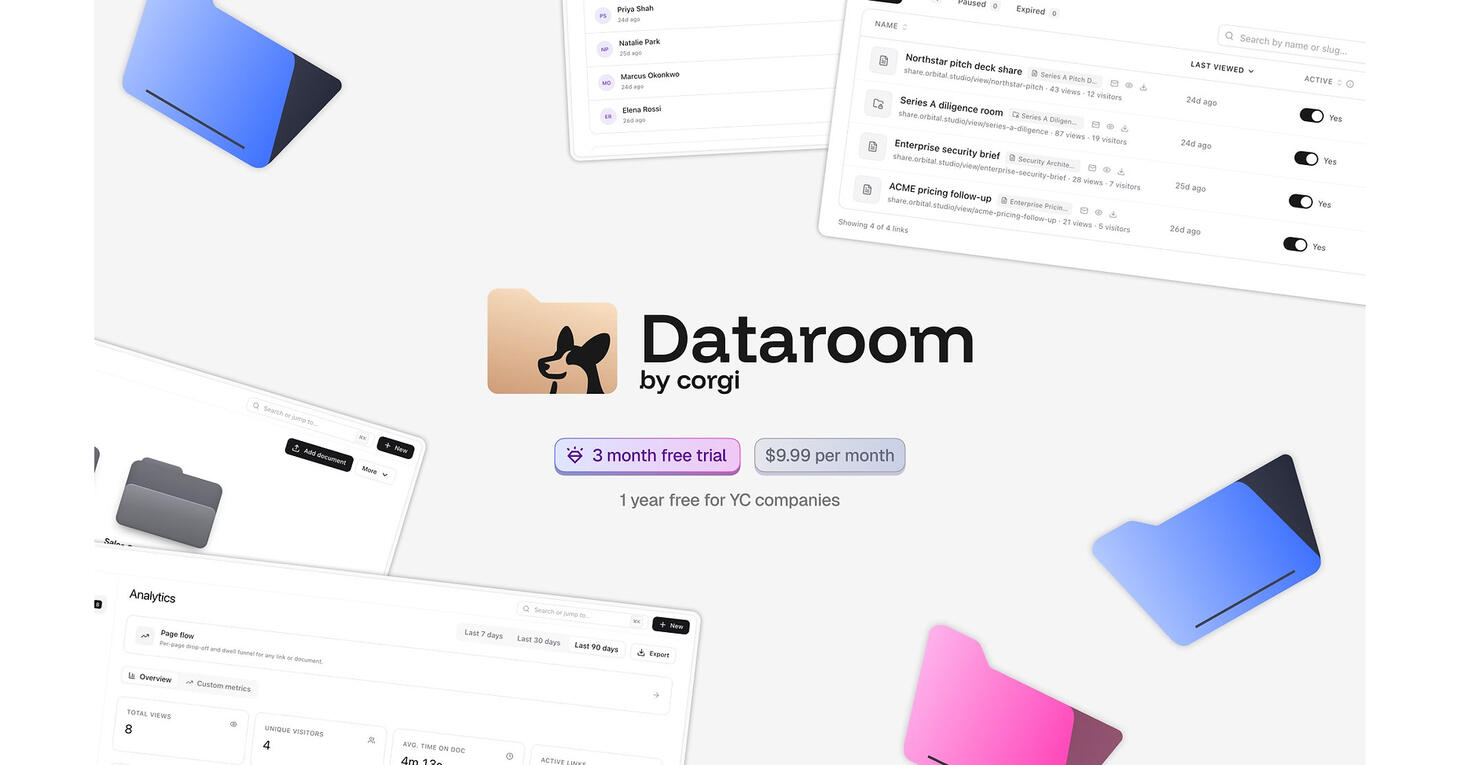
Corgi Launches Dataroom, an All-in-One Platform for Document Sharing and Analytics
Corgi announced the launch of Dataroom, a document platform that combines secure sharing, e-signatures, virtual data rooms, and engagement analytics in a single workspace.
Developed internally by the team at Corgi, Dataroom was originally built to solve a problem the company encountered while scaling its insurance operations: managing critical business documents required multiple disconnected tools, making it difficult to track what happened after a document was sent.
"Insurance runs on documents," said the Corgi team. "Every policy, certificate, agreement, and renewal depends on documents moving quickly between people. We found ourselves juggling separate platforms for sharing files, managing data rooms, and tracking engagement. We built Dataroom to bring all of that into one place."
Announcements

Convr® Makes the Industry's Only Commercial P&C Risk Context Engine Available to AI Agents via Model Context Protocol (MCP)
An underwriter reviewing a $40M manufacturing submission can now ask their AI assistant — Microsoft Copilot, Claude, or any compatible agent, "What are the key risk characteristics on this account and how does it compare to similar risks?" and get an answer grounded in Convr's commercial P&C Risk Context Engine (RCE). That includes exposure profile, prior losses, peer benchmarks, and classification, all traceable to source.
Convr® has added support for the Model Context Protocol (MCP), the open standard that lets AI agents call external systems as tools, making the RCE the industry's only commercial P&C knowledge graph and semantic ontology purpose-built for underwriting — available to any MCP-compatible AI system.
What underwriters can now do from inside their AI agent of choice:
- Triage new submissions against carrier appetite
- Pull exposure summaries, prior-loss context, and peer benchmarks mid-conversation with a broker
- Validate classifications and surface missing information before binding
- Ground AI-drafted quote rationale, declination letters, and referral memos in RCE data the underwriter can trace
Nationwide joins Columbus Crew ownership group
Nationwide announced today that it is joining the Columbus Crew ownership group. The insurance and financial services giant based in Columbus will take a meaningful minority stake in the club, joining Haslam Sports Group and the Edwards family.
The investment marks another milestone in Nationwide's centennial year and reflects the company's continued belief in the future of Columbus and one of its most iconic franchises.
"As we celebrate Nationwide's 100th anniversary, we are focused not only on where we've been, but where we're going," said Nationwide CEO Kirt Walker. "The Crew and its fans represent the passion and strong connection to the Central Ohio community that Nationwide has enjoyed for more than a century. Now is the right time for us to deepen our investment in the team and the city's future."
The announcement comes nearly two months after the Haslam Sports Group, the Edwards family and Nationwide helped bring the 18th National Women's Soccer League franchise to Columbus.
Telematics, Driving & Insurance
State Farm Adds Opt-In Crash Data Sharing for Toyota, Lexus Owners - Autobody News
Eligible customers driving 2020 or newer Toyota and Lexus models can opt in to share crash data to help speed claims processing.
State Farm has begun offering an optional feature that lets owners of 2020 or newer Toyota and Lexus vehicles share vehicle-generated crash data directly with the insurer during the claims process, according to a June 24 announcement from State Farm. The data points the company can access, with a customer's consent, include the vehicle's direction of travel, speed, point of impact and the loss location on a map, the type of detail estimators and appraisers already use to evaluate how a vehicle was damaged.
The announcement adds to a list of insurers and automakers that have introduced tools capturing vehicle-generated crash data before a shop or adjuster inspects the vehicle.
State News

Assembly advances bill to help Californians keep their home insurance
A bill to help homeowners keep their insurance by requiring greater disclosure of reasons for nonrenewal and instructions for how to keep coverage when possible passed the Assembly Insurance Committee today.
A bill to help homeowners keep their insurance by requiring greater disclosure of reasons for nonrenewal and instructions for how to keep coverage when possible passed the Assembly Insurance Committee today. The bill, SB 1301 by Senator Ben Allen, is co-sponsored by Consumer Watchdog and the Every Fire Survivor’s Network in response to concerns expressed by L.A. fire survivors and consumers across the state that they will not be able to keep their home insurance.
The bill requires insurance companies to give homeowners more notice before a loss of coverage, specific disclosure of the reasons and evidence behind the nonrenewal, and clear instructions on what to do to keep their home insurance if the issue is repairable.