
Climate/Resilience/Sustainability
Interview with Daniel Kaniewski Ph.D
Interview with Daniel Kaniewski, Founder and CEO, Northstar Risk & Resilience, Former FEMA Deputy Administrator for Resilience, and Marsh US Public Sector Leader
By Megan Kuczynski, Founder and CEO, ClimateTech Connect
Dan, it has been a pleasure to collaborate with you on multiple occasions this past year, and it was our honor to have you on the main stage at ClimateTech Connect for the past two editions in Washington D.C. Given your background as the first Deputy Administrator for Resilience at FEMA, and the depth of your expertise across government, property & casualty insurance, and emergency management, you were top of my list to interview for the inaugural edition of Risk2Resilience.
It was great to get the FEMA band back together with Pete, Roy, and Andy. A common theme from our discussion was that resilience has to be viewed holistically, not as a bunch of disconnected programs. We understand the role that emergency management, P&C insurance, and the National Flood Insurance Program play in reducing disaster impacts for Americans, and know that the whole is greater than the sum of its parts.
The *FEMA Review Council report *reinforces that point by embracing the model that we developed back when the four of us were at FEMA: emergency management should be locally executed, state-managed, and federally supported. The Council emphasized the role block grants can play in speeding disaster assistance to communities, and the emergency management community has broadly embraced this idea.
Our consensus view was that the right lesson is not to weaken FEMA, but to modernize it so FEMA can provide post-disaster assistance in a timely manner while also incentivizing communities to invest before disaster strikes. FULL INTERVIEW
News

Global natural catastrophe protection gap hits US$424 billion – Swiss Re
The global natural catastrophe protection gap widened to US$424 billion in 2025, up from US$395 billion a year earlier, even as insurance coverage broadly kept pace with rising exposures, according to new research from the Swiss Re Institute.
The figures come from Swiss Re Institute’s Natural Catastrophe Insurance Resilience Index, which measures the extent to which available private insurance protection covers modeled expected losses. The protection gap is expressed in premium-equivalent terms – the difference between premiums currently written and those required to fully cover expected economic losses.
Despite the widening gap in absolute terms, the resilience index – the share of protection needs covered by insurance – remained broadly stable at 27.3% in 2025, little changed from 2024. Over the past decade, the index improved by two percentage points, rising from 25.3% in 2015. Swiss Re Institute attributed the growth in the gap primarily to the increasing value of assets exposed to natural catastrophes

USAA to return nearly $1 billion to Florida members as legal reforms help lower insurance costs
USAA said it will deliver nearly $1 billion in combined savings and returns to eligible Florida members, including a $500 million dividend, CNBC can exclusively report.
eligible current Florida auto policyholders are expected to begin receiving dividend payments June 15. The average payment will be about $760, with more than a quarter of eligible members receiving more than $1,000, according to the company.
The insurer credits Florida’s civil litigation and tort reforms as a key reason it can send money back to policyholders. USAA says its legal costs declined after Florida moved to curb what insurers have long described as legal system abuse.
In 2023, Florida passed tort reforms that shortened the statute of limitations to two years, eliminated so-called phantom damages and ended one-way attorney fee awards. Those changes were designed to reduce incentives for excessive litigation, particularly in insurance claims.
Since then, the litigation numbers have shifted sharply. Auto glass lawsuits fell from about 24,000 in the second quarter of 2023 to roughly 2,600 in the same period of 2024, according to a Milliman white paper cited by USAA. Florida had ranked second nationally for “nuclear verdict” payouts from 2009 to 2022, but dropped to 10th by 2024, according to Milliman.

US Personal Lines Insurers Ask for Less Rate After Period of Catch-Up
It appears as though auto and home insurers have caught up, appropriately matching premium to risk in their portfolios.
According to a new report from insurance industry rating agency AM Best, rate increases for homeowners and private passenger auto insurance dropped in 2025 following several years of significant rate increases as insurers’ underwriting profits wound up in the red. In 2025, the average approved rate increase for homeowners insurance was 8.3% compared with 13.5% in 2024. For auto, rates went up 3.7% in 2025 versus up 9.7% in 2024.
For five of the six years from 2018 to 2023, homeowners insurers netted underwriting losses, but 2025 results “showed continued improvement as the industry produced an underwriting profit of more than $16 billion for the homeowners line, the first such profit in five years,” thanks to no hurricane landfalls and a “more willing” reinsurance market, AM Best said. FULL ARTICLE
AI in Insurance

Could AI actually escape human control? Top researchers think it's worth worrying about
The American insurance industry's relationship with AI is more complex than most risk frameworks currently acknowledge
Three stories broke this week that, taken individually, each look like a niche technology news item. Read together, they add up to something more significant - and something the US insurance industry, which has bet heavily on AI as a driver of growth and efficiency, should be thinking about carefully.
The first: Anthropic, one of the world's most prominent AI developers and the San Francisco company behind some of the most widely used AI models in the US market, published a report suggesting a global slowdown in frontier AI development would "likely be a good thing" - and warned that the human role in AI development is already "narrowing at each step."
The second: a Stanford-led study - conducted at one of America's most prestigious research institutions, examining applications to US employers - found that AI hiring tools produced "clear racial disparities," with Black and Asian candidates disproportionately screened out, and that the same algorithmic models were being shared across employers, meaning rejection at one company predicted rejection at others.
The third: the Financial Times reported that Google DeepMind, Anthropic and Meta have quietly expanded research into machine consciousness, hiring philosophers and psychologists to study whether AI systems might one day have experiences that matter morally.
None of these stories is directly about insurance. All of them are. MORE
The Insurance Gap Is Reshaping Hyperscale Data Ce | S&P Global Ratings
The Insurance Gap Is Reshaping Hyperscale Data Center Finance
Key Takeaways
- As capital spending to build hyperscale data center campuses reaches tens of billions of dollars per site, full insurance coverage may no longer be possible when compared with traditional data centers.
- This insurance gap could increasingly function as a capital-structure constraint, where available coverage supports the portion of asset value lenders may view as recoverable in downside scenarios.
- With insurance programs structured through probable maximum loss or maximum foreseeable loss-based and layered programs that may only cover part of the total project value, a larger share of tail risk may be shifting into financial structures.
- As a result, assessing the underlying risk of these mega infrastructure projects is increasingly complex for market participants and may currently be underappreciated, given evolving and non-standard insurance frameworks and the growing migration of tail risk into financial structures for data center lenders.
Capital spending to build hyperscale data center campuses has reached tens-of-billions of dollars per site, pushing beyond the levels at which traditional property and construction insurance markets have historically provided full replacement-style coverage at a single location. These constraints primarily apply to physical construction and real asset development. As a result, insurance for data centers is increasingly structured through probable maximum loss (PML) or maximum foreseeable loss (MFL)-based and layered programs that may only cover part of the total project value, leaving a larger share of exposure outside the insurance coverage than has been typical for large-scale infrastructure.
Commentary/Opinion
The opportunity in the bottom half of the K-shaped economy
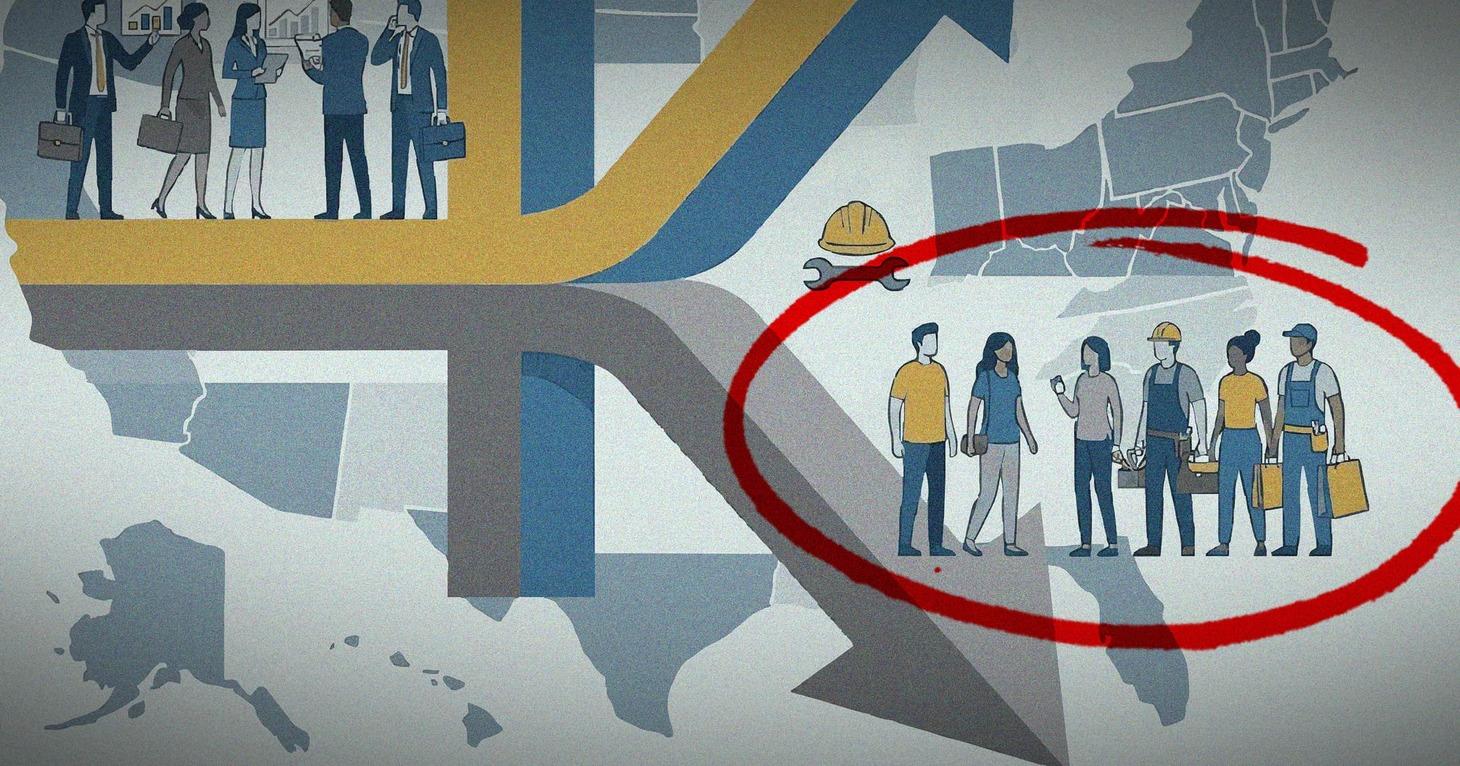
The K-shaped economy narrows in on a reality that life insurers can no longer afford to treat as secondary. Consumers are experiencing the current financial environment in very different ways, and carriers must respond accordingly.
Higher-income households may still evaluate insurance coverage through the lens of income replacement, estate planning and wealth strategy. But families on the lower half of the “K” are trying to figure out what fits into the budget now, and whether the life insurance will still be there when their family needs it. For carriers serving the middle market, or those in the $50,000 to $150,000 annual income range, this distinction should shape product strategy, distribution planning and customer engagement.
The issue becomes affordability under pressure. Inflation, elevated living costs and ongoing budget strain have made it more difficult for families to focus on protection because they’re so focused on today's expenses. This is a call to the industry to design simpler, more flexible products, remove unnecessary friction from the buying process and build trust with consumers who are making every financial decision more carefully. Industry leaders should recognize that growth in this segment will come only from understanding how families purchase the products, not from applying traditional assumptions more aggressively.
Nick Rohan is the director of partner management at TruStage

How transparency is reshaping insurance pricing strategy
Transparency and governance in insurance pricing are becoming defining factors in how insurers design, deploy and defend pricing models. As pricing systems become more sophisticated and increasingly powered by advanced analytics and AI, the ability to clearly explain how decisions are made is no longer optional. It is central to operational credibility, regulatory confidence and internal trust, according to AKUR8.
In practice, transparency is shifting pricing away from opaque model outputs and towards structured, explainable decision-making frameworks. Insurers are now expected not only to deliver accurate pricing, but also to demonstrate how each assumption, variable and adjustment contributes to the final outcome. This is changing how pricing strategies are built from the ground up.
For MGAs and regional carriers, the impact is even more pronounced. These organisations typically operate with lean actuarial and pricing teams, meaning they cannot afford inefficient or manual governance processes. Without embedded transparency, teams risk spending disproportionate time reconstructing decisions, validating outputs and responding to internal or regulatory queries. As a result, transparency is becoming a core design requirement rather than an added layer of oversight.
Claims

Total Insight 2026: Metrics That Matter on Total Loss Claims
Today more than 23% of all auto insurance claims are deemed a total loss, and more than 40% of policyholders switch carriers after a total loss claim – compared to just 8% after a repairable claim1. That adds up to over 2 million policyholders walking out the door every year because of how their total loss was handled – compared to just 1 million after a repairable claim.
A decade ago, when total losses represented 10%-15% of all claims, a singular focus on Net Salvage Return was a reasonable strategy. Today it is not. With total losses now over 23% of claim volume and driving the highest shopping and switching rates in auto insurance, any friction in a total loss claim is an invitation for a competitor to step in and win the policyholder.
The good news: Policyholder Retention and Net Salvage Return are not mutually exclusive. Both are driven by Cycle Time – particularly at a few key milestones in the total loss process.
Podcast Sponsor

Audio Version - 'Connected: The Podcast' --- Sponsored by Pulse Podcasts
The ‘Connected’ Podcast by Alan Demers and in dedication of Stephen Applebaum, is a condensed audio version of the day's ‘Connected' newsletter, a daily scan of all the happenings in the world of Insurance & InsurTech News.
Pulse Podcasts: Introduce a new way for your audience to hear your voice! We are a podcast creation service that helps businesses turn their written content, like blog posts and news articles, into beautiful podcasts. Our platform writes the script, records the voices, and mixes the audio to create engaging content for your audience. It's affordable and has super-fast turnaround!
LISTEN AND SUBSCRIBE BELOW
Recommended Events

AM Best to Hold Analytical Briefing on How Insurers Are Using Artificial Intelligence
AM Best will hold an analytical briefing on the state of artificial intelligence (AI) use in the insurance industry and what the future holds, based on a recent AM Best survey, scheduled for Thursday, July 16, 2026, at 2:00 p.m. EDT.
The briefing will explore how AI is reshaping the insurance industry, drawing on a Best’s Special Report that revealed survey results of more than 150 insurers and MGAs on their AI usage and plans. Panelists for the event include industry executives, innovation leaders and AM Best analysts discussing adoption trends, operational impact, regulatory considerations and the future of AI-enabled underwriting and claims.
Joining the panel discussion will be Aman Gour, CEO, FurtherAI; Josh Hershman, insurance commissioner, Connecticut; Chetan Kandhari, senior vice president, chief AI and digital transformation officer, Nationwide; and Kaitlin Piasecki, industry research analyst, AM Best. Sridhar Manyem, senior director, Industry Research and Analytics, AM Best, will moderate.
Topics will include:
Key findings from the AM Best’s AI survey - How insurers are using AI to improve underwriting, claims, and customer experience - Emerging risks and governance challenges around AI adoption. - What insurers, reinsurers and rating agencies expect from AI over the next three to five years
For more information and to register for the virtual briefing, please visit here