
News

The Super El Niño Effect on insurance and what it means for clients
Forecasters are warning that Super El Niño is expected to make its debut soon and will likely continue through winter and early 2027.
Though Atlantic hurricane activity may be reduced, insurance carriers will still feel its impacts. Elevated losses from flooding, severe convective storms, winter storms, wildfires, and mudslide exposure are currently top of mind.
For clients in high-risk states like Florida, Oklahoma, Mississippi, Louisiana and Nebraska, Super El Niño could make securing affordable home insurance coverage even more difficult than it already is.
Why home insurance costs may skyrocket
Beth Swanson, insurance analyst at The Zebra, explained that the average annual home insurance premium in the United States is now $2,966, almost a 6% increase from 2025, but this figure varies widely based on factors such as a home’s age and condition, value and location.
With climate risks on the rise, many homeowners in high-risk states are paying more than $5,000 a year for home insurance.
Climate/Resilience/Sustainability

Insurance Built a Model for the Wrong Kind of Natural Disaster | Insurance Thought Leadership
Consider what 2025 demonstrated about the insurance industry's risk assumptions. No major hurricane made landfall in the United States. By the logic of traditional catastrophe modeling, which has always placed tropical cyclones at the center of loss scenarios, 2025 should have been a manageable year. Instead, global insured losses hit $107 billion.
Secondary perils that catastrophe models have historically treated as background noise, including wildfires, severe convective storms and floods, accounted for a record 92% of that total, up from a 56% average over the prior decade. Severe convective storms alone delivered their third-costliest year on record.
The industry did not have the wrong year. It has the wrong product architecture.
The more important question is not why secondary perils are growing, but why, after a decade of this data, the market has not produced instruments adequate to transfer the risk. The answer is structural, and it is uncomfortable: The institutions with the capital and sophistication to absorb the frequency of secondary peril risk have rationally opted not to.
Siddhartha Jha is the founder, chairman and CEO of Arbol

The state of America’s roofs Risk, resilience, and rising costs
Executive Summary:
Roof-related claims continue to dominate residential property insurance losses.
Data from 2025 shows $23 billion in roof replacement cost value (RCV), compared to an aver- age of $24.36 billion from 2021 to 2024. The lower figure reflects an inactive 2025 U.S. hurricane season, with hurricane-related claims down roughly 87% from the four-year average.
As climate patterns shift and housing stock ages, understanding roof risk has never been more critical for the insurance industry.
Wind and hail remain the primary drivers of roofing losses, while economic pressures from labor inflation and regional disparities in roof condition can create mounting challenges for underwriters and claims professionals. The data reveals clear patterns: older roofs concentrated in certain regions, cost pressures amplifying claim sever- ity, and significant variations in loss performance across materials and geographies.
Commentary/Opinion
Agentic AI In Insurance
Autonomous agents have become the wrongly envisaged North Star for agentic AI in insurance for many.
In a regulated industry where every material decision must be explainable, auditable, and human-owned, the race to “fully autonomous agents” is colliding with operational reality. Most production deployments of agentic AI in insurance today augment existing workflows rather than replace human decisions. This reflects the constraints that insurers operate under: Regulators require decision lineage, bias testing, and human accountability, and frontline teams will not adopt systems they can’t understand or challenge. Autonomy without trust stalls programs under governance, compliance, and workforce resistance.
Augmentation Beats Autonomy — For Now
Leading insurers accept narrow operational boundaries as a design principle. Agentic AI works reliably when tasks are repeatable, outcomes are verifiable, and the consequences of failure are manageable. That’s why early production success clusters in claims intake, customer service, and underwriting triage. Agents handle discrete tasks (extracting data, routing work, resolving routine inquiries), while humans retain ownership of material decisions. This boundary reflects where explainability and accountability can be enforced in practice.
Announcements
Coforge Launches Nexa Agentic AI Platform to Industrialize Intelligent Insurance Operations
Coforge Limited (NSE: COFORGE), an AI-native engineering services leader, today announced the launch of ‘Nexa Agentic AI Platform’, a next generation insurance business platform designed for the global insurance industry, marking a significant advancement in how insurers operationalize AI to drive measurable business outcomes.
Nexa Agentic AI Platform is designed to help carriers extract greater value from their existing insurance platforms and accelerate time to market–without disrupting the core. Rather than replacing incumbent systems, it layers AI orchestration on top, combining Coforge's decades of platform and insurance industry expertise within the guardrails of leading platform providers. Its orchestration agents are fully modular and composable, allowing carriers to adopt targeted capabilities where impact is highest or deploy the full suite through an Insurance-in-a-Box model.
The platform is built around human-in-the-loop oversight, with full auditability, measurable outcomes, and rich insurance industry intelligence embedded by design. Built on Coforge One AI platform, Nexa Agentic AI Platform embeds intelligence into core insurance workflows. It provides a marketplace of 30+ insurance AI assets spanning underwriting, claims, product development, customer service, and platform modernization.
AI in Insurance

Hyland Helps Erie Insurance Turn Unstructured Content into Action to Support Nearly 7 Million Policies
The unstructured content challenge in insurance is one of the most acute in any industry, and the data is striking.
With nearly 7 million policies in force as the 12th largest auto insurer and 11th largest home insurer in the US, Erie Insurance is no stranger to these challenges, with some 80% of the company's documents falling under the category of unstructured content. This includes the millions of documents in the form of emails, text documents, research, legal reports, voice recordings, and more that insurers rely on to process claims.
To help overcome this challenge, Erie Insurance is partnering with Hyland, deploying the Content Innovation Cloud™ to AI‑enable the company's unstructured content and turn it into trusted operational intelligence at scale. As a global leader in enterprise content management (ECM) and the pioneer of the content‑powered agentic enterprise for highly regulated, document‑intensive industries such as insurance, Hyland is helping ERIE transform unstructured content into governed, AI‑ready intelligence. By activating this content foundation, Hyland enables ERIE to operationalize information across the enterprise—empowering teams to accelerate informed decision making.
"Hyland has been a tremendous partner for Erie Insurance as we evolve into a more human‑led, AI‑enabled organization focused on better serving our customers," said Partha Srinivasa, EVP, CIO & Enterprise Services at Erie Insurance. "With the Content Innovation Cloud, we're activating our unstructured content at enterprise scale and transforming it into operational intelligence that helps our teams work more efficiently, make more informed decisions, and better supports employees, agents, and customers."

New Convr Survey Reveals a Confidence Gap in Commercial P&C: Carriers Are Adopting AI Faster Than They Can Build a Strategy for It.
Convr®, the leading AI underwriting workbench purpose-built for commercial P&C insurance, today released findings from its 2026 Convr Insurance Talent and Tech Trends Survey, revealing a striking gap between how quickly carriers are adopting AI in underwriting and how confident they are in the strategy guiding that adoption.
The survey of 211 commercial insurance professionals — including a majority at the leadership, vice president, and executive levels — found that AI adoption in underwriting is accelerating across the industry, yet strategic clarity is lagging.
The pace of adoption is undeniable:
- 89.5% of respondents expect more underwriting tasks to be automated in the coming years
- 70.6% delivered new AI underwriting tools to their teams in 2025
- 65.9% plan to deliver additional AI tools in 2026
- 53.6% have AI deployed in at least one production underwriting workflow
But strategic confidence has not kept pace:
- Only 20.4% of leaders are "highly confident" their organization has a clear, actionable AI strategy for underwriting
- More than 40% rate themselves in the bottom half of the confidence scale
- 56.9% describe their organizational culture toward AI as "cautiously open — interested but wanting proof before commitment"
"The industry has crossed a threshold," said John Stammen, Chief Executive Officer at Convr. "AI in commercial underwriting is no longer a question of whether, but a question of how. What our survey reveals is that while carriers are moving quickly to deploy AI tools, many are doing so without the strategic framework to ensure those investments deliver lasting business outcomes."

How AllDigital Specialty built an AI-first insurer from the ground up
Most insurance companies talk about AI transformation. AllDigital Specialty Insurance never had to.
When** CEO Athula Alwis (pictured)** and his co-founders launched the company, they built it entirely around machine learning from day one - no legacy infrastructure, no entrenched workflows, no resistance to change. Today, roughly 70% of the company's business is handled autonomously by AI systems, a figure that most established carriers can only aspire to.
"We started AI-first, and our architecture was always set up that way," Alwis said. "The idea was to give an agency to the AI system. We did not have to deal with legacy data issues or the employee resistance you see in certain places."
That foundation has given AllDigital Specialty a structural advantage in the specialty insurance market - but Alwis is candid that the path is not without its complexities, and that human oversight remains non-negotiable. For insurance professionals watching the industry grapple with AI integration, his company's experience offers both a roadmap and a reality check.
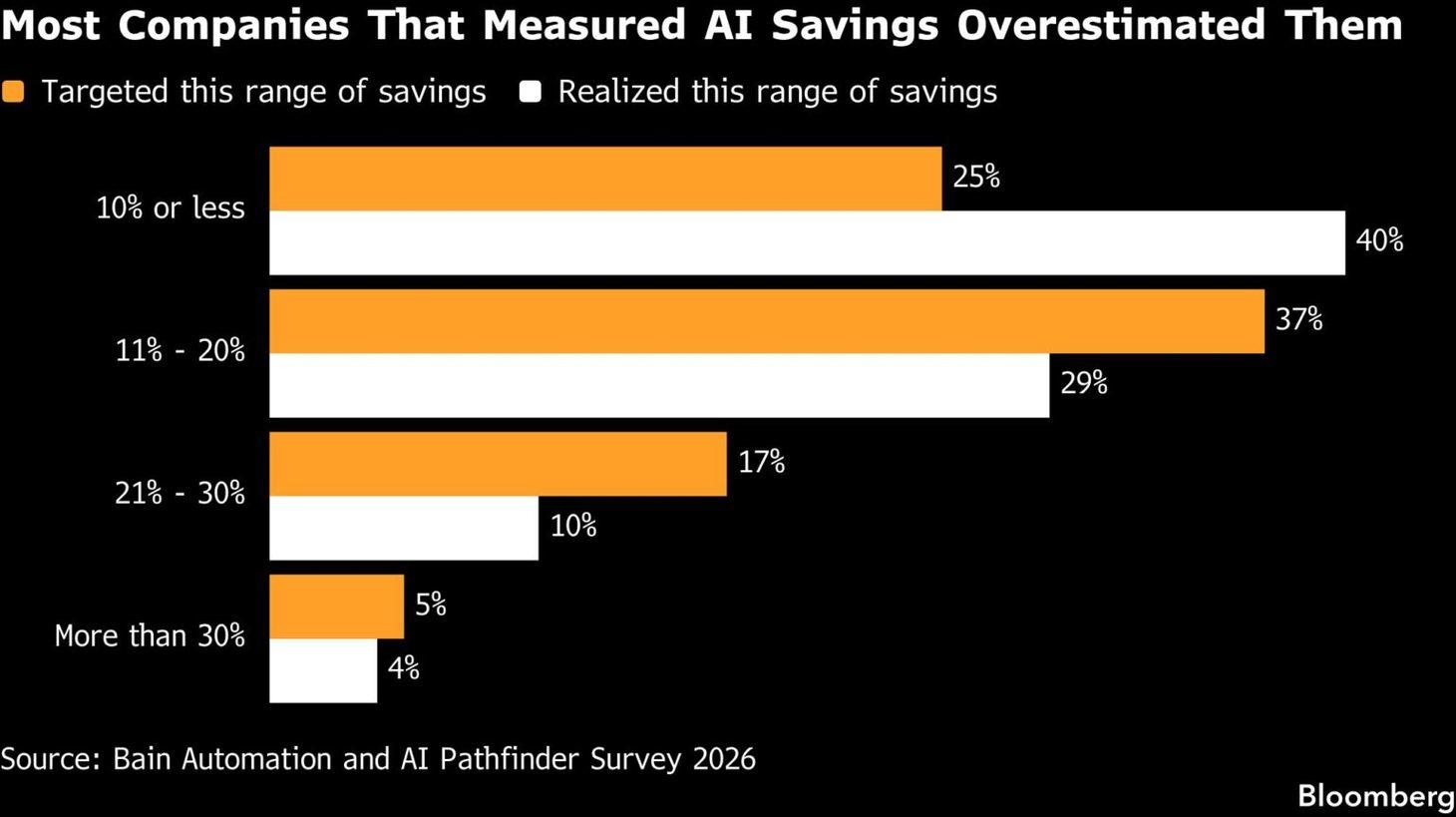
AI Savings Misses ‘Should Be Making Executives Uncomfortable,’ Bain Says
Cost savings from automation are broadly falling short of projections, according to a new Bain & Co. global survey of large companies.
The missed targets “should be making executives uncomfortable,” especially since many of them are approving increased spending for artificial intelligence on the basis of expected savings, the consulting firm said in a report shared exclusively with Bloomberg News.
“Self-funding the next wave from past returns sounds like discipline. In reality, it is a circular bet with a structural leak,” the report said.
The survey, completed in April, was based on responses from executives at 951 companies with more than $100 million in revenue, across nine sectors: retail, technology, advanced manufacturing, healthcare, consumer products, energy, financial services, telecom/media/entertainment and insurance.
State News

California’s home insurance crisis: What it means for advisors
California’s home insurance crisis unfolded gradually over the past decade, starting with catastrophic wildfire seasons in 2017 to 2018 that caused massive losses and exposed how quickly risk was increasing.
Over the next few years, insurers faced rising pressures from more frequent fires, surging construction and rebuilding costs, and higher reinsurance prices, while state rules limited their ability to raise premiums or use forward‑looking risk models.
By 2022 to 2023, this mismatch hit a breaking point: major insurers began pausing or limiting new policies and cutting back in high-risk areas, reducing the private market and making it harder for homeowners to find coverage.
“Over the past few years, the conversation in California has broadened from ‘rates are rising’ to ‘capacity is shrinking,’ explained Robert Pritula, national placement and solutions leader at Marsh McLennan Agency.
InsurTech/M&A/Finance💰/Collaboration

Pace lands $46m funding round to automate insurance workflows
Pace, an AI operations company focused on insurance workflows, has raised $46m in Series B funding as it accelerates the rollout of its agentic automation platform across global insurance markets.
The round was co-led by Thrive Capital and Sequoia Capital, with participation from Emergence Capital and Pruven Capital, as investors back the company’s ambition to scale AI-driven operational automation across the insurance value chain, according to InsurTech Insights.
Founded last year, Pace builds AI agents designed to automate insurance workflows spanning submissions, renewals, policy servicing and claims processing, positioning itself as an infrastructure layer for what it describes as an “agentic workforce” in insurance operations.
The company said its platform has already autonomously completed more than 250,000 insurance workflows, with clients including Prudential, Palomar, Convex and WTW using the technology across different parts of their operations.
Pace said the new capital will be used to expand its deployment across the US, Europe and additional international markets, with a focus on scaling to tens of millions of insurance operational tasks in 2026.
Podcast Sponsor

Audio Version - 'Connected: The Podcast' --- Sponsored by Pulse Podcasts
The ‘Connected’ Podcast by Alan Demers and in dedication of Stephen Applebaum, is a condensed audio version of the day's ‘Connected' newsletter, a daily scan of all the happenings in the world of Insurance & InsurTech News.
Pulse Podcasts: Introduce a new way for your audience to hear your voice! We are a podcast creation service that helps businesses turn their written content, like blog posts and news articles, into beautiful podcasts. Our platform writes the script, records the voices, and mixes the audio to create engaging content for your audience. It's affordable and has super-fast turnaround!
LISTEN AND SUBSCRIBE BELOW