
Climate/Resilience/Sustainability
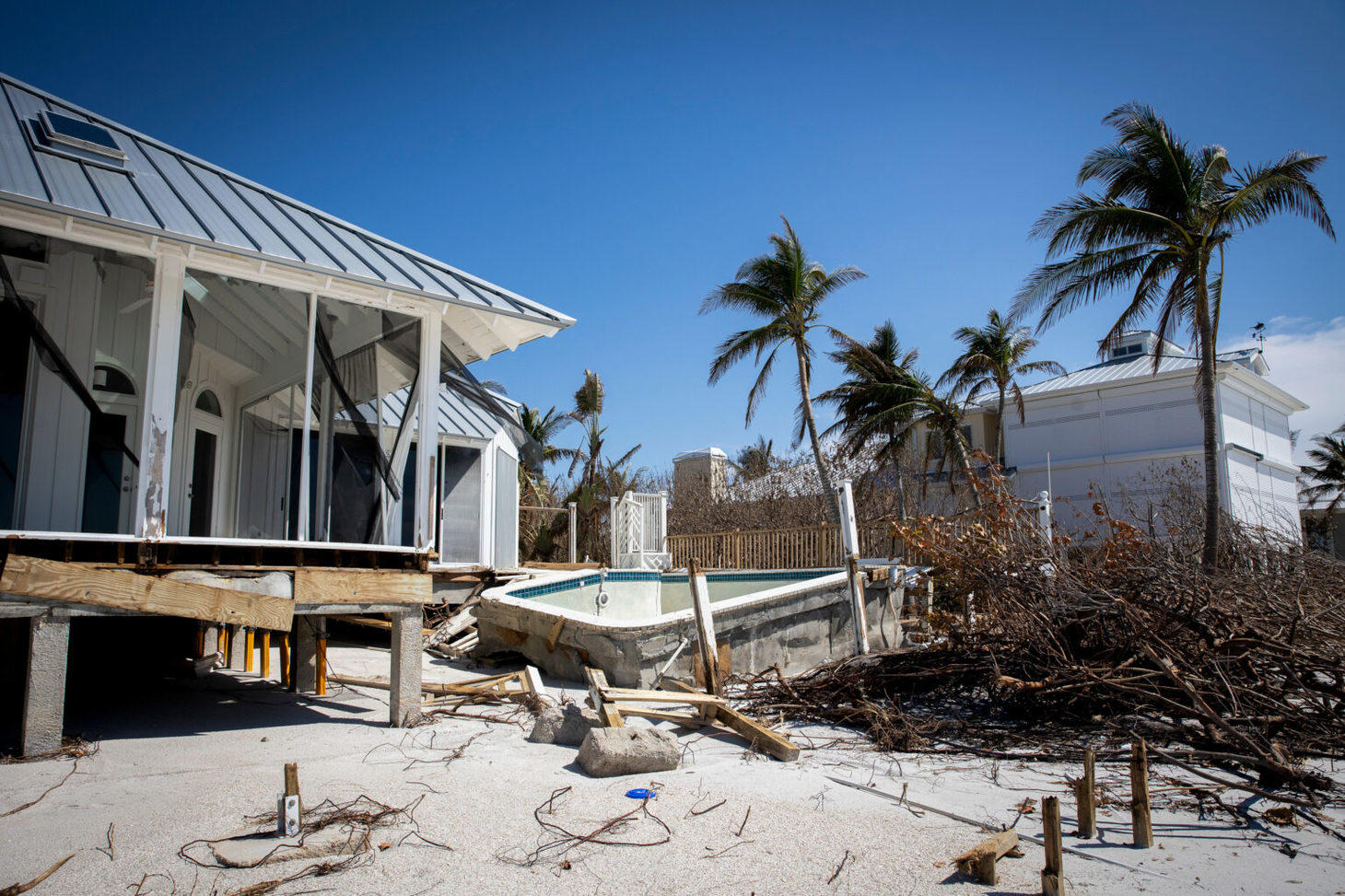
US Home Insurance Prices Set to Keep Rising With Severe Weather
U.S. home insurance premiums are set to rise for a fifth straight year in 2026 as insurers grapple with losses from extreme weather and high rebuilding costs.
The average annual premium is projected to increase 4% to about $3,057 this year, after jumping 12% in 2025, according to Insurify, an online insurance comparison site. The expected gain follows several years of steep growth in rates. Since 2021, premiums have climbed 46%, roughly three times as much as inflation, Insurify said.
In a separate analysis last year, the Consumer Federation of America said premiums rose in 95% of ZIP codes between 2021 and 2024. Over that period, the cost of coverage for a typical homeowner increased by $648 on average.
Research

Homeowners Insurance Claims Satisfaction Rises in 2026 Amid Faster Repairs and Digital Gains
Overall customer satisfaction with homeowners insurance claims has improved in 2026, even as policyholders continue to face rising premiums, higher deductibles, and increased out-of-pocket costs.
The latest J.D. Power 2026 U.S. Property Claims Satisfaction Study shows that insurers have strengthened the claims experience by reducing repair timelines, speeding payments, and expanding digital capabilities. These improvements have helped many customers offset financial pressures.
The study highlights a year shaped by both challenges and operational gains. Although customers experienced cost increases, insurers improved efficiency across the claims process. At the same time, fewer large-scale weather events, a relatively calm hurricane season, and a decline in non-catastrophic claims contributed to a more stable environment.
According to J.D. Power, overall customer satisfaction rose 20 points to 702 on a 1,000-point scale. This increase occurred despite the fact that 19% of homeowners faced a combination of premium increases, out-of-pocket expenses, and deductibles of $1,000 or more. Among this group, satisfaction averaged 606, significantly lower than the industry average.
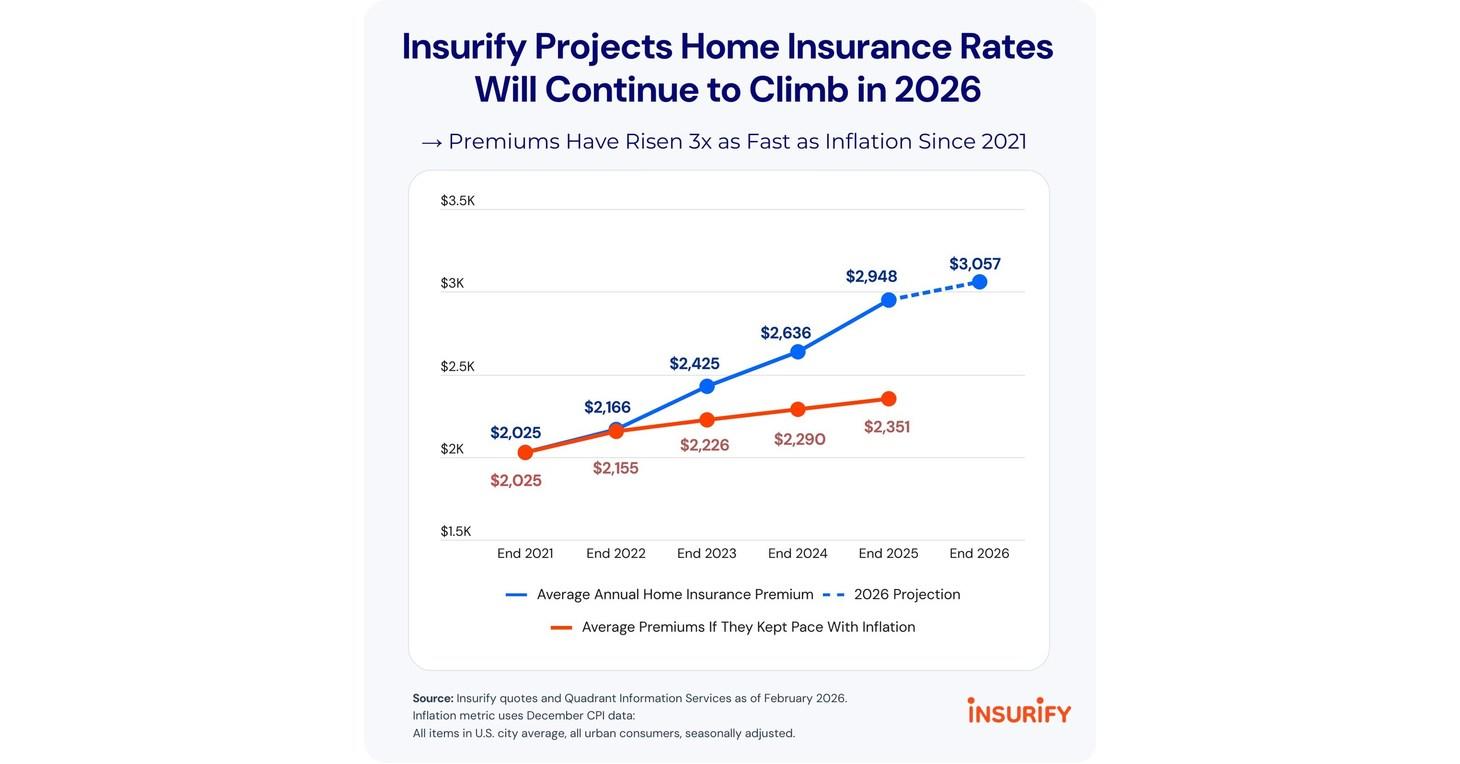
Insurify Projects Average Home Insurance Price Will Climb 4% in 2026, After Jumping 12% in 2025
Insurify, America's top-rated online insurance marketplace and leader in data-driven consumer insights, has released its 2026 Insuring the American Homeowner Report. This report incorporates Insurify's proprietary database of real home insurance quotes to assess 2025 trends and forecast 2026 outcomes.
Following four consecutive years of rising premiums, Insurify data scientists project the average annual cost of home insurance will rise another 4%, to $3,057, by the end of 2026. California will see home insurance climb the fastest, an average of 16% by the end of the year, Insurify data scientists predict.
States likely facing double-digit percentage increases in 2026 include:
- California, +15.8% (to $2,843)
- Nebraska, +13.2% (to $4,560)
- New Mexico, +10.8% (to $2,524)
- Georgia, +10% (to $3,167)
The report points to continued volatility and a deepening crisis in the home insurance market, the expanding effects of climate change on a greater number of states, and a widening affordability gap among states.
News
USAA execs saw hearty compensation growth in 2025
Before former USAA CEO Wayne Peacock made his exit in April 2025, he raked in approximately $14.1 million in total compensation from five USAA insurance companies for the year. This was a 47% increase from the $9.6 million he took home in 2024 and a 74% jump from the $8.2 million he made in 2023. It is unclear whether the $14.1 million Peacock received in 2025 included severance payments.
These executive compensation figures are part of the data USAA and other insurers who do business in the state are required to report to the Nebraska Department of Insurance. There are a total of five USAA companies that report to the NDI: United States Automobile Association, USAA Casualty Insurance Co., USAA General Indemnity Co., USAA Life Insurance Co. and Garrison Property and Casualty Insurance Co.
USAA named Juan Andrade, a board member and long-time insurance executive, as Peacock's replacement in January 2025, with him stepping into the position after Peacock's departure in April. According to the San Antonio Express-News, Andrade was listed under only one company, United States Automobile Association, and earned $332,662 in 2025, including just over $78,000 for his service on USAA's board of directors.
Financial Results
Boyd Reports Margin Growth, Returns to Same-Store Sales Gains in Q4 - Autobody News
Boyd Group Services Inc. reported a strong finish to 2025, with improved margins and a return to positive same-store sales growth in the fourth quarter, while highlighting improving demand trends and ongoing consolidation in a “highly fragmented industry of approximately 30,000 repair locations,” according to the company’s March 18 earnings release.
The results come as collision repair businesses across the industry continue to navigate fluctuating claims volume and shifting market conditions, with many shops adjusting operations in response to fewer repairable claims earlier in 2025.
Boyd posted full-year sales of $3.1 billion, up 2.4% from 2024, driven in part by contributions from 119 new locations that added $94.2 million in revenue. Same-store sales declined 0.2% for the year, which Boyd attributed partly to one fewer selling day, reducing capacity by approximately 0.4%.
Adjusted EBITDA rose 12.4% year over year to $376.3 million, while adjusted net earnings increased 28.8% to $62.4 million. Adjusted EBITDA margin expanded to 12.0% from 10.9% in 2024.
“We closed out 2025 with strong momentum, highlighted by our second consecutive quarter of positive same-store sales growth, continued outperformance relative to industry trends, margin expansion and a strengthened competitive position,” said Brian Kaner in the release.
AI in Insurance

Chubb CEO signals significant workforce reductions as AI strategy accelerates
Chubb is planning to “reduce [its] global employee population significantly” as part of a wider shift toward AI-driven operations, according to chairman and CEO Evan Greenberg.
The move, outlined in the insurer’s latest shareholder letter, reflects a broader transformation strategy focused on embedding technology, data and artificial intelligence across underwriting, claims, marketing and operations. While reductions are expected to come largely through natural staff turnover, the company said it will also continue hiring in areas such as engineering and analytics.
Greenberg described the transition as a fundamental reshaping of the operating model, with fewer roles required in some areas and increased demand in others. He added that employees who adapt to the changes will continue to have opportunities within the business, even as overall headcount declines.
Technology shift driving structural change
Chubb is investing heavily in AI, including both algorithmic tools and large language models, with the aim of improving pricing accuracy, speeding up decision-making and enhancing customer experience.

HSB Introduces AI Liability Insurance for Small Businesses
Specialty insurer HSB today introduced a new artificial intelligence (AI) liability insurance coverage that protects businesses from lawsuits resulting from the use of AI technologies.
- AI insurance protects businesses from AI lawsuits
- Includes bodily injury, property damage, advertising injury coverage
- HSB survey shows 91 percent of companies plan to use AI
- AI liability protection helps add certainty to an AI-driven world
Fills Coverage Gaps and Exclusions
Designed for small and medium-sized companies, HSB AI Liability Insurance can pay for AI-related losses that some General Liability policies exclude, including bodily injury, property damage, and advertising injury for claims stemming from AI-generated advertising, marketing, blogs, and social media.
“All types of businesses are using AI to do things more quickly and efficiently” said Timothy Zeilman, global head of product ownership for HSB, part of Munich Re Group. “At the same time, the AI transformation brings new legal and financial exposures. Business owners may wonder, am I protected? AI insurance helps remove that uncertainty by filling the gaps in coverage, so businesses can stay ahead of emerging risks.”

Gradient AI Launches Workers’ Comp Claims Triage Tool | Insurance Innovation Reporter
Gradient AI (Boston, Massachusetts) has launched ClaimVoyant, an AI-driven triage solution designed to identify complex or potentially high-cost workers’ compensation claims at first notice of loss.
The tool is intended to support property/casualty insurers, TPAs and self-insured employers by flagging claims that may involve co-morbidities or other risk factors associated with higher costs or longer recovery periods.
“Our new ClaimVoyant solution delivers powerful insights at FNOL that enables carriers, TPAs and self-insured employers to take meaningful action before a claim trajectory takes a negative turn,” says Brook Rosenbaum, General Manager, Property & Casualty, Gradient AI. “Notably, ClaimVoyant’s ease of use and flexibility allows for integration in virtually any claims handling workflow.”
According to the company, ClaimVoyant uses data captured at first notice of loss to assess claim complexity and provide recommendations for early intervention, including care management planning and staff assignment.

Getting to the How and Why: AI Shows Its Work
For years, the most pressing questions surrounding artificial intelligence solutions for insurance underwriting concerned accuracy. In a sector where margins are thin and exacting calculations non-negotiable, could AI be accurate enough to trust?
Executive Summary
With insurance sector AI solutions, explainability was once a hindrance to widespread adoption. Those days are waning thanks to next-gen models, according to Gradient AI’s Stan Smith. That question has largely been answered. Modern AI systems routinely outperform traditional actuarial and rules-based models across a range of underwriting applications. They uncover patterns humans overlook, integrate broader data sources, and continuously learn from outcomes. In terms of predictive performance, AI has arrived.
Yet adoption across insurance remains cautious and disjointed. Why? Because the hesitance involves explainability rather than accuracy. FULL ARTICLE
Telematics, Driving & Insurance

Court allows suit alleging Allstate collected and sold consumer data to move forward, dismisses portion
A federal court won’t fully dismiss a case that alleges Allstate contracted with third-party apps to collect data on drivers, and then used it when creating consumer rates.
The U.S. District Court for the Northern District of Illinois did agree to dismiss counts alleging harm for rates, if they were previously approved by a state’s governing body. However, any suits that include statutory damages will remain.
The class action suit alleges that Allstate and, Arity, owned by Allstate, secretly collected and sold trillions of miles of consumers’ driving behavior data from mobile devices, in-car devices and vehicles to build “the world’s largest driving behavior database.”
Allstate used the information to support its underwriting and coverage decisions and to profit from selling the data to third-parties, including other car insurance companies, the suit says.
According to the suit, Allstate paid developers millions of dollars to integrate software development kits (SDKs) into their apps. The insurance company also gave the developers bonus incentives for increasing the size of their datasets.
Third-party apps included Sirius XM, Routinely, Life360, GasBuddy, and Fuel Rewards, the suit alleges.
Consumer phone data was used to justify increasing car insurance premiums, denying coverage, and dropping coverage, the suit claims.
InsurTech/M&A/Finance💰/Collaboration
Jewelers Mutual® Group Launches New Digital Jewelry Insurance Program Powered by Sure
Sure, the global insurance technology leader that unlocks the potential of AI-first insurance, today announced the launch of a new digital jewelry insurance program underwritten by JM Specialty Insurance Company, a member insurer of the Jewelers Mutual® Group. Developed in collaboration with Jewelers Mutual and built to meet its specialized underwriting and coverage standards, the program reflects a modern approach to specialty insurance and is delivered end to end on Sure's configurable insurance platform.
"Specialty products like jewelry insurance require both category expertise and modern technology to deliver a great customer experience," said Wayne Slavin, co-founder and CEO of Sure. "This program demonstrates Sure's ability to power complex, regulated insurance offerings at speed and scale, while enabling carriers like JM Specialty Insurance Company to maintain full control over underwriting, pricing, and claims."
The program enables rapid launch and long-term scalability. Jewelers Mutual Group selected Sure to provide the technology foundation needed to bring its jewelry insurance product to market through a seamless digital consumer experience
Podcast Sponsor

Audio Version - 'Connected: The Podcast' --- Sponsored by Pulse Podcasts
** The ‘Connected’ Podcast by Alan Demers and Stephen Applebaum, is a condensed audio version of the day's ‘Connected' newsletter, a daily scan of all the happenings in the world of Insurance & InsurTech News**.
Pulse Podcasts: Introduce a new way for your audience to hear your voice! We are a podcast creation service that helps businesses turn their written content, like blog posts and news articles, into beautiful podcasts. Our platform writes the script, records the voices, and mixes the audio to create engaging content for your audience. It's affordable and has super-fast turnaround!
LISTEN AND SUBSCRIBE BELOW