
News

Insured losses from Iran war manageable if conflict short-lived: Moody’s - Business Insurance
The Middle East conflict is amplifying tail risks for global specialty insurers but losses are likely to be contained for large, diversified insurers if the conflict is short-lived, rating agency Moody’s said.
Moody’s baseline scenario is for the conflict to be relatively short, likely a matter of weeks, and that navigation through the currently blocked Strait of Hormuz will then resume at scale.
But longer hostilities would increase the likelihood of larger and more complex loss scenarios, Moody’s said, adding that concentration of high-value assets in the Gulf region increases the potential for loss accumulation relative to other recent geopolitical tensions, such as Russia’s invasion of Ukraine.
“While the conflict in the Middle East is increasing geopolitical and specialty insurance risks, we expect that losses are likely to be manageable for well-diversified insurers unless hostilities become more prolonged or escalate significantly,” it said.
It added that war exclusion clauses will also provide insurers with some insulation but they are likely to face legal challenges in some cases.
Moody’s said that specialty insurers are facing a higher likelihood of severe but low-frequency claims as missile and drone attacks disrupt key transport corridors in the Gulf region, including the Strait of Hormuz. Marine, aviation and political violence lines are particularly exposed, the ratings agency said.
Financial Results
Berkshire Hathaway Faces Insurance Headwinds as Underwriting Profits Decline and Reinsurance Pricing Softens
Key Points
- Berkshire Hathaway's 2025 operating earnings fell to $44.49 billion from $47.44 billion, with insurance underwriting profits declining 19.5% year-over-year to $7.26 billion due to catastrophe losses and softer reinsurance pricing.
- Insurance float grew to $176 billion by year-end 2025, and the property & casualty combined ratio improved to 87.1%, reflecting continued underwriting discipline despite volume pullbacks.
- CEO Greg Abel warned of ongoing headwinds in 2026, including decelerating rate increases, lower retention, and property reinsurance price declines driven by benign catastrophe activity and new capital inflows.
- Zacks currently rates BRK.B a Rank #4 (Sell) with a VGM Score of F, citing a 6.5% return on equity that trails the industry average of 7.3%.
Berkshire Hathaway, the conglomerate led by Warren Buffett, is navigating a more challenging insurance environment in 2026 after reporting a notable decline in underwriting profits for 2025. Full-year operating earnings came in at $44.49 billion, down from $47.44 billion the prior year, as catastrophe losses — including $1.1 billion from California wildfires — and softening reinsurance pricing weighed on results.
Despite the earnings decline, Berkshire's financial position remains formidable. Total assets reached $1.12 trillion in early 2026, insurance float grew to $176 billion, and the company maintains over $100 billion in cash reserves with minimal debt.

Liberty Mutual ‘Shifting from Fixing to Building’ in 2026, CEO Says
Liberty Mutual’s underwriting results across its businesses came in ahead of targets the company set three years ago when the business was unprofitable, the chief executive reported yesterday, also giving a sense of future strategies.
“In 2026, a key focus is shifting from fixing to building—taking what’s working and scaling it, leaning into our target segments and distribution, and growing only where returns meet our thresholds,” Tim Sweeney said on an investor conference call for Liberty Mutual Holding Company.
For the full year, Liberty reported a 55% jump in net income to $6.8 billion, with its combined ratio landing at 88.4—7.5 points lower than 2024’s 95.9 combined ratio. ARTICLE
Telematics, Driving & Insurance

How Smart Car Technology Is Changing Accident Liability and Insurance Claims - Gearbrain
A car crash used to come down to one question: who made the mistake?
Smart vehicle technology has expanded the answer in a big way. Software logs, sensor data, and automated systems now play a central role in determining fault and shaping insurance claims.
Drivers are no longer the only decision-makers behind the wheel. As cars take on more tasks, accident investigations increasingly focus on the performance of technology alongside human behavior.
Each major smart feature introduces new legal and insurance challenges. In this article, we will explore in detail exactly how smart technology, from advanced driver assistance systems to telematics, is changing accident liability and insurance claims.
How Advanced Driver Assistance Systems Affect Liability
Advanced driver assistance systems, often called ADAS, include features like automatic emergency braking, lane-departure warnings, and blind-spot monitoring. These systems are designed to reduce human error, which has long been the leading cause of crashes.
Vehicles equipped with front crash prevention systems can show meaningful reductions in certain types of collisions. Fewer crashes should mean fewer claims for you, yet when a collision does occur, insurers closely examine whether the system functioned properly.
Claims can hinge on things like whether:
A warning was ignored A sensor malfunctioned The driver misunderstood the system’s limits Manufacturers emphasize that ADAS features assist rather than replace drivers. Insurance companies may still argue that ultimate responsibility remained with the person behind the wheel.
AI in Insurance

Insurtech Providers Under Pressure To Turn AI Pilots To Tangle Business Outcomes, Report Reveals
Insurance providers are under mounting pressure to turn artificial intelligence from pilot projects into tangible business advantages, according to a fresh analysis released by CB Insights.
The latest report warns that companies failing to execute swiftly on AI could lose ground to more agile players. Major carriers such as Aviva, Chubb, and MetLife are already expanding internal AI teams, setting a higher bar for startup partners.
Meanwhile, venture funding has grown more selective, rewarding only those insurtech ventures with proven commercial progress.
Drawing on proprietary data including hiring trends, deal activity, and company maturity scores, the research spotlights three developments executives cannot ignore heading into 2026.
The first prediction centers on agentic AI systems—autonomous tools that act independently on behalf of users. For the fastest-growing startups in this space, building strong implementation teams has become non-negotiable.
Seven of the nine leading firms by hiring growth are actively recruiting roles focused on client rollout rather than pure research.
Recent funding rounds underscore this: nearly every agentic AI player except one secured capital in the past year only after demonstrating deployment expertise.

Who owns compliance decisions in automated systems?
Automation is steadily moving from the margins of financial services into its operational core. Surveillance systems flag misconduct, onboarding platforms assess risk, and AI models increasingly recommend — or even execute — compliance actions. Yet as decision-making becomes embedded in automated systems, a fundamental question is becoming harder to answer: who actually owns the decision?
For decades, accountability in financial services was structurally simple. Humans made judgments, documented them, and regulators knew where responsibility sat. Automation complicates that model.
When compliance outcomes are shaped by machine learning models, external vendors, and complex data pipelines, the chain of responsibility becomes less visible – even as regulators continue to expect clear accountability.
How firms define accountability
A question on the mind of many in the RegTech industry right now is how businesses are defining accountability when compliance decisions are partially or fully automated.
For Janet Bastiman, chief data scientist at Napier AI, responsibility still sits with the human even for fully automated decisioning, which is why we recommend human-in-the-loop approach. Regulators, she outlines, have been clear about the human accountability in frameworks even when provisioning for AI implementations in AML.
She explained, “Humans must remain in the loop because they are ultimately responsible for the decisions. AI can generate alerts, make recommendations, suggest rules and automations that better match analyst decisions, generate natural-language explanations, but these all have to be under the oversight of human responsibility.”
Claims
How Collision Repair Shops Are Responding to Fewer Repairable Claims - Autobody News
With claim counts declining and total losses rising, shop leaders are turning to market data, customer-pay work, and stronger dealership partnerships to protect volume.
With claims count declining and total losses increasing, many collision repair shops are reassessing how they generate work and maintain profitability.
During a panel discussion at the recent Collision Industry Conference (CIC), several industry leaders shared how shops are adjusting their strategies to adapt to changing market conditions.
“I spent a lot of time last year trying to figure out in my own facility how to handle some of these things,” Amber Alley, manager of Barsotti’s Body & Fender in San Rafael, Calif., said during a panel discussion at CIC. “We all hear in these meetings that you should just ask your paint company, that they can give you advice and help you with consulting, etc., so I went through that process, and they did an evaluation of my local market.”
Matt Boyd, national strategic sales manager for Axalta, the paint company Alley’s shop works with, walked through the types of information in the market report his company offers (noting that other paint companies offer something similar).
“We use it for customers to understand the market they are in, or also if they’re looking to expand into another market,” Boyd said.
The report breaks U.S. neighborhoods down into 13 “life mode” groups (based on residents’ age, education, income, lifestyle indicators, etc.), and 61 distinct segments (“high-rise renters,” “loyal locals,” “single thrifties,” etc.).
The market report for Alley’s shop indicated there are 205,000 registered vehicles, 1.88 vehicles per household on average, and an average commute time of 22 minutes. While 18,100 residents have commute times of 35 minutes or more, a significant portion of the population (51%) in this Bay Area market work from home (or at least don’t drive to work).
“So that means fewer vehicles on the road,” Boyd noted. “The total number of accidents reported is 4,143 [over a year]. Those are just reported accidents; some are not reported.” MORE
State News

State Farm reaches settlement on 17% rate hike for California homeowners
State Farm customers impacted by the 2025 wildfires in California and the 17% rate hike for homeowners insurance that followed will likely pay the same for coverage following a three-party settlement on March 6.
State Farm, the California Department of Insurance and Consumer Watchdog reached the three-party agreement in a hearing to determine State Farm's request.
"The agreement will provide financial relief to many policyholders while ensuring continued coverage for State Farm policyholders while California's insurance market stabilizes," according to the California Department of Insurance.
The settlement agreement is currently being reviewed by an impartial administrative law judge and follows months of public review and negotiation called for by California Insurance Commissioner Ricardo Lara under the state's voter-approved Proposition 103 rate hearing process.
To date, State Farm insures roughly 250,000 homes and 880,000 automobiles in LA County. The company insures over one million homes and more than four million autos across the state.
"Many Californians are worried about home insurance right now. When a home is often a family's largest investment, questions about coverage and cost can feel deeply personal," a State Farm spokesperson told PropertyCasualty360.com.
New York proposes credit score ban, zip code limits in auto insurance | Insurance Business
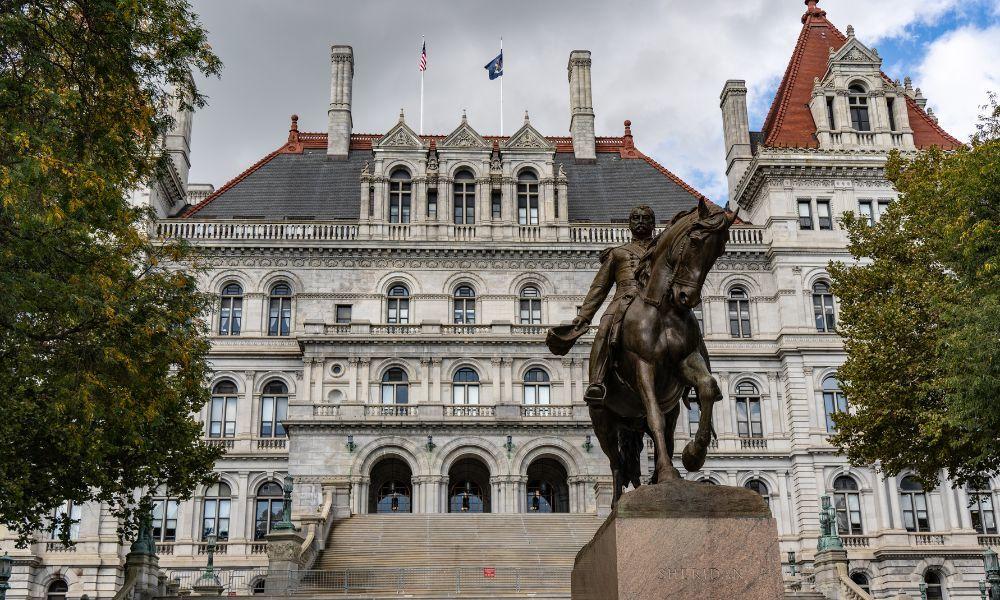
New York could ban credit scores, zip codes, and income as auto insurance rating factors under a bill introduced on March 6, 2026.
Assembly Bill A. 10524, introduced by Assembly Member Lunsford and referred to the Committee on Insurance, proposes repealing and replacing Section 2331 of New York's insurance law. The bill, titled "Motor Vehicle Insurance Fairness," would prohibit insurers from using a long list of factors that have long been staples of auto insurance underwriting and rating, including consumer credit scores, education level, the level of income or wealth, home ownership, property value, employment or occupation (with limited exceptions for business use), the absence of prior insurance, and the amount or provider of prior insurance coverage.
The bill would also restrict the use of zip codes and any territorial designation geographically smaller than a zip code in rating, unless tied specifically to auto-related crime rates or accident rates. Even where territorial factors are allowed for rating purposes, the bill caps their impact at no more than twenty-five percent of the premium that would otherwise be charged. For underwriting decisions, such as whether to sell, refuse to sell, cancel, or non-renew a policy, territory and geography would be off the table entirely.
Autonomous Driving/Insurance

Marsh and Apollo launch insurance facility for Uber autonomous vehicles
Marsh Risk, part of Marsh, and Apollo, a Skyward Group company, have launched an insurance facility for Uber Technologies to support autonomous vehicle rollouts.
The arrangement, called the autonomous vehicle insurance programme (AVIP), sits within Uber’s recently announced Uber Autonomous Solutions programme, which supports developers, fleet operators, manufacturers, owners and original equipment manufacturers globally.
The companies said the programme is intended to help partners commercialise and expand autonomous ride-hailing and delivery services across international markets through Uber’s platform and related operations.
AVIP is underwritten by Apollo’s ibott division, giving Uber dedicated capacity to provide autonomous vehicle partners with primary and excess liability cover at rates linked to safety performance.
Marsh Risk autonomous, mobility and platform risk practice leader Melissa Daly said: “Marsh is committed to enabling the growth of the autonomous vehicle sector through tailored risk and insurance solutions.
“Our work with ibott and Uber represents a meaningful step forward in delivering a scalable, cost-effective framework for AV [autonomous vehicle] risk management and accelerating the responsible deployment of autonomous technology.”
InsurTech/M&A/Finance💰/Collaboration
Agero Enters into Agreement to Acquire Urgently, for $5.50 in Cash Per Share, Expanding Tech-Driven Roadside Assistance Across Automotive, Fleet, Rental, and Insurance Markets
Agero, Inc., the leading white-label provider of digital driver assistance services and software for major automotive and auto insurance brands, today announced that it has entered into an agreement to acquire Urgent.ly, Inc. (Nasdaq: ULY) (“Urgently”), a U.S.-based technology focused provider of roadside and mobility assistance with innovative, tailored solutions within the automotive, fleet, and rental markets, for a cash price of $5.50 per share.
“We’re uniting the best ideas, technology, and talent from Agero and Urgently to create a stronger platform for the entire roadside assistance ecosystem.” -- David Ferrick, President and CEO of Agero
The acquisition brings together two industry leaders that share a vision for advancing roadside assistance through modern technology, AI, data insights, and customer-focused innovation. By combining Urgently and Agero’s operational scale, which serve over 150 million vehicles and managing 13 million events annually, the companies are creating a unified solution that will accelerate an enhanced experience for automakers, dealerships, insurance carriers, fleet operators, and the drivers they serve.
Podcast Sponsor

Audio Version - 'Connected: The Podcast' --- Sponsored by Pulse Podcasts
** The ‘Connected’ Podcast by Alan Demers and Stephen Applebaum, is a condensed audio version of the day's ‘Connected' newsletter, a daily scan of all the happenings in the world of Insurance & InsurTech News**.
Pulse Podcasts: Introduce a new way for your audience to hear your voice! We are a podcast creation service that helps businesses turn their written content, like blog posts and news articles, into beautiful podcasts. Our platform writes the script, records the voices, and mixes the audio to create engaging content for your audience. It's affordable and has super-fast turnaround!
LISTEN AND SUBSCRIBE BELOW