
News
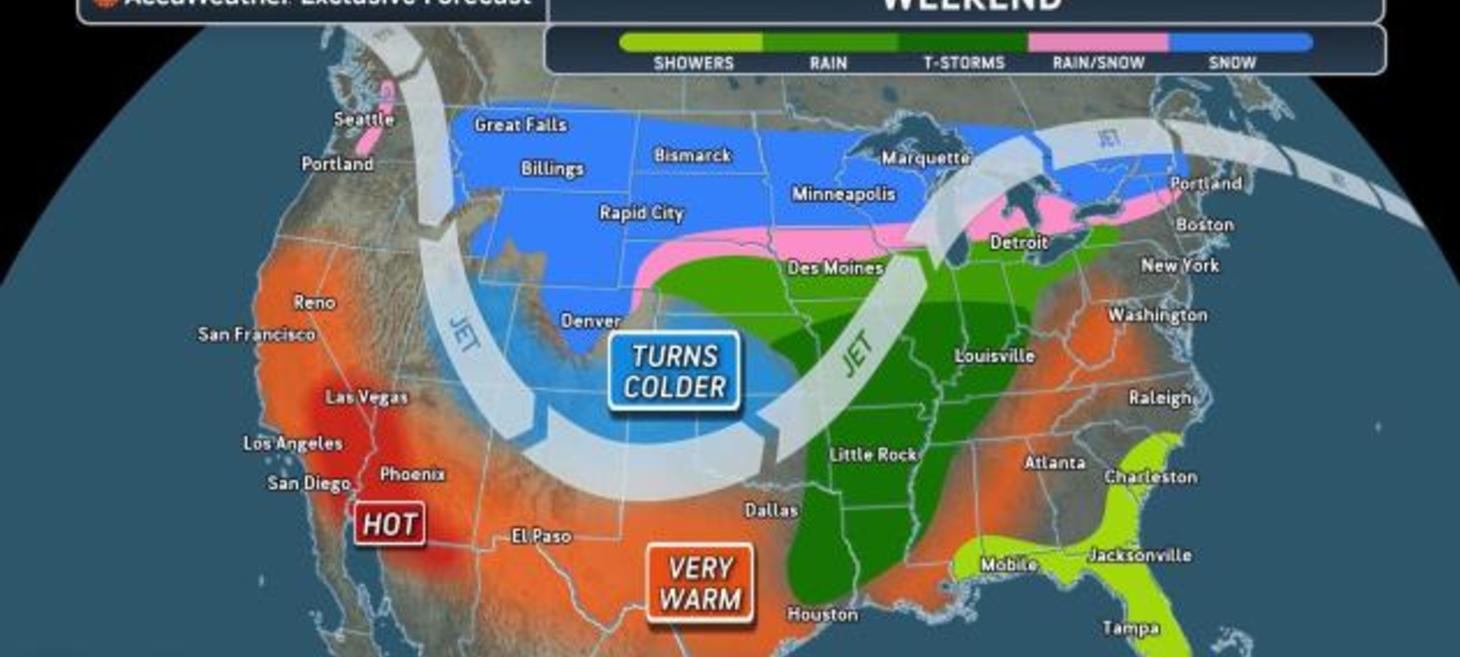
Explosive mid-March storm to impact 200 million in US, feature Midwest blizzard
A rapidly strengthening storm could evolve into a bomb cyclone, unleashing blizzard conditions in the Midwest and severe thunderstorms, flooding rain and damaging winds in much of the central and eastern United States.
AccuWeather’s Bernie Rayno warns of severe weather continuing this weekend for the Midwest from the risk of hail, high winds and flash flooding to extreme cold and snow for the North Central states.
A powerful storm will rapidly intensify and expand across the central United States from Sunday into Monday, bringing widespread disruptions for millions. Blizzard conditions and high winds are expected in parts of the Upper Midwest, while strong thunderstorms, heavy rain and gusty winds affect areas farther south and east.
The storm will rank among the top impactful U.S. weather events of the year so far.
At some point during the storm’s evolution, its wind, rain, thunderstorms, snow or cold air could impact areas home to nearly 200 million people across the central and eastern U.S.
“The storm from Sunday into Monday has the potential to become a bomb cyclone, which occurs when central pressure drops at least 0.71 inches of mercury (24 millibars) in 24 hours or less,” AccuWeather Chief On-Air Meteorologist Bernie Rayno said. “That rapid strengthening would generate an expansive and intense wind field.”

Widening insurance impact of US-Iran war: From delayed cargo to canceled Mediterranean cruises
Physical losses may still be relatively contained but the US-Iran conflict is generating a second wave of insurance exposure through delay, deviation, cancellation and aggregation risk that has become the central insurance issue. For insurers and brokers, one big supply chain focus area is what happens when assets like ships, cargo and planes are immobilised and when voyages extend in duration, or, are canceled altogether.
“The accumulation risk from prolonged disruption across ports and chokepoints is increasing,” said Lewis Hart, head of marine, Asia at Willis, a WTW business. “Particularly for clients with high asset concentrations especially around the Straits of Hormuz where maritime activity remains at a standstill.”
The shipping sector is where that pressure is most visible. Maersk has suspended reefer and dangerous cargo acceptance in and out of several Gulf markets and halted all new bookings between the Indian subcontinent and upper Gulf markets including the UAE, Bahrain, Qatar, Iraq, Kuwait and parts of Saudi Arabia. The same advisory earlier this month warned that airline cancelations and re-routing, sea-air disruption, customs delays and stricter security could all extend transit times and shift costs.
Financial Results

Generali achieves record operating result in 2025 as P&C premiums rise 7.6% - Reinsurance News
Global insurer Generali produced its best ever operating result of €8 billion for the 2025 financial year, with a strong performance in all segments, notably the property and casualty (P&C) arm which delivered a 20% year-on-year increase in its operating result to €3.7 billion.
2025 is the first year of Generali’s strategic plan ‘Lifetime Partner 27: Driving Excellence’ and the firm produced record results.
Alongside the stronger P&C operating result, the life operating result increased by 4.3% year-on-year to €4.2 billion, and the asset & wealth management operating result rose by 1.5% to €1.2 billion, partially offset by holding and other businesses operating result of -€610 million, and consolidation adjustments of -€397 million.
The adjusted net result totalled €4.3 billion in 2025, up on 2024’s €3.8 billion, as the net result rose to €4.2 billion from €3.7 billion.
Group-wide gross written premiums (GWP) increased by 3.6% to €98.1 billion in 2025, with growth of 7.6% in P&C to €36.2 billion, driven by the performance of both business lines.
Research

Business Leaders Face Major Blindspot on Risks That Could End Their Companies
Sentry survey reveals dangerous disconnect between executives' top concerns and threats that could prove catastrophic to their companies.
Business leaders are underestimating the risks most likely to permanently close their companies, despite experiencing these threats firsthand, according to Sentry Insurance’s 2026 C-Suite Stress Index Report, as reported by Risk & Insurance.
The big picture: While executives express broad optimism about 2026, a striking disconnect exists between their lived experiences with catastrophic risks and their prioritization of those threats. This gap leaves companies vulnerable to lawsuits and natural disasters that could force permanent closure.
By the numbers:
93% of executives have experienced company litigation within the past five years, yet only 17% count lawsuits among their top threats for 2026.
69% acknowledge that a single multimillion-dollar verdict could end their business.
92% of executives have experienced weather-related disruptions over the past five years, but only 32% cite natural catastrophes among their top five risks.
50% believe the next major weather event could force their company to close entirely.
Worth noting: Third-party litigation funding is adding complexity to a dangerous landscape. Two-thirds of executives view investor-financed litigation as a mounting concern in their industries, with long-haul trucking leaders expressing the most alarm.
Short-Term Rentals Pose Insurance Risks for Homeowners and Multi-Unit Dwellings | Morningstar
As short-term rentals grow in popularity, homeowners and multi-unit dwelling owners face potential insurance pitfalls. Standard homeowners insurance typically does not cover commercial activities, including renting out a property on a short-term basis.
Failing to notify insurers can result in denied claims, reduced liability coverage, higher deductibles, or even policy cancellation, according to a new Insurance Information Institute (Triple‑I) Outlook, Short-Term Rentals and Homeowners Insurance.
“It’s important for homeowners to understand the potential for coverage gaps to arise when residential dwellings are used for commercial purposes,” said Triple‑I CEO Sean Kevelighan, emphasizing the importance of proper insurance planning for anyone operating a short-term rental. “Short-term rental activity often brings higher guest turnover and greater exposure to liability, which many standard policies aren’t designed to address.”
Triple-I’s Outlook emphasizes operating short-term rentals can potentially lead to higher premiums, as insurers may view properties as higher risk due to increased guest turnover and liability claims. Additionally, owners need to comply with local zoning laws, permits and short-term rental regulations, since noncompliance can further jeopardize coverage.
For two‑ and multi-unit dwellings, operating short-term rentals can impact the shared master insurance policy, affecting all unit owners. One owner’s rental activity can increase premiums or alter policy terms for all residents, highlighting the importance of collective compliance. Homeowners are advised to notify their insurance professional, adhere to policy terms and purchase additional commercial coverage, such as specialized short-term rental insurance, to protect against rental-related risks.
Commentary/Opinion

Building Insurance’s Next-Generation Workforce
Insurers must blend technical expertise with technology, adaptability, and purpose-driven leadership to build their future hybrid workforces.
Key Takeaways:
- Insurers must prioritize digital and AI fluency, adaptability and diverse thinking to meet rapidly evolving industry demands.
- Building the workforce of the future demands a blend of new and existing talent and requires pockets of transferable skills to be optimized, creating industry futurists or change orchestrators in addition to industry practitioners.
- With 43% of today’s tasks set to be automated by 2030, organizations now require talent models that can anticipate change, accelerate capability building and support long-term resilience.
Today, profitable growth in insurance is driven by more than just market share — it requires building adaptable, high-performing teams that can respond to changing risks, regulations, and client needs. Insurers that outperform are those who align talent strategies with business goals, investing in technical, digital and AI fluency, and leadership capability while fostering a culture of agility and continuous learning to sustain performance throughout the market cycle.
With 97% of insurers accelerating automation — one of the highest rates across any sector — technology is now one of the biggest disruptors in insurance, redefining what it means to compete for talent. Insurance leaders are accelerating capability building to keep pace with digital disruption, but recruitment alone cannot close the gap. The industry is in urgent need of individuals who possess a blend of behavioral and technical abilities to better underwrite and provide relevant cover to customers. While there are some exceptions, it’s clear that the insurance industry, compared to sectors like banking, tech and life sciences, needs to step up its readiness and investment game.
Why experts are calling this the ‘golden age’ of underwriting
Advancements in technology are ushering in what experts on a recent InsTech panel have dubbed the “golden age of underwriting,” a period expected to be marked by greater speed, efficiency and managing general agency activity.
“I think now, with the evolution of technology, that we can move into this golden age because the technology allows, especially underwriters, to have systems that they can use and be effective with,” Matthew Twist, chief risk officer and commercial director at Concirrus, said during the webinar.
However, he underscored that the industry hasn’t hit that golden peak just yet, noting that there are still more challenges to address before insurance can get there.
“If we’re going to talk about the golden age of underwriting, we must be realistic about where we are today. And if we’re in an industry where very skilled and capable people are keying in information into a system and then into another system and potentially another system after that, are we really in the golden age? Probably not,” he said.
His fellow panelists agreed and emphasized the need for dialogue between IT and underwriters in the field to ensure technology is not only developed in a meaningful way but also that uptake is encouraged on an individual level.

POLICY CHECK - Insurance News
Your house isn't just a place to hang your hat — it's also one of your most valuable financial assets.
That's why homeowners without enough insurance can face financial ruin when disaster strikes and they find themselves suddenly homeless and unable to rebuild.
The problem is widespread. Emily Rogan, senior program officer for United Policyholders, says underinsurance has been a problem in every disaster the nonprofit consumer advocacy group works on.
"People are surprised to find out that what they've been paying for isn't enough to rebuild their home after a major loss," Rogan says.
For example, 74% of those who filed insurance claims after the Marshall Fire — a costly wildfire that swept through the Boulder, Colorado, suburbs in December 2021 — didn't have enough homeowners insurance to fully replace their home. Researchers at the University of Colorado found these homeowners were underinsured by an average of $139,000.
The study, "Coverage Neglect in Homeowners Insurance," analyzed nearly 5,000 affected policyholders and concluded that many homeowners buy the amount of coverage their insurer suggests, which often isn't enough. Most people who lost their homes in the Marshall Fire had not begun to rebuild more than a year later.
AI in Insurance
Reinventing Insurance: The Second Gilded Age
We are entering what increasingly looks like a Second Gilded Age.
LinkedIn Blog: Mick Moloney Partner, Global Head of Insurance & Asset Management and Managing Partner, Actuarial at Oliver Wyman
The acceleration in AI infrastructure—data centers, transmission, grid access, energy procurement—has prompted me to revisit four books that together describe how industrial power formed, consolidated, and was ultimately regulated during America’s first Gilded Age in the late 1800s and early 1900s.
The AI buildout increasingly appears to be following a similar arc, and the parallels are worth considering.
Not because history repeats neatly, and not because AI is simply “the new internet,” but because the underlying pattern increasingly looks familiar: a new industrial system is being built around scarce physical bottlenecks, enormous capital needs, emerging concentration of power, and a regulatory structure that will almost certainly arrive after the architecture is already set.
That was the logic of the first Gilded Age.
Cornelius Vanderbilt controlled the arteries of commerce. John D. Rockefeller stabilized and integrated the critical input. J.P. Morgan organized capital at system scale. Theodore Roosevelt arrived when concentrated private power had become too economically and politically important to ignore.
Claims

P&C claims are changing faster than they have in 30 years | Deloitte Canada
How can Canadian insurers adapt to 6 game-changing trends to stay competitive? New customer experiences, open standards, AI, and cloud technologies are transforming how insurance claims are filed, processed, and settled. Here’s what Canadian P&C insurers should be doing right now—and why it matters.
Key takeaways
- Claims functions are becoming seamless, fast, and AI‑enabled—compressing cycle times, reducing leakage, and improving the policyholder experience when it matters most.
- Surge readiness is now a core capability, not a contingency plan. Cloud and automation are essential to protecting both customers and the combined ratio during volatility.
- Talent strategy is business strategy. Automation isn’t replacing expertise—it’s refocusing it where judgment, negotiation, and experience create the most value.
How policyholders interact with insurers when filing and settling claims will soon be unrecognizable. Property and casualty insurers’ claims functions are transforming faster than at any point in the last 30 years, driven by rising loss costs, climate volatility, fraud, talent shortages, and digital‑first customer expectations.
Predict & Prevent
Insurance Companies Have a New Product: Not Needing Them
When a State Farm policyholder in Texas plugs a small sensor into their electrical outlet, they probably think little of it. But that device, made by Whisker Labs under a program called Ting, is part of a change in how American insurers think about their business.
State Farm claims it has now placed those sensors in more than 1 million homes across 45 states, monitoring for electrical arcing that can trigger house fires. The goal is to make sure the claim never happens in the first place.
Scott Holeman of the Insurance Information Institute, a nonprofit that tracks insurance industry data and trends for consumers, businesses, and policymakers, says the shift is already underway.
Building the Prevention Machine
"U.S. insurers are increasingly using AI to shift from a traditional 'detect and repair' model, where claims are handled after an accident, to a more proactive 'predict and prevent' approach," Holeman said to AIM Media House.
Some insurers are already producing results they can measure. The Whisker Labs program is one example.
A July 2025 study by Triple-I, Whisker Labs, and Octagram Analytics found the Ting sensor program reduced annual fire damage claims by $81 per home and cut non-catastrophic fire claims by an estimated 63%.
Recommended Events

Scout Expands to Pittsburgh
We’re bringing Scout to Pittsburgh!
On April 15th, we’re bringing together leading insurance professionals from across P&C, Health, Life, and Benefits, along with founders and innovators shaping the future of the industry.
No panels. No pitches. Just a room full of people building relationships and talking about where insurance is going.
When: April 15, 4:00-6:00pm
Where: Elly’s, Carnegie, PA
This VIP event is hosted by Kurt Keller, Joshua Linton and an emerging group of leaders native to the Pittsburgh area.
Complimentary, but spots are limited. Register here: