
News
US P&C industry sees decade-high performance in 2025, AM Best reports
The United States property and casualty (P&C) insurance sector recorded its strongest performance in ten years in 2025, driven by disciplined underwriting, robust pricing and investment gains, despite ongoing pressures from claim costs and liability exposure, according to credit rating agency AM Best.
In its annual Review & Preview Best’s Market Segment Report, **“Rate Action and Investment Gains Drive US P&C Industry Results Despite Headwinds,” **AM Best notes that momentum in pricing and investment income across principal lines allowed net underwriting income for the P&C segment to more than double year-on-year to an estimated $39 billion, even after significant first-quarter losses due to California wildfires and other weather-related events.
The combined ratio is projected to improve to 95.0 in 2025 from 97.1 in 2024. AM Best cautions, however, that stabilising or softening rate trends across most major lines could weigh on underwriting results in 2026, and a severe catastrophe could produce worse outcomes.
The personal lines segment remained strong, with private passenger auto and homeowners’ lines maintaining favourable trends. Within commercial lines, workers’ compensation and commercial property underpinned underwriting profitability, helping to offset weaker results in commercial auto, general liability, including umbrella and excess coverage, and medical professional liability.
Best’s Special Report: U.S. Economy Grows Despite Emerging Headwinds
The U.S. economy entered 2026 from a position of relative strength, continuing to outperform most advanced economies in 2025, a theme that is expected to persist in the coming year, according to a new AM Best report.
According to the Best’s Special Report, “U.S. Economy Grows Despite Emerging Headwinds,” International Monetary Fund projections indicate that the country’s real gross domestic product growth will rise slightly to 2.4% in 2026, compared with 2.1% last year. By comparison, growth across advanced economies as a group is expected to improve only marginally, from 1.7% in 2025 to 1.8% in 2026, underscoring the United States’ comparatively stronger growth outlook and fundamentals.
“Growth dynamics in 2025 were uneven, in part impacted by trade tensions earlier in the year and the government shutdown towards the end of the year,” said Ann Modica, director, AM Best. “Additional headwinds included the tightening of trade conditions, elevated levels of fiscal and policy uncertainty, and slower population and labor force growth.”
Despite these headwinds, the near-term risk of a recession in the United States remains limited. Personal consumption remains the primary engine of U.S. economic activity, accounting for nearly 70% of GDP. In recent years, household spending has been supported by a combination of unprecedented fiscal stimulus, moderating inflation, positive real wage growth, elevated household net worth linked to equity and housing markets, and still-solid labor market conditions.

Soft Market Emerges as Commercial Insurance Premiums Flatten in Q4 2025
Capacity, competition and favorable loss ratios signal major shift across most lines of business, according to CIAB Q4 2025 Market Index.
The insurance market has entered a pronounced soft phase, with commercial property and casualty premiums rising just 0.2% on average in the fourth quarter of 2025, a dramatic deceleration from the 1.6% average increase in Q3, according to The Council of Insurance Agents & Brokers’ Q4 2025 Market Index
Softening conditions manifested across nearly every segment of the market in Q4, according to the report. Nine lines of business—including commercial property, cyber, and workers’ compensation—recorded premium decreases. This represented a notable expansion from just six lines showing declines in the previous quarter.
Two Lines Bucking the Trend
Despite the broader softening, commercial auto and umbrella coverage continued to defy market pressures, the CIAB said.
Commercial auto premiums increased 6.6% — the highest among all lines — marking the 58th consecutive quarter of increases dating back nearly 15 years. Analysis from AM Best revealed that the average commercial auto claim cost more than doubled between 2015 and 2024, rising annually at rates around 8% — nearly triple the overall economic inflation rate. These mounting claim frequencies and severities, driven by social inflation and elevated jury verdicts, continued to constrain carrier capacity and support premium growth for commercial auto, the report said.
Research

5 Key takeaways from 2025's insured losses
In 2025, global catastrophes caused about $224 billion in economic losses and roughly $108 billion in insured losses.
It was the sixth year in a row that insured losses were more than $100 billion. But 2025 insured losses were about 25% lower than they were in 2024.
Lower losses were due mostly to the fact that no hurricanes made landfall in the United States last year. But that also means that losses from "secondary" perils like wildfires and severe convective storms helped close the gap.
For example, the United States accounted for 80% of global insured losses, due largely to the LA wildfires and losses from severe convective storms.
Announcements
Floodbase and Liberty Mutual launch instant parametric flood quoting capability for US commercial market
Floodbase, the leading platform for insuring flood risk, and Liberty Mutual (Liberty) announced the launch of an instant quoting application for parametric flood (re)insurance in the US. This solution allows wholesale and retail brokers to price parametric flood covers in minutes, removing friction and introducing the speed required to serve the high-volume small to midsized commercial market more effectively. Designed specifically for the US market Liberty's pricing engine, powered by Floodbase Platform's new API, revolutionizes a traditionally time-consuming and demanding quoting process to deliver the speed and consistency that distributors need.
Large-area parametric flood covers have reached a point of product maturity, with policies now transferring the risk of economic loss at global scale for US Municipalities, Colombian Farmers, CEI's nation-wide distributed property portfolio in Italy, and more. As the US demand for comprehensive flood risk management grows – driven by more frequent and intense flood events, rising National Flood Insurance Program premiums, and uncertainty around federal flood insurance – parametric flood is increasingly viewed as a viable complement to traditional property coverage, while also covering non-damage business interruption financial losses.
US flood risk continues to outpace private market capacity. Two-thirds of modelled US flood losses go underinsured1, underscoring the need for scalable private options alongside traditional indemnity coverages. While originally constrained by basis risk and product standardization, the primary limitation today is scalable distribution.
Financial Results
Kin FY 2025 Revenue Climbs 29% to $201.6 Million; Baseline Operating Margin Reaches Record 49%
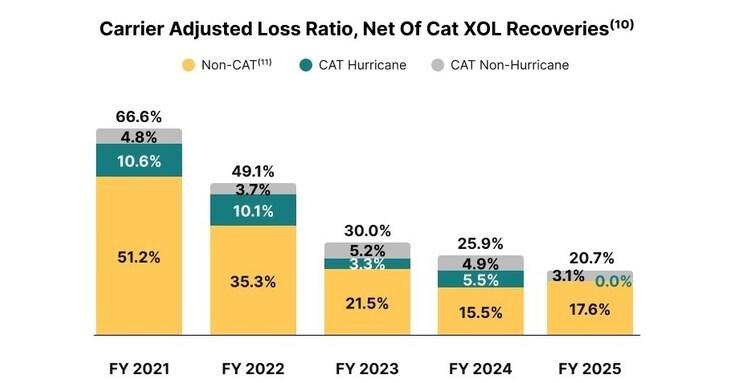
Kin delivered robust growth in 2025, ending the year with $634.4 million in Gross Written Premium, and Total Revenue of $201.6 million, an increase of 29% over 2024 revenue. This top-line growth, combined with ever-increasing operating leverage enhanced by Kin's AI- and ML-enabled technology, drove Baseline Operating Income to $68.6 million, up 116% year-over-year.
"We grew revenue three times faster than we grew our fixed expense base, which drove our annual Baseline Operating Margin to a record 49%," said Kin Founder and CEO Sean Harper. "We aren't trying to find our way to profitability. Our core engine is already highly profitable. We are actively choosing to spend our operating income investing in our technology moat and acquiring more customers while others pull back."
Kin achieved 29% annual revenue growth in a market environment where many insurance distributors are finding it harder to grow. "In 2025, it was a bit harder to attract new customers than it was in 2024. That's just where we are in the insurance cycle with a softening market. Fortunately, our high baseline operating margins allowed us to increase marketing spend to ensure a fast growth rate, while still nearly doubling our overall operating profit," said Harper.
"Despite a more competitive environment, we chose to proactively capture market share," said Kin CFO Jerry Fadden. "Kin benefits from strong core unit economics — evidenced by our 94% Gross Profit Margin — and we continued to acquire high-LTV customers even at a higher initial cost. We are deliberately spending more on new revenue now because we know that with our strong customer retention, the long-term return is highly accretive to our margins."
Kin's evolution was marked by product expansion in 2025. In Q3, the company launched auto insurance in Texas and home financing in Florida. And, in Q4, Kin launched auto insurance in its largest market, Florida.
AI in Insurance

Insurers look beyond efficiency to risk management in AI use
Insurers are shifting their investments in artificial intelligence from automation and efficiency toward smart tools that can identify risks and prevent losses.
They are using AI to scan public social media feeds for red flags, such as sparklers and free alcohol at bars and restaurants, and to analyze high-resolution aerial imagery to flag emerging hazards such as roof ponding and newly installed solar panels on properties, experts say.
Zurich Insurance is investing in AI tools for risk management and loss prevention, said Amy Nelsen, New York-based head of underwriting operations, U.S. middle market at Zurich North America.
Last year, the insurer partnered with Nearmap, a provider of property and location intelligence, to integrate AI-powered data and property insights directly into its U.S. middle-market underwriting platform.
Underwriters use the technology to access regularly updated property details such as high-resolution aerial imagery, roof condition scores and signs of deferred maintenance, Ms. Nelsen said.
The tool identifies potential areas of concern for underwriters, she said. “It gives us that really early view” of a risk, she said.
Underwriters may recommend that policyholders take specific actions to remedy conditions and prevent potential losses, and policies and deductibles can be structured more accurately, she said.
“It also tells us the positive story about a property that looks really good, where the insured’s taken good care of their property and should benefit from having nice exposure results,” Ms. Nelsen said.
InsurTech/M&A/Finance💰/Collaboration

Convr® and Ohio Mutual Insurance Group Announce Partnership and New Ways to Automate Underwriting
Convr®, the leading provider of artificial intelligence solutions for commercial insurance, announces a new partnership with Ohio Mutual Insurance Group (OMIG) to offer an advanced underwriting workbench solution that streamlines underwriting decisions. The partnership reflects a strong alignment in values and a shared approach to execution.
Ohio Mutual turned to Convr to move beyond legacy, siloed tools—embracing what they describe as the most advanced and visionary platform available today. One of the biggest appeals to OMIG was Convr's centralized repository that could accommodate their unique underwriting needs and align with their vision for the future of underwriting. The specialty insurer is utilizing modules within Convr's end-to-end underwriting workbench to automate their underwriting including the following:
Intake ingests, splits, classifies, and prioritizes precise data from structured and unstructured documents in PDF, Excel, Word, email, etc. formats to automate and enrich clearance, rating, and/or loss analysis workflows.
Risk 360 is a new and better way to capture business insights from thousands of public, private and/or customer preferred data sources and digital artifacts. Convr prioritizes the most relevant and accurate information in minutes.
Convr AI Generative and Deep Learning Models are assistive to users helping customers perform their workflow tasks with greater ease, improving productivity.
"Convr enables underwriting teams to efficiently and effectively do their work, empowering them to provide a truly tailored accurate offering to their customers," said John Stammen, Chief Executive Officer at Convr. "By enabling Intake and Risk 360 within the Convr Underwriting Workbench along with Convr, Ohio Mutual will deliver an even greater experience to their customers."
Fraud

Allstate fires RICO lawsuits against alleged no-fault DME fraud
Allstate is going after alleged no-fault fraud rings in New York with twin federal RICO lawsuits.
The insurer filed two separate actions on February 19, 2026, in the US District Court for the Eastern District of New York, accusing ten durable medical equipment companies and nine individuals of running separate but similar schemes to exploit the state's No-fault auto insurance system. No final determination has been made in either case.
The allegations paint a familiar but troubling picture for the industry. According to the filings, the defendants formed DME supply companies for the alleged purpose of defrauding insurers, then entered into kickback arrangements with No-fault medical clinics across the New York metropolitan area. Those clinics, the suits claim, churned out identical prescriptions for expensive rental equipment to virtually every patient who walked through the door, regardless of what their injuries actually required. MORE
People

Carpe Data Names Shapiro Chairman of Board
The insurance claims executive joins as the company marks its 10th anniversary and expands its data-driven claims offerings.
Carpe Data (Santa Barbara, Calif.) has appointed Glenn Shapiro chairman, board of directors, as the company enters its next phase of development.
Shapiro brings more than three decades of senior claims leadership experience at U.S. carriers. Carpe Data says his background in claims transformation and analytics will support the company’s continued focus on technology-enabled claims management.
“Carpe Data has been at the forefront of modernizing the claims processes, and the opportunity ahead is even greater,” says Glenn Shapiro. “I’ve seen first-hand how insurers are under immense pressure to deliver faster, fairer, and more consistent outcomes for customers. Carpe Data’s technology gives them a meaningful edge.”
Shapiro previously served as president, Allstate Insurance Company, where he oversaw digital transformation initiatives and expanded automation across complex claims workflows. He has also held leadership roles at Liberty Mutual Insurance, Safeco Insurance and Hartford Life.
Podcast Sponsor

Audio Version - 'Connected: The Podcast' --- Sponsored by Pulse Podcasts
** The ‘Connected’ Podcast by Alan Demers and Stephen Applebaum, is a condensed audio version of the day's ‘Connected' newsletter, a daily scan of all the happenings in the world of Insurance & InsurTech News**.
Pulse Podcasts: Introduce a new way for your audience to hear your voice! We are a podcast creation service that helps businesses turn their written content, like blog posts and news articles, into beautiful podcasts. Our platform writes the script, records the voices, and mixes the audio to create engaging content for your audience. It's affordable and has super-fast turnaround!
LISTEN AND SUBSCRIBE BELOW