
Research
Sentry survey: More than half of executives are optimistic about the year ahead, while 60% report higher stress than last year
The 2026 C-Suite Stress Index Survey by Sentry®, one of the largest and most financially secure mutual insurance groups in the United States, shows that while more than half of business leaders are more optimistic about their businesses' survival and growth this year, many feel under greater stress than last year.
According to the research, more than half (54%) of U.S. executives are confident their company will survive—and thrive—in 2026, but 60% report feeling more stressed than last year.
Lawsuits impacted 93% of businesses in the last 5 years. 69% of leaders say one large verdict could close their doors.
The survey of 1,250 business owners, CEOs, CFOs, and Chief Risk Officers at U.S. companies, conducted by Wakefield Research on behalf of Sentry, revealed while many executives are focused on perceived threats, many are overlooking key risks that could shutter their businesses for good.
TOP BUSINESS RISKS FOR 2026 Executives cited among top business risks in 2026 supply chain or logistics challenges (45%) and economic pressures (44%). They also are concerned about tariffs and trade uncertainty (39%), labor shortages (38%), rising employee healthcare costs (38%), and cyberattacks (37%).
"Our research reinforces the same concerns expressed by our policyholders as they head into 2026," said Jeff Cole, AVP of National Accounts at Sentry. "These concerns may be having a direct impact on decision-making. For example, we're noticing a reduction in payroll growth, which is a strong indicator of the concern about what 2026 may bring."
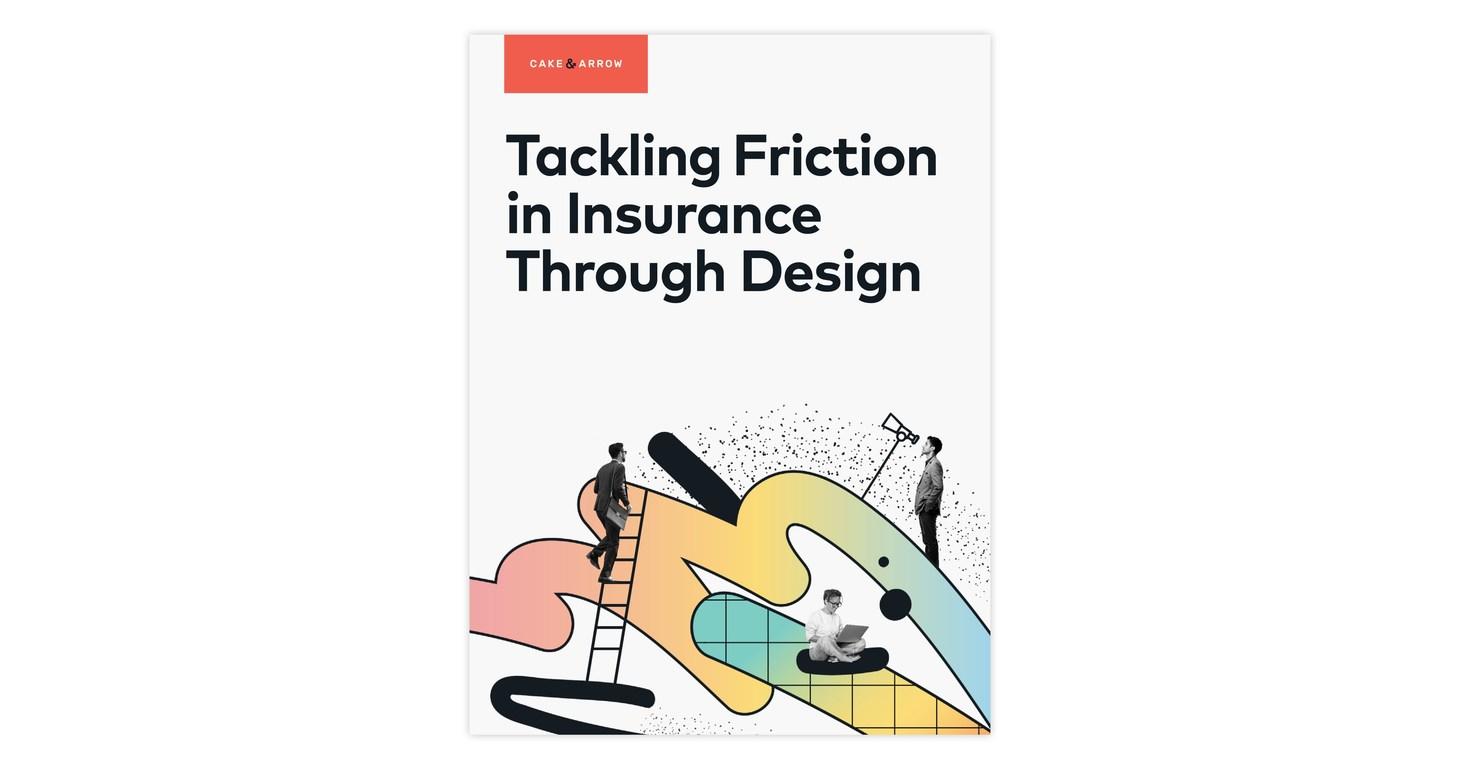
Cake & Arrow Releases New Industry Report on Tackling Digital Friction in Insurance Through Design
Cake & Arrow, an experience design and product innovation agency focused exclusively on insurance, today announced the release of Tackling Friction in Insurance Through Design, a new industry report exploring why digital experiences across insurance are still fragmented, confusing, and difficult to use.
While the broader digital world has spent decades optimizing for "frictionless" experiences, insurance continues to grapple with complexity across customers, agents, brokers, underwriters, employers, and internal teams. The report draws on Cake & Arrow's two decades of experience designing within the insurance industry to examine how friction shows up, and what to do about it.
Rather than positioning friction as a simple UX problem, the report outlines three systemic patterns that commonly emerge in insurance experiences:
Role friction occurs when multiple user types share the same system, but roles, permissions, and responsibilities aren't clearly defined. Offering friction emerges when related products and services are delivered through disconnected systems, making bundled coverage feel siloed instead of cohesive. Mission friction arises when a platform is pulled in competing directions by internal priorities, leaving users unclear about what the system is designed to help them accomplish.
"In insurance, friction doesn't just slow people down, it compounds," said Josh Levine, CEO and Founder of Cake & Arrow. "When platforms don't reflect how people actually work, collaborate, or make decisions, users create workarounds. Email threads replace workflows. Spreadsheets replace systems. And complexity keeps growing.
Financial Results

Premium Slowdown, Inflation Factors to Lead to Higher P/C Combined Ratio: AM Best
Success for the property/casualty industry in 2025 was marked by rate increases and investment income, but plateauing or softening rates in many lines of business may pressure financial results in 2026, said AM Best.
In a new report, the insurance industry financial rating analyst said it expects lower net premium growth in 2026 and has predicted that P/C industry combined ratio will increase 1.9 points to 96.9.
“Macroeconomic headwinds, including rising claims costs attributable to higher prices of materials required for home, commercial property and auto physical damage repairs, will likely lead to a slightly higher industry loss ratio,” Jacqalene Lentz, senior director at AM Best, said in a statement.

Hippo Reports Fourth Quarter 2025 Financial Results
Hippo Holdings Inc. (NYSE: HIPO), a technology-native insurance platform driving growth across owned and partner MGAs, announced its consolidated financial results including diluted earnings per share of $0.23 and diluted adjusted earnings per share of $0.67 for the quarter ended December 31, 2025.
2025 Full Year Highlights
- Gross Written Premium increased 24% to $1.1 billion over 2024
- Net Written Premium increased 13% to $422 million over 2024
- Net Income attributable to Hippo of $58 million compared to a Net loss of $41 million in 2024
- Adjusted Net Income attributable to Hippo of $18 million compared to an Adjusted Net loss of $20 million in 2024
- Net Loss Ratio improved 17 percentage points to 60% compared to 2024
- Combined Ratio improved 25 percentage points to 113% compared to 2024
"We closed 2025 with strong momentum, evidenced by our 40% gross written premium growth, positive net and adjusted income, and an underwriting profit in the fourth quarter," said Rick McCathron, Hippo President and CEO. "Looking ahead to 2026, I am excited about Hippo's prospects for increased diversification, strong growth, and continued improvement in profitability. This progress reflects our team's efforts over the last several years, and is exemplified most recently by the relaunch of our homeowners business outside of builders with select partners. Together, these developments reinforce our confidence in achievement of our targets of over $2 billion of gross written premium and over $125 million of adjusted net income by the end of 2028."
Hiscox Re's profit rises as combined ratio strengthens to 67.4% in 2025 - Reinsurance News
Hiscox Re, the reinsurance business and third-party capital platform of specialist insurer Hiscox, generated profit before tax of $286.7 million in 2025, an increase of 7% on the prior year, as the segment’s undiscounted combined ratio strengthened to 67.4%.
The global specialty insurer’s reinsurance arm delivered insurance contract written premium (ICWP) of $1.094 billion in 2025, an increase of 6% on the prior year’s $1.032 billion, driven by net growth and increased third-party capital support. Net ICWP rose by 8% year-on-year to $538.7 million, with growth in pro-rata and specialty lines, including parametric climate resilience, mortgage and surety.
Hiscox Re’s insurance service result increased to $189.4 million in 2025 from $165.7 million in 2024, as the undiscounted combined ratio strengthened by 1.6 percentage points, aided by a benign second half of the year in terms of natural catastrophe losses.
Throughout 2025, Hiscox Re saw rates decline by 5% amid heightened competition, notably in property catastrophe, although importantly, “attachment points and terms and conditions remained broadly stable.” At year-end 2025, cumulative rate increases since 2018 were 83%.
AI in Insurance

AI reshapes insurance hiring as job openings hit decade low
New data shows artificial intelligence and technology transformation are definitively reshaping hiring behavior in insurance and across the broader financial sector.
In a new Insurance Labor Market Study conducted in Q1 2026 by The Jacobson Group and the benchmarking division of Aon’s Strategy and Technology Group, around half of carriers said they plan to increase headcount over the next 12 months. However, job openings in finance and insurance have dropped to their lowest monthly level in a decade.
During a webinar presenting the findings, Jeff Rieder (pictured on the left), partner and head of benchmarking at Aon’s Strategy and Technology Group, noted that the average monthly number of finance-related job openings fell sharply between 2022 and the end of 2025. While the annual average sat at 281, by December it had fallen to roughly 138 – the lowest monthly level seen in 10 years for finance roles, including banking and wealth.
“We’ve really seen a large divergence that started back in 2023," Rieder said. "While 72% of companies expect to grow revenue, we’re at near-record lows in terms of those expecting to increase employee numbers. The only time it’s been lower for those expecting to increase employees was back in 2011.
“I really do think this might be an indication of how AI is starting to influence many of these activities and how companies are thinking about hiring.”

Most Companies See AI Benefits, But ROI Timeline Stretches Into 2028 -
Gallagher's latest survey reveals AI adoption is accelerating, yet skills gaps and governance shortfalls threaten to slow the realization of returns.
Companies are rapidly implementing AI and seeing productivity gains, but expect to wait more than two years for meaningful financial returns, according to Gallagher’s 2026 AI Adoption and Risk Survey, as reported by Risk & Insurance.
The big picture: The shift from AI experimentation to operational deployment reveals a longer, more complex transformation process than many businesses anticipated.
While most companies surveyed report positive impacts on productivity and revenue, the reality of embedding AI into workflows requires significant upfront investment in technology, skills and governance that delays payback. By the numbers:
- 63% of organizations have now operationalized or adopted AI across parts of their business — up from 45% in 2025 and 34% in 2023.
- 28 months is the average projected timeline for companies to recover upfront AI costs and realize meaningful financial returns.
- 86% of businesses report positive impacts from AI on employee productivity, rising to 91% in the U.S. and 93% in Canada and Australia.
- Less than 47% of organizations have adopted formal risk management frameworks, conducted ethical impact assessments, or developed AI-specific incident response plans.
- 57% identify AI errors and hallucinations as top concerns, while 56% worry about legal and reputational risks from misuse.

Could AI claims settlement without a lawyer become the new norm?
A groundbreaking case of a legal-tech company’s artificial intelligence successfully settling a personal injury claim directly with an insurer, without the use of a lawyer, could be the start of a game-changing new trend for American consumers and the larger insurance landscape.
“We are now, for the first time, giving consumers AI to negotiate with the insurance company’s AI to reach a faster, fairer settlement without the consumer having to pay any money to an attorney or anybody else, period,” Joshua Schwadron, founder and CEO of Mighty, said.
Mighty is a New York-based company that uses AI technology to handle personal injury property/casual claims completely digitally. Its platform is free for consumers to use, helping them reach settlements faster and with less hassle — and helping insurers save on legal costs too.
Schwadron said the company was formed after he realized “a lot of the innovations that happen in personal injury are not passed onto the consumer; they are just taken by the personal injury lawyer, who often makes more money.”
“A lot of personal injury cases are straightforward and shouldn’t have a lawyer taking 33% to 40% when there’s no legal work to be done. What we are doing is bringing the innovations directly to consumers to allow them to settle directly with insurance companies and get justice after an accident,” he explained.
He added that this process is increasingly being negotiated entirely by AI, both from Mighty’s side and from the insurers to be settled with.
Announcements

RIMS announces 2026 legislative priorities
Issues RIMS will focus on in 2026 include third-party litigation funding and reauthorization of the NFIP.
RIMS, the risk management society, has announced which legislative issues its Public Policy Committee will prioritize in 2026.
The organization's 2025 legislative priorities included third-party litigation funding, data privacy and security, the National Flood Insurance Program, non-profit tax reform and the Invest in Tomorrow's Workforce Act. Many of these issues remain on RIMS' radar for the coming year.
The areas where RIMS plans to focus in 2026 include the following.
Third-party litigation funding Like last year, third-party litigation remains at the top of RIMS' priority list for 2026.
RIMS says: "Protecting organizations against nuclear verdicts and other legal exposure is quickly climbing to the top of most risk professionals' priority lists. Third-party litigation funding (TPLF) exacerbates legal exposures, enabling outside investors to finance plaintiffs' lawsuits in return for a portion of any settlement or award. RIMS is advocating for greater transparency around these funding arrangements and urging Congressional leaders to prevent foreign third parties from financing U.S. civil litigation." MORE DETAILS
ReSource Pro Launches Partnership Program to Expand Collaboration Across the Insurance Ecosystem
ReSource Pro, a leader in operations, analytics, and technology solutions for the insurance industry, today announced the formal launch of its Partnership Program, designed to strengthen collaboration with technology, data, and industry organizations that support insurance carriers, agencies, brokers, and MGAs.ReSource Pro, a leader in operations, analytics, and technology solutions for the insurance industry, today announced the formal launch of its Partnership Program, designed to strengthen collaboration with technology, data, and industry organizations that support insurance carriers, agencies, brokers, and MGAs.
"Insurance organizations are managing increasingly complex environments, from system integrations to compliance requirements and operational scale," said Rob Marinello, Senior Director Partner Alliances, ReSource Pro. "Our Partnership Program creates a more intentional way to work alongside trusted partners, so clients benefit from stronger coordination and more consistent execution."
ReSource Pro’s partner ecosystem already includes a growing group of established insurance technology and industry organizations, spanning capabilities across the insurance value chain, from core systems integration and managed services to direct billing technology, compliance, data automation, and operational efficiency.
2026 Outlook/Predictions

2026 Conning Insurance Investment Risk Survey: U.S. Insurers Optimistic Despite Increased Headwinds
U.S. insurers remain optimistic about investment conditions for 2026, even as they anticipate a more challenging macroeconomic environment marked by higher inflation, liquidity risk and lower Fed interest rates, according to the new annual Conning Insurance Investment Risk survey.
Despite these headwinds, insurers detect opportunities in private markets, high-quality fixed income and infrastructure which will allow them to increase the investment risk necessary for growth in the year ahead, 201 U.S. P&C and Life insurance investment decision-makers noted. The survey was completed in December of 2025.
- 57% of insurers expect inflation to increase moderately over the next 12 months
- 52% of insurers expect the yield on the 10-year Treasury to end the year below 3.5%
- 47% of insurers say Federal Open Market Committee actions will be significantly important to their investment strategy in 2026
“An increasingly complex market requires insurers to balance heightened risk awareness with the need to adapt to shifting macroeconomic expectations,” said Matt Reilly, managing director, head of Conning’s Insurance Solutions group, and author of the survey report. “Choosing the right partners, tools, and investment strategies is critical in this environment,” he added.
Challenges Aside, Opportunities for Investment Improve
Overall, respondents are increasingly optimistic about the investment environment in 2026, as sentiment rebounded from a slight dip in the prior year’s survey.