
News

Zurich discloses interest in Beazley as takeover battle intensifies
Zurich Insurance Group disclosed a 1.47% interest in Beazley on Monday, days after the British specialty insurer rejected the Swiss group’s $10 billion takeover offer following multiple approaches.
Zurich, Europe’s second‑largest insurer by market value, held about 8.9 million ordinary shares in Beazley as of January 30, a regulatory filing showed. The disclosure puts Zurich as one of Beazley’s top 20 shareholders, according to LSEG data.
The British insurer last month rejected Zurich’s takeover offer, saying the 1,280‑pence‑per‑share bid materially undervalued it and was below a previously undisclosed 1,315 pence proposal — also turned down by Beazley last year.
The British firm has seen its stock rise about 35% over the past 12 months, with a significant jump since Zurich’s offers were disclosed. Beazley’s market valuation currently stands at roughly 6.8 billion pounds ($9.29 billion).
In response to a Reuters query on the stake, Zurich said it had “nothing to add” beyond the filing, while Beazley did not immediately respond to a request.

John Hancock looks to new AI underwriting tool to slash processing time
John Hancock's new Gen-AI powered underwriting tool may cut down preliminary processing times from one day to just 15 minutes.One of the newest Gen-AI powered underwriting tools to enter the market promises to cut down preliminary processing times from about one day to just 15 minutes, saving agents time and improving customer experience.
Quick Quote is the most recent AI tech tool to spring from John Hancock/Manulife’s innovation team, a global leader in the field.
“There’s a lot of AI activity in insurance right now, but Quick Quote stands out because it’s one of the first reasoning-based GenAI quote-generating engines in the U.S. life insurance market,” Hector Martinez, head of insurance, John Hancock, said.
Martinez explained that while many of the AI tools built for insurance focus on automating paperwork or scanning documents, John Hancock’s new tool is capable of processing information and providing guidance.
He said this allows for agents to receive faster and more consistent preliminary guidance, for underwriters to use their time more effectively and for customers to receive a smoother start to the buying process.
“Quick Quote is designed to be a starting point,” Martinez said. “It’s a fast, early look that helps agents and customers understand what to expect, without replacing the full application and underwriting process that ultimately determines eligibility.”
Financial Results
WTW posts 6% organic revenue growth for Q4'25 - Reinsurance News
Global re/insurance broker WTW saw a slight decrease in revenue for the fourth quarter and full year 2025 when compared to the prior year, driven by the sale of TRANZACT, but on an organic basis, revenue increased for both periods.
For the fourth quarter of 2025, WTW generated revenue of $2.9 billion, down 3% year-on-year on a reported basis, but up 6% on an organic basis. Income from operations increased by 13% to more than $1 billion, with an operating margin of 34.6%, compared with 29.7% a year earlier. Net income totalled $736 million in Q4’25, a decrease of 41% year-on-year, as adjusted net income fell by 3% to $784 million.
Within the firm’s Risk & Broking segment, total revenue increased by 10%, or 7% on an organic basis to $1.3 billion, driven by higher levels of new business activity and strong client retention globally. However, Insurance Consulting and Technology organic revenue declined modestly in the quarter, reports WTW, reflecting clients’ continued caution in managing expenses amid ongoing economic uncertainty.
Risk & Broking operating income increased by 14% year-on-year to $435 million in Q4’25 with an operating margin of 34.7%, compared with the prior year’s 33.5%, primarily driven by operating leverage from strong organic revenue growth.
Research

North American risk pros see double-digit salary gains
RIMS reports the median base salary for U.S. risk management professionals increased by around 11% from 2023 to 2025.
North American risk management professionals have seen notable salary increases over the last two years, with some in leadership receiving raises in excess of 15%, according to the RIMS 2025 Compensation Survey.
The median base salary for U.S. risk management professionals increased by around 11%, from $144,300 in 2023 to $160,000 in 2025. Meanwhile, those in Canada saw an even higher increase of 15%, from $122,000 in 2023 to $140,000 in 2025.
"There are many factors that reaffirm the immense value business leaders place on risk management, but few are more compelling than the salary increases highlighted in this year's RIMS Compensation Survey," RIMS CEO Gary A. LaBranche, FASAE, CAE, said in a release. "Around the world risk professionals are driving organizational growth and innovation. RIMS is proud to provide this resource for them to sustain that momentum and advance their careers."
This bi-annual survey is conducted by email, and the 2025 edition is reportedly based on 1,068 responses from both RIMS members and non-members who were employed as risk management professionals as of June 1, 2025, in the United States or Canada.
Risk management leadership also saw notable salary growth over the last two years, with RIMS reporting that the median annual base salary of U.S. risk professionals who hold the title of chief risk officer or vice president increased by 16% from 2023 to $245,000 in 2025. Canadian CROs and vice presidents saw an average salary increase of 15% from 2023 to $225,000 in 2025.

CRASH Network Announces Results of 2026 Insurer Report Card
[Ed. Note: Highly Recommended]
More than 1,100 body shops graded as many as 40 different insurers on claims practices that promote quality repairs and customer service
CRASH Network has released the results of its 2026 Insurer Report Card, which allowed more than 1,100 body shops around the country each to grade as many as 40 different insurance companies in their state on claims practices that promote quality repairs and customer service.
The results revealed that none of the 10 largest national auto insurers received an overall grade higher than a C+, with more than 60 other insurers ranking higher. Twenty-two companies, including six of the largest U.S. auto insurers, received a grade of C- or lower.
Only seven insurance companies received a grade of A- or higher. A total of 35 auto insurers received a B or higher to earn a spot on this year’s honor roll.
By Jason Stahl who has 32 years of experience as an editor, and has been editor of BodyShop Business for the past 20 years. He currently is a gold pin member of the Collision Industry Conference.
Commentary/Opinion

The mental health of U.S. workers isn't good, has anyone noticed?
Traumatic brain injuries sustained on the job, day-to-day stress of life and work contribute to invisible and misunderstood symptoms.
He only fell 10 feet when it happened, but there was a heavy bundle of shingles on his shoulders when the ladder gave way. My big brother worked in construction for thirty more years after that fall — and the injuries are still evident in his hunched over way of walking.
But not all injuries are on the surface or leave physical reminders. Unfortunately, the residual symptoms of traumatic brain and other injuries are often invisible. Once the bruises heal, managers, co-workers and even the hurt employee expect an immediate return to normal work and behaviors.
As a business journalist for 15 years, I've written hundreds of stories on U.S. labor and employment, and to some degree, have touched every aspect of the industry from manufacturing and distribution; to corporate layoffs and worker injuries.
For most of those years, the mental health of workers impacted by brain and other injuries was not a topic for either industry or news reporting.
Today, I receive dozens of story pitches each month from folks like Pie Insurance, Clayco and Southeastern Oklahoma University solely focused on the mental health of U.S. workers, whether they've been injured on the job or not.
As it turns out, anxiety and depression are also invisible, and industry employers have finally recognized the importance of their workers' mental health and are responding through research and data collection, market reporting and jobsite policy changes.
But I bet if you asked the average American worker, they might say something different.
Joe Toppe

The future of P&C insurance depends on rethinking talent
The insurance industry is approaching a pivotal moment. A significant number of seasoned professionals will reach retirement eligibility by 2026, according to U.S. Bureau of Labor Statistics projections, accelerating a talent gap that has been widening for years. The question is no longer whether the industry will feel the impact; it's whether we are prepared for it.
This moment also presents an opportunity. The urgency to fill upcoming gaps is pushing companies to rethink how they hire, train and develop people — and, more importantly, which capabilities will define successful underwriting in the years ahead.
As automation and analytics take on more administrative tasks, the differentiators in underwriting will increasingly be the human strengths technology can't replicate: sound judgment, curiosity, empathy, communication and complex problem-solving. These capabilities are already reshaping how organizations think about talent and who they bring into the field.
David Corry is Head of Casualty with Argo Group.
Legal System Abuse/Social Inflation

Litigation pressures keep US casualty insurance rates firm | Insurance Business
The US casualty insurance market continues to resist broader pricing declines, with rising litigation costs, nuclear verdicts, and social inflation keeping rates firm despite easing conditions across most commercial P&C lines, according to Morningstar DBRS.
Morningstar DBRS reported that commercial property and casualty insurance pricing in the US has softened after several years of increases, with composite rates declining through Q3 2025. The shift has been supported by competitive pressures, ample market capacity following profitable underwriting periods, and lower reinsurance costs. Casualty insurance has not followed this trend, with pricing continuing to rise while most other P&C segments move downward.
The persistence of higher casualty rates is tied to litigation trends and social inflation in the US Claims severity has increased due to larger and more frequent jury awards, including verdicts exceeding $10 million, commonly described as nuclear verdicts. These developments have contributed to rising loss costs and greater uncertainty in long-term claims.
Casualty insurance provides coverage for liability resulting from injury to third parties or damage to property and is often included within P&C policies. Claims are typically long tail, meaning losses may be reported and settled years after the insured event. This timing gap, combined with changes in jury behavior and legal standards, has complicated underwriting and reserving practices.
AI in Insurance

Preparing for an AI Native Future
Artificial intelligence is becoming a core competency for insurers that want to stay competitive in the face of geopolitical volatility, shifting claims patterns, persistent cost pressures and rising customer expectations. But to unlock AI’s full potential, carriers need to first navigate shifting workforce dynamics, modernize outdated legacy systems and overcome their tech-scoping problem, said panelists during a recent webinar from Federato.
Unlike other technology trends like cloud or mobile that really only transform one area, AI is “about fundamentally rethinking business models and creating new opportunities, and it affects everything across the value chain,” said Mark Breading, partner at ReSource Pro. He said that “the Internet of 30-plus years ago maybe is the closest parallel.” FULL ARTICLE
AI is here, but who will regulate it?
Insurance companies are a full go on incorporating artificial intelligence into everything they do. Behind the scenes, however, there is uncertainty over the scope of AI regulations and who will be writing them.
Surveys by the National Association of Insurance Commissioners revealed high current or planned AI usage across various sectors: health insurers, 92%; auto insurers, 88%; home insurers, 70%; life insurers, 58%.
More than 90% of insurance executives identified AI as a top strategic initiative going forward.
In short, AI is here and it is a powerful tool that is changing the insurance industry from beginning to end. That comes with questions about privacy rights, potential discrimination and other possible misuses in need of regulatory oversight.
The NAIC has been slow to meet the AI challenge, consumer representatives say. In December 2023, the NAIC adopted the Model Bulletin on the Use of Algorithms, Predictive Models and Artificial Intelligence Systems by Insurers.
The bulletin carries no authority and “will be effective in any particular state only if it is adopted by that state and would apply to any insurer holding a certificate of authority to do business in the state,” the law firm BakerHostetler explained in a blog post.
“[I]nsurers are expected to develop and maintain a written program for the responsible use of AI systems,” the law firm wrote. “The model bulletin also encourages insurers to use verification and testing methods ‘to identify errors and bias’ and the potential for unfair discrimination in predictive models and other AI systems.”
State News

State-run Wildfire Insurance Fund Won't Work, There's A Better Way, Says Consumer Watchdog President
Consumer Watchdog President Jamie Court released the following statement on a potential California state-run wildfire insurance plan today.
"Following last year's wildfire losses, California policymakers are searching for structural fixes. One idea is to create a state-backed wildfire insurance fund, often justified by reference to New Zealand's natural-hazard insurance system. Such a proposal would let insurance companies sell property coverage, but carve out wildfire losses and put them in a state-run insurance pool. Californians would buy wildfire insurance coverage from this California fund.
Considering the viability of a California wildfire insurance plan, I am reminded of Rudyard Kipling's interview with Mark Twain. Twain told Kipling he liked reading mathematics books. "I didn't understand a word of it: but facts, or what a man believes to be facts, are always delightful," Twain said. "Get your facts first, and then you can distort 'em as much as you please."
Californians have paid hundreds of billions of dollars in premiums over the decades, which have allowed California insurance companies to slowly and methodically build up their surplus and reserves. This lets them pay out not only on every day, normal losses (a kitchen fire or a fallen tree branch breaking windows) but also for catastrophic events like large scale wildfires. A state-run wildfire fund could let the insurers walk away holding the decades' worth of surplus and reserves taken from policyholders, while dumping future long-tail liability.
We need to learn the lessons from the failure of California's state-run earthquake insurance experiment. The California Earthquake Authority was created to stabilize the market, yet decades later it offers expensive, thin coverage that has not meaningfully improved affordability or availability for most homeowners.
2026 Outlook/Predictions
Insurify Projects Car Insurance Costs Will Increase to $2,158 by the End of 2026, After Falling 6% in 2025
Insurify, America's top-rated online insurance agent, has released its 2026 Insuring the American Driver Report, which analyzes the emerging car insurance affordability gap across states.
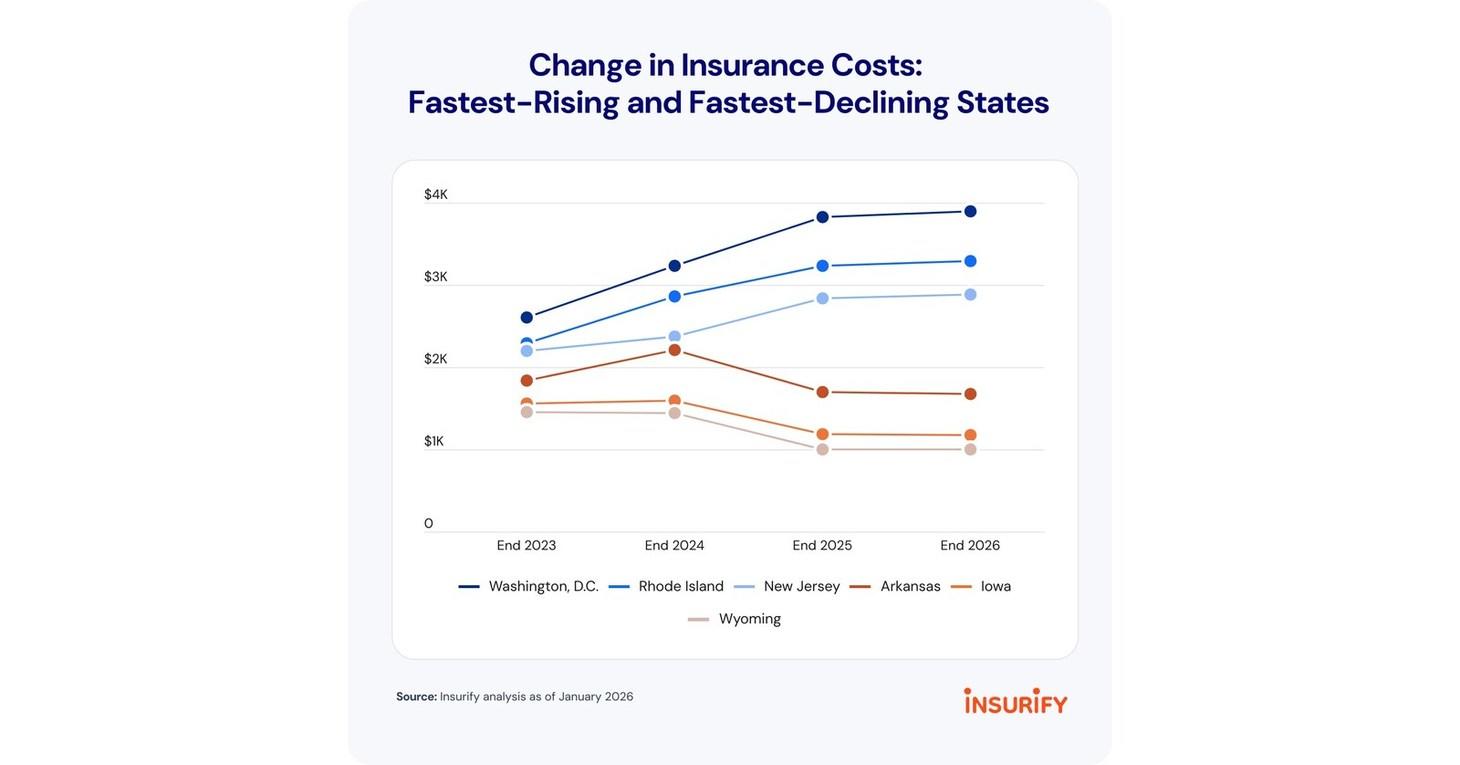
Drawing from Insurify's proprietary database of more than 190 million real auto insurance quotes, the platform's data scientists found that car insurance became more affordable for many Americans in 2025. But 10 states logged premium increases in 2025, with some as high as $618 annually. Nationally, full-coverage auto insurance prices have increased 43% since 2021, even after falling 6% in 2025, with the average annual cost landing at $2,144.
Most states saw rates decrease or stabilize last year. But rate relief may not continue into 2026. Insurify projects that insurance costs in the most expensive areas of the country will continue ticking up in 2026. The average annual cost of full-coverage car insurance will increase by about 1% in 2026, to $2,158. However, rates in Washington, D.C., are expected to increase to $4,088, after prices surged 18% last year.
In 2025, four of the most costly states and Washington, D.C., bucked the national trend of price stability. The average cost of car insurance surged by at least $130 per year in: