
News
Chubb stock falls after denying AIG takeover approach report By Investing.com
Chubb Limited (NYSE:CB) stock fell 1.55% to $296.54 Wednesday following reports that it had made an informal takeover approach for American International Group (NYSE:AIG), which both companies have denied. According to InvestingPro data, Chubb is currently trading below its Fair Value, suggesting the market may be undervaluing the insurance giant with its $116.71 billion market capitalization.
The Insurance Insider reported that Chubb had approached AIG regarding what would potentially be the largest acquisition in insurance industry history. According to the report, Chubb has denied making such an approach, while AIG stated it is not for sale.
The rumored combination would create significant business overlap in several areas, including large account commercial business globally, excess and surplus lines through Westchester and Lexington, London operations, and private client services.
Evercore ISI noted that the previous $28 billion merger between Chubb and ACE in 2015 generated $650 million in expense synergies. The firm pointed out that AIG and Chubb are larger entities with more operational overlap, suggesting potential for greater cost savings.

WTW to acquire Newfront, a specialized broker combining deep expertise and cutting-edge technology - WTW
WTW announced it has signed a definitive agreement to acquire Newfront, a San Francisco-based, top-40 U.S. broker combining deep specialty expertise and cutting-edge technology.
** WTW (NASDAQ: WTW) (the “Company”)**, a leading global advisory, broking and solutions company, announced it has signed a definitive agreement to acquire Newfront, a San Francisco-based, top-40 U.S. broker combining deep specialty expertise and cutting-edge technology.
The agreement provides for upfront and contingent consideration payments totaling $1.3 billion. The upfront portion of $1.05 billion is comprised of approximately $900 million in cash and $150 million in equity to be paid to Newfront employee-shareholders; the contingent consideration of up to $250 million is payable primarily in equity, subject to Newfront’s achievement of specified performance targets. Additionally, up to an incremental $150 million payable primarily in equity would become payable if Newfront achieves above-target revenue growth. The transaction is expected to close during the first quarter of 2026, subject to receipt of certain regulatory approvals and other customary closing conditions.
The acquisition of Newfront expands WTW’s reach in the U.S. middle market and presence within high-growth specialties including technology, fintech and life sciences. Newfront’s two business segments, Business Insurance and Total Rewards, will be combined with WTW’s Risk & Broking (R&B) and Health, Wealth & Career (HWC) segments, respectively. Newfront has grown organic revenue at a 20% CAGR between 2018-2024, driven by its growing producer base, proprietary client-facing technologies and use of cutting-edge agentic AI. The integration of Newfront’s technology platforms and more than 120 producers will position WTW to accelerate deployment of capabilities across both R&B and HWC.
Announcements
Zurich launches first-of-its-kind Builders Risk data center solution
Zurich North America, a trusted leader in construction risk, today announced the launch of Data Center Project Guard, a first-of-its-kind offering that both broadens and customizes Zurich's award-winning Builders Risk coverage to address coverage gaps and unique loss drivers for data centers, a segment experiencing rapid growth propelled by AI, cloud computing and hyperscale builds.
Data center investment surged 92% year-over-year to $32.9 billion in November 2025, according to ConstructConnect's Data Center Report. Global data center investments are projected to reach $6.7 trillion by 2030, according to McKinsey. These trends make the need for risk innovation in the space clear.
Zurich has extensive data center experience
Zurich has insured more than 250 data center projects across 20+ states. Data Center Project Guard harnesses this experience to deliver specialized coverages for hyperscalers, contractors and developers building next-generation digital infrastructure.
"Zurich has insured over $350 billion in data center projects, and our early, extensive leadership in this space positions us to set a new standard for insuring next-gen digital infrastructure," said Kelly Kinzer, President of U.S. Specialties and, as of Jan. 1, 2026, the Group Head of Construction and Surety for Zurich Insurance globally. "Data Center Project Guard is experience-based and purpose-built to support the unprecedented pace and scale of infrastructure development to power the digital economy."

PartsTrader launches AI platform to manage parts ordering
PartsTrader says it has launched a next-generation, AI-enabled parts procurement platform in response to marketplace challenges, fueled by extensive input from collision repairers, as well as collaborative engagement with repairers, insurers, and suppliers.
Called Orderly, the platform manages the parts ordering process from initial request/estimate to delivery and reconciliation, PartsTrader told Repairer Driven News.
“While the PartsTrader Marketplace focuses on competitive sourcing and price transparency, Orderly goes further by managing the entire workflow,” stated a PartsTrader spokesperson in an email to RDN. “Orderly combines the best of Marketplace—competitive sourcing and pricing—with end-to-end workflow management in a single platform.
PartsTrader says Orderly aims to solve the following market conditions/challenges:
- “Fragmented ordering processes: Fragmented, analogue processes, multiple systems, and frequent inaccuracies.
- “Lack of a unified digital system for parts procurement: Inability to manage the end-to-end parts procurement workflow, resulting in inconsistent execution.
- “Administrative overload: High labor costs tied to managing parts orders and follow-ups. Repair shops [are] increasingly professionalizing operations by eliminating outdated processes and workflows to improve efficiency.
- “Stricter requirements: Insurers require auditability, adding complexity for repairers. With rising repair complexity. Orderly was built to reduce friction, accelerate cycle times, and improve accuracy, ultimately benefiting repairers, insurers, and suppliers.”
Telematics, Driving & Insurance

OCTO Revolutionizes Vehicle Safety with AI: Introducing the Proactive and Predictive Anti-Theft System
Anticipating a theft before it happens. This is the goal of OCTO’s new predictive anti-theft system, developed by the global leader in telematics and data analytics solutions for connected mobility.Anticipating a theft before it happens. This is the goal of OCTO’s new predictive anti-theft system, developed by the global leader in telematics and data analytics solutions for connected mobility.
The new technology combines artificial intelligence, machine learning, and advanced sensors to deliver real-time, personalized vehicle protection capable of recognizing risk signals before a theft event occurs.
Drawing on more than 22 years of experience and 610 billion kilometers of driving data, the system transforms the paradigm of vehicle security from reactive to proactive.
This approach enables prevention rather than mere response, increasing protection for both private vehicles and corporate fleets.
The main features include:
- Tampering detection: sensors identify attempts to access or remove the devices.
- Abnormal vehicle movement: the system detects vehicle dragging or lifting while the engine is off. -- Loss of connection between the devices installed on the vehicle: when one of the two devices is located and removed by a thief, communication with the second terminal is interrupted and an alert is promptly sent to our control center.
- Driver behavior analysis: an AI model identifies suspicious behavior compared to habitual driving patterns, analyzing driving style, typical routes, and timings.
- Geofencing: OCTO’s system maps all high-risk areas where thefts have historically occurred, as well as suspicious locations such as commercial ports or national borders, alerting the theft monitoring center whenever a vehicle approaches or enters these areas.
AI in Insurance

Most insurance AI patents come from just 3 U.S. insurers, study finds
Artificial intelligence patenting in insurance is becoming a high-stakes, highly concentrated race dominated by a handful of U.S. carriers.
Artificial intelligence patenting in insurance is becoming a high-stakes, highly concentrated race dominated by a handful of U.S. property and casualty carriers, even as overall activity remains 30% below its 2020 peak.
Evident, an AI benchmarking and intelligence platform focused on financial services, has released new data from its Insurance AI Patent Tracker, providing a sector-wide view of how insurers are protecting AI innovation.
The analysis shows that 166 AI-related patents have been filed by 30 major insurers in North America and Europe since January 2023. Filings are heavily clustered among a small group of U.S. carriers, with State Farm, USAA and Allstate alone accounting for 77% of all AI patents filed by insurers over the past decade. P&C insurers dominate overall, responsible for 89% of AI patents, reflecting their advantage in telematics, IoT-driven risk monitoring, and other sensor-based systems that more easily satisfy patentability standards in the U.S. and Europe.
“Patents offer a rare window into where insurers are placing their biggest bets on AI,” said** Alexandra Mousavizadeh, Co-founder and CEO of Evident**. “This data shows that innovation is overwhelmingly being driven by a handful of US firms, especially in P&C. While the volume of filings remains modest compared to banking, we’re seeing a sharp uptick in generative and agentic capabilities. The IP landscape is shifting from protecting past systems to enabling future ones.”
Claims
Rebuilding Negotiation Talent: Why This Skill Is Missing and How to Fix It
Executive Summary
"For decades, the industry has not treated negotiation as a discipline to be taught, strengthened and measured," writes Westfield Specialty's Krista Glenn. "Fixing the negotiation talent void is not a matter of personal improvement. It is a leadership responsibility," she asserts, going on to offer a leadership blueprint to rebuild negotiating skills as a core competency across insurance organizations.
This article is the third installment of a multipart educational series, "Negotiation Reclaimed," conceived by Guest Editor Taylor Smith, founder and president of Suite 200 Solutions. Smith introduced the idea in his recent CM article, Taking Back Negotiation: Why Claim Professionals Must Lead the Next Chapter Read Part 1: Negotiation Is the Job: Reframing Defense Work in an AI-Enhanced Era Read Part 2: The Power of the First Offer: Anchoring, Evidence and the Battle for Perception
After decades in claims handling and leadership roles, I’ve seen firsthand how profoundly negotiation quality shapes indemnity spend, resolution timing, and partner alignment. And I’ve also seen how far we still have to go.
As the plaintiff bar continues to modernize its negotiation capabilities by investing in analytics, offer scripting, message testing, and AI-driven demand tools, the defense industry is confronting a widening skills gap. This gap is not a reflection of the talent or commitment of our professionals. On the contrary, it is a reflection of the fact that, for decades, the industry has not treated negotiation as a discipline to be taught, strengthened and measured. And without the willingness or ability to measure our results, we have lost the ability to accomplish our mutual goals of managing the risk for our insureds by paying only what we owe while providing our employees with the opportunity to improve their negotiation skill set in a controlled setting. ARTICLE
Commentary/Opinion

Why Insurers May Unwittingly Become AI Safety Champions
Suppose you googled yourself and the box generated by artificial intelligence at the top of the search page alleged you are being sued by the state’s attorney general for deceptive sales practices. To your knowledge, you aren’t being sued by the attorney general. Still, your customers start dropping off and you begin losing business you spent years building up.
That was the case for Wolf River Electric, which claimed it lost $24 million in sales in 2024 due to errant search results. In response, the solar-panel installment company sued Google for $110 million in damages.
While an upsetting episode, it’s possible the tech giant could have paid the damages by turning to its insurance company. But insurers might not be able to provide such cover for much longer.
According to the Financial Times, insurance companies including AIG, Great American, and WR Berkley have sought government permission to limit their liability from mistakes made by AI agents and chatbots. Another insurer, Mosaic, told the publication this was because the technology is perceived as too much of a “black box” to establish liability.
This leaves companies in a bind. On the one hand, they are told that if they don’t adopt AI they will fall behind. On the other hand, AI might come with unacceptable liability risks.
To date, companies’ calculation has seemed to be that the benefits outweighed the risks. Companies have rushed to incorporate AI into their business models, even though complaints about AI hallucinations date at least as far back as ChatGPT’s release in 2022.
According to a McKinsey report from January, 92% of companies planned to invest more in generative AI over the next three years. Applications have ranged from customer service to marketing and finance. Governments have even started using AI to hold public office.
2026 Outlook/Predictions

P&C Outlook for 2026: Stability ahead, but rising complexity beneath the surface
The U.S. P&C market is entering 2026 on more stable footing, but the underlying risk environment is not easing with it. Direct premiums written are expected to grow around 4% next year, and insurer return on equity is projected to hover near 10%.
Large rate spikes have cooled, but that does not mean the market is softening enough for companies to relax. Instead, climate volatility, AI-driven automation, regulatory tightening, workforce pressures, and capital-market shifts are converging in ways that make risk harder — not easier — to manage.
If 2026 has a message for business owners, it’s this: Complacency is the biggest uninsured risk on your balance sheet.
Risk is getting more complex even as pricing begins to stabilize, and the companies that thrive will be those that update their strategy, modernize their data, and work with their broker to stay ahead of emerging exposures. Terms, capacity, and risk control — not rate shopping—will determine outcomes next year.
Hot industries: Where growth and exposure collide
Several sectors are entering 2026 with expanded opportunities and escalating risks. These industries, illustrated in the slideshow above, are where insurance scrutiny will be highest and where a reactive approach will be most costly.
What companies should do next...
Stability in the P&C market does not mean simplicity. The firms that outperform their peers will be those that take a more structured, data-driven approach to risk management and insurance program design. Here’s what companies should focus on:
No. 1: Make risk management a strategic function. Risk management cannot operate as a back-office exercise. Carriers expect clearer data, stronger safety metrics, and documented controls.
Action steps:
- Run quarterly reviews of fleet, property, and cyber exposures.
- Conduct updated property inspections and deferred-maintenance checks.
- Perform tabletop exercises for cyber and business-continuity scenarios.
- Track loss trends and near-misses.
- Stronger data directly translates into better terms, more capacity, and fewer underwriting surprises.READ ON
Jeff Lang is president of Retail Property & Casualty at Venbrook. .
InsurTech/M&A/Finance💰/Collaboration
State Farm’s big venture pivot back to auto tech | Insurance Business
As big insurers rediscover the car, State Farm’s venture arm is steering hard into automotive tech - from dashcams and sensors to self‑driving shuttles and claims platforms
Once cautious stewards of idle cash, America’s biggest auto insurers are now fine-tuning their approach to venture investing to better match their core market demand, as reflected in State Farm’s more recent choice of automotive-technology company investments.
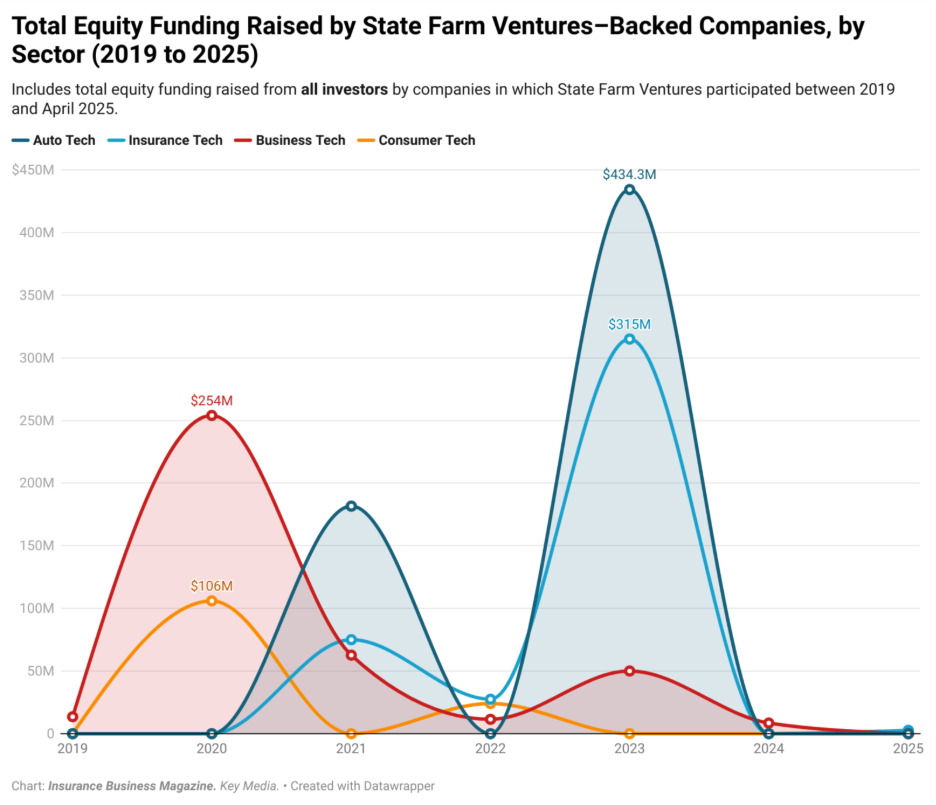
Insurance Business America analyzed every company backed by State Farm Ventures between 2019 and April 2025, along with the total equity funding those firms raised from all investors.
Between 2019 and April 2025, companies in which State Farm Ventures participated as an investor collectively raised $1.66 billion from all funding sources. State Farm’s own cheques were only part of that amount, but the direction of its money has changed sharply. Instead of spreading bets across business- and consumer-focused ventures, which were once dominant, the US’s larger P&C insurer is increasingly backing tools that shape how cars are driven, how crashes are recorded and how claims get paid.
Branch Partners With ClaimTouch to Enhance Personal Property Claims Management
Branch Insurance (“Branch”), a rapidly growing insurtech transforming home and auto insurance through advanced data and automation across underwriting and claims, today announced a new partnership with ClaimTouch Analytics Inc. (“ClaimTouch”), an AI-native insurtech delivering analytics, predictive modeling, and end-to-end solutions for personal property claims.
“We’re excited to elevate the experience for both our policyholders and our claims team by implementing ClaimTouch’s best-in-class platform for contents claims.”
“The contents claim process has seen limited innovation in decades, and its importance is often overlooked in the industry,” said Charlie Wendland, Chief Claims Officer at Branch. “We’re excited to elevate the experience for both our policyholders and our claims team by implementing ClaimTouch’s best-in-class platform for contents claims.”
“Branch shares our vision of leveraging data and automation to create a seamless and highly accurate claim experience,” said Mick Noland, President & Co-Founder of ClaimTouch. “We are thrilled to support their continued growth by applying our AI and data capabilities to deliver a best-in-class claims journey.”
Guidewire adds Wisedocs to its Insurtech Vanguards community
Wisedocs, an AI-powered medical record review and claims documentation platform with expert human oversight, has joined the Guidewire Insurtech Vanguards program, a curated community of InsurTechs helping property and casualty (P&C) insurers modernise and scale their operations.
The platform is designed to support claims teams as they face rising claim volumes, fewer experienced adjusters and growing expectations for speed and accuracy.
Wisedocs combines artificial intelligence with human oversight to deliver faster, more defensible decisions across the claims lifecycle.
Using advanced document intelligence, the platform sorts, deduplicates, summarises, and indexes claims files—from thousands of pages of medical records to legal reports—creating structured data that accelerates decision-making.
The firm has processed over 100m documents for insurers, third-party administrators, and legal teams, making it a trusted partner for organisations seeking scalable, AI-driven solutions.
Jenna Earnshaw, Co-Founder at Wisedocs, said, “We’re proud to be part of the Guidewire Insurtech Vanguards program and stand alongside innovators helping insurers close some of the biggest gaps in today’s claims ecosystem. The industry is facing a real scalability challenge: rising claim volumes, fewer experienced adjusters, and higher expectations for accuracy and speed. Wisedocs is built to meet that reality head-on. By combining AI with expert human oversight, we’re giving claims teams the confidence and capacity to make their best decisions end-to-end — not just faster, but smarter and more defensible for every stakeholder involved.”
Podcast Sponsor

Audio Version - 'Connected: The Podcast' --- Sponsored by Pulse Podcasts
** The ‘Connected’ Podcast by Alan Demers and Stephen Applebaum, is a condensed audio version of the day's ‘Connected' newsletter, a daily scan of all the happenings in the world of Insurance & InsurTech News**.
Pulse Podcasts: Introduce a new way for your audience to hear your voice! We are a podcast creation service that helps businesses turn their written content, like blog posts and news articles, into beautiful podcasts. Our platform writes the script, records the voices, and mixes the audio to create engaging content for your audience. It's affordable and has super-fast turnaround!
LISTEN AND SUBSCRIBE BELOW