
News

AI Stocks Plunge As Investors Panic Over Capex, Risk of Data Center Slowdown
Investors dumped AI stocks on Thursday as they weighed the risks of a slowdown in data center development. The Nasdaq 100 had its worst day since March 2020.
Investors' postelection euphoria lasted just one day before fears about the AI trade came roaring into view.
Democrats' sweeping victories on Tuesday sparked a monster postelection rally, but US stocks are now getting pummeled by worries that the blue wave will usher in a new era of tighter regulation for data centers and AI development, with cascading effects for the bull market and broader economic growth.
Editors' Note

Data Centers' Inconvenient Marriage to the Economy
"Affordability" (or lack there of) might just be the word of the year.
Promises of fixing affordability are racking up - cited as the strongest reason for election outcomes across America this week.
Equally trending is angst among Data Centers and AI in general. Like it or not, affordability and AI success are interdependent. From 401K's to pensions, job growth and plans for AI powering nearly every business are all in question among looming anti-Data Center movement.
If it was unclear how much AI and Data Centers are driving the economy, yesterday's stock market analysis says it all.
Slowing AI by crippling Data Centers has huge economic implications. And yes, affordability too.
AI in Insurance

P&C Specialist - Progressive Braces for AI-Driven Insurance Shopping
Progressive Braces for AI-Driven Insurance Shopping
Progressive expects agentic AI to become a more significant insurance shopping channel, intensifying competition for customers and rewarding insurers that can adjust prices faster.
Executives of the Mayfield Village, Ohio-based insurer said it has begun receiving inbound quote requests from agentic AI tools, though the volume remains a small fraction of overall quote activity in the direct channel.
"Activity we see today suggests much of this usage reflects experimentation rather than true shopping intent," CEO Tricia Griffith said during the company's third-quarter earnings call Tuesday. ARTICLE (may require subscription)
Varada Bhat

Your Policyholder Has an AI Agent, Too | Insurance Thought Leadership
Imagine the customer of a 20-year-old life insurance policy trying to figure out if it makes sense to surrender the policy. Do they call the insurance company first, hoping to talk to a knowledgeable agent? Probably not. They will upload the policy contract, riders and most recent statement to the AI assistant with a list of questions: What benefits would be lost by surrendering the policy? What happens to the outstanding loans? Are there other alternatives to surrendering the policy? Which policy provisions are the most important to consider before deciding?
This AI might be right, or might be partly right, or might be very wrong. But what is becoming abundantly clear is that this customer arrives at their insurer with a level of analysis and a body of knowledge that once cost time, or cost money, or both.
This leads me back to the question insurers have been asking for years about how AI will change what we do: underwriting, servicing, operations, all inside the enterprise. So what happens when the policyholder is AI-enabled as well?
Bhargavi Vepuri is a director in the insurtech and fintech field and an independent researcher
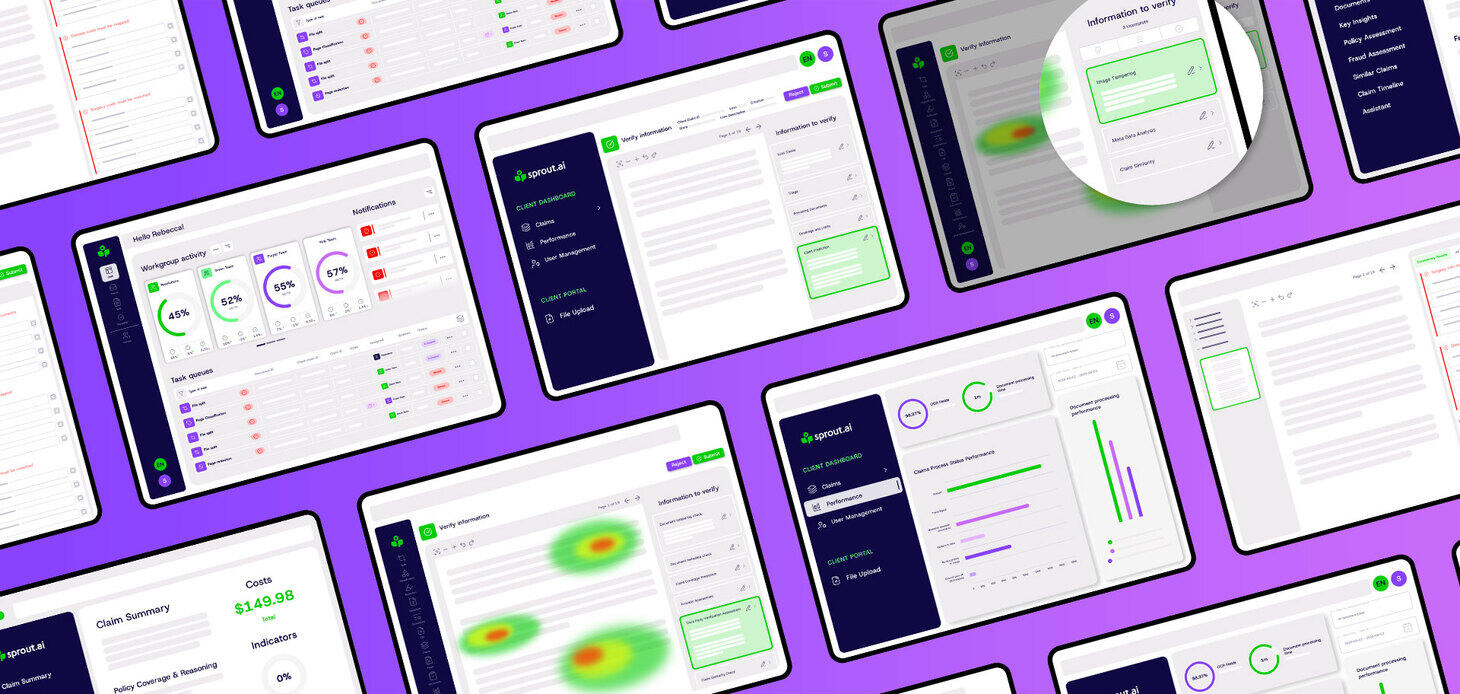
The token time-bomb: why your internal AI build could cost much more than you think Sprout.ai
The backlash against ‘tokenmaxxing’, which equates more AI usage with greater productivity, is growing as token bills escalate. For Claims leaders, a successful AI pilot is only the start. In this blog we explain why costs can spiral in production, where internal builds leave insurers exposed, and how to secure beneficial outcomes with more predictable AI spend.
We’ve all seen the stories of mystery companies blowing $500 million on Claude AI in a single month, of Uber capping employee AI usage after spending their entire AI budget in four months, and of a major healthcare insurer seeing its monthly AI token consumption go from three million to over one hundred fifty million in under a year.
The days of unrestricted AI adoption are passing, and the cost vs. value of deploying AI into your business is creeping up the agenda as exponential token spend hits P&Ls at every enterprise. Finance and Claims leaders are becoming increasingly discerning about where their AI budgets are spent, and experienced CIOs are expecting delivery outcomes supported by predictable AI spend.
“Insurers routinely face technology buy vs build scenarios to strike the right balance. Although there are several advantages to building AI in-house, insurers must also weigh timelines, expertise, and all related costs. Partnering with purpose-built AI solution providers allows insurers to buy and build, essential for a successful AI strategy. - Alan Demers"

Kalepa raises $75m to expand AI underwriting platform
Insurance AI firm Kalepa has raised $75 million in Series B funding at a $470 million valuation, as it looks to expand its AI platform across the insurance value chain and into new markets.
The funding, led by Updata Partners with participation from IA Ventures and Inspired Capital, is expected to support product expansion and a doubling of headcount in 2027.
Kalepa reported that revenue and customer numbers have tripled over the past year and it has remained cash flow positive for more than two years. Founded in 2018, Kalepa's customers include WR Berkley, Bowhead Specialty and AmRisc and previously raised $14 million in Series A funding in 2021, bringing total funding to $91 million.
Insurity Challenges the P&C Insurance Industry to Rethink Who Owns AI as Core Platforms Race to Acquire It
As the market consolidates around acquired AI, Insurity argues the defining question of the next decade isn’t whether carriers have AI, but whether they control the intelligence that runs their business
Insurity, a leading provider of cloud-based software for insurance carriers, brokers, and MGAs, today called on the insurance industry to rethink who controls the intelligence powering its core operations. As core platform providers race to acquire AI capabilities and integrate them into existing systems, Insurity is reaffirming its AI-native strategy that gives carriers greater control over their models, data, and decisions, with governance and auditability that operate independently of any individual AI model.
The wave of AI acquisitions confirms what the industry already knows. AI is no longer a differentiator in core insurance technology, it is the baseline. As AI becomes embedded in underwriting, pricing, and claims, the ability to maintain control over the intelligence making those decisions, and the cost of changing it, will increasingly determine how insurers compete and innovate.
Financial Results
AIG’s General Insurance Q3 Underwriting Income Down 29%
Third quarter 2026 underwriting income in American International Group’s (AIG) General Insurance segment decreased nearly 30% compared with the prior year, to $564 million.
Insurance financial results for Q3 included catastrophe losses of $283 million, an increase over the $100 million AIG absorbed during Q3 2025. AIG said catastrophe losses were driven by severe convective storms in North America.
Results for Q3 also included less favorable net prior year development, net of reinsurance, of $91 million versus $180 million a year ago during the same time.

Root Inc (ROOT) Q3 2026 Earnings Call Highlights: Profitability Surges With $14 Million Net ...
Root Inc (ROOT) swung to a $14 million profit with a 97.2% combined ratio and expanding partnership channel, even as competitive pressures drove an 8% decline in gross written premium.
This article first appeared on GuruFocus.
- Revenue: $381 million, down from $388 million in the prior year period.
- Net Income: $14 million, compared with a net loss of $5 million a year ago.
- Gross Written Premium: $358 million, down 8% year-over-year.
- Gross Earned Premium: $356 million, down 5% year-over-year.
- Policies in Force: 484,000, up 4% year-over-year and broadly stable with the second quarter.
- Net Combined Ratio: Improved 4.9 points year-over-year to 97.2%.
- Accident Period Loss Ratio: 61.1%, within the long-term target range of 60% to 65%.
- Partnership Channel New Writings: Grew 19% year-over-year; represented 52% of total new writings, up 44% from the prior year's period.
InsurTech/M&A/Finance💰/Collaboration

Q3 global insurtech funding drops 44.6%: Gallagher Re
Third-quarter global insurtech funding declined 44.6% from the second quarter to $1.36 billion as the number of funding rounds above $100 million slipped substantially.
The amount of “mega-round” funding – those fundraising rounds above $100 million – dropped to $660 million in the third quarter from $1.67 billion in the second quarter, according to a report Thursday from Gallagher Re, the reinsurance brokerage of Arthur J. Gallagher & Co.
Year-over-year, funding increased 34.9% from third-quarter 2025.
There were 104 funding transactions in the third quarter, almost even with the 107 in the second quarter despite the decline in overall funding.
Artificial intelligence also continued to dominate funding, with AI-focused companies attracting 83.2% of all insurtech funding, raising $1.13 billion across 72 deals.
Commentary/Opinion
The hidden cost of minimum car insurance coverage
News flash: The median price drivers now pay for annual car insurance coverage is $2,079.
With grocery, utility, gasoline, and other costs rising and consumers seeking to save dollars wherever they can, it's not surprising that many policyholders are opting to lower their insurance coverage levels (often by sacrificing collision coverage).
For some, reducing coverage is the right call. But while this strategy can lower your premium, it could also leave you financially vulnerable. Just imagine being involved in a multi-car crash with bodily injury claims and a totaled car, but you only have minimum coverage that's legally required in your state. It's an outcome that could drain five to six figures from your bank account.
In this article, TheZebra.com helps you better understand the risks behind dropping coverage, scenarios where it's recommended, why you shouldn't rely on state minimum coverage, and alternative ways to pay less.
Podcast Sponsor

Audio Version - 'Connected: The Podcast' --- Sponsored by Pulse Podcasts
The ‘Connected’ Podcast by Alan Demers and in dedication of Stephen Applebaum, is a condensed audio version of the day's ‘Connected' newsletter, a daily scan of all the happenings in the world of Insurance & InsurTech News.
Pulse Podcasts: Introduce a new way for your audience to hear your voice! We are a podcast creation service that helps businesses turn their written content, like blog posts and news articles, into beautiful podcasts. Our platform writes the script, records the voices, and mixes the audio to create engaging content for your audience. It's affordable and has super-fast turnaround!
LISTEN AND SUBSCRIBE BELOW