
News
JP Morgan sees no near-term floor as reinsurance rates fall 16% at midyear
The bank estimates Q2 insured catastrophe losses at approximately US$15bn, with rate declines accelerating at the July midyear renewal
Insured catastrophe losses came in below US$20 billion for the fifth consecutive quarter in Q2 2026, according to a JP Morgan report. The US banking group estimated total Q2 insured losses at approximately US$15 billion in a bottom-up assessment of major catastrophe events. Severe convective storms (SCS) in the United States accounted for the majority of the total.
SCS drove approximately 90% of insured losses in the second quarter, JP Morgan stated. Estimated SCS-related losses totalled approximately US$64 billion in 2023, before declining to more than US$50 billion in 2024 and around US$49 billion in 2025. SCS losses have nonetheless remained elevated relative to pre-2023 levels, JP Morgan noted.

Reinsurance Buyers Gain Pricing Power as Global Capital Hits Record $790 Billion
Global reinsurer capital reached an all-time high at the start of 2026, handing insurance buyers their strongest pricing leverage in years, according to Aon’s Reinsurance Market Dynamics midyear 2026 report, as reported by Risk & Insurance.
The big picture: A surge in both traditional and alternative capital has decisively shifted negotiating power toward reinsurance buyers, reversing years of hard-market conditions.
The abundance of capacity is not only driving down prices but also unlocking more customized deal structures that buyers have long sought. Florida — a market that spent years in crisis — is emerging as one of the clearest beneficiaries of the turnaround.
By the numbers:
- Global reinsurer capital reached a record $790 billion as of March 31, 2026.
- Third-party capital rose to a new high of $141 billion, with catastrophe bond issuances of $17.1 billion in the first half of 2026 outpacing $10.4 billion in maturities.
- U.S. property catastrophe treaty pricing fell 15% to 25% on a risk-adjusted basis at mid-year renewals.
- Property facultative reinsurance saw reductions of 20% to 40%.
- U.S. casualty excess of loss reinsurance rates fell 5% to 10%, while international casualty pricing ranged from flat to down 10%.
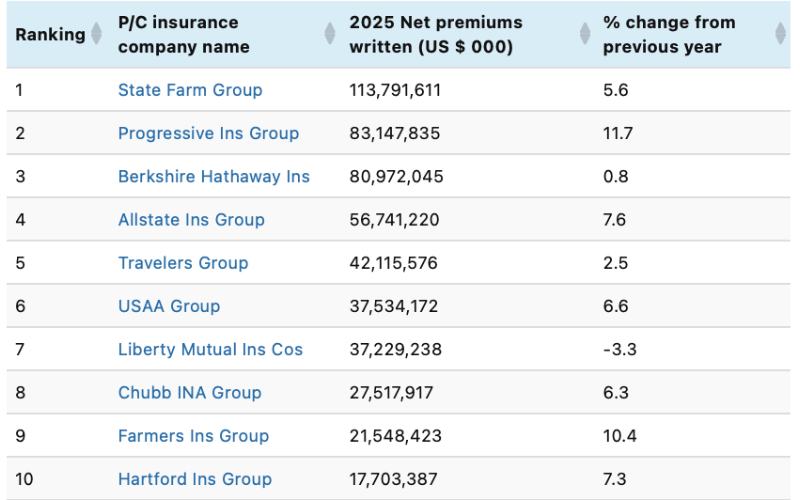
State Farm maintains leading US P&C insurer position in 2025
State Farm retains its leading position as the largest US property and casualty (P&C) insurer in 2025, based on total net premiums written (NPW), with the company reporting $113.79 billion in NPW.
Our directory of the Top 100 U.S. P&C Insurance Companies is based on research data from rating agency A.M. Best.
State Farm’s total NPW is $30.64 billion ahead of second-place Progressive Insurance Group.
Progressive has moved ahead of Berkshire Hathaway Insurance Group to become the second-largest US P&C insurer, with $83.1 billion in NPW, representing an 11.7% increase from 2024, and the largest percentage increase among the top 10 insurers.
Meanwhile, Berkshire Hathaway Insurance Group reported $81 billion in NPW, representing a 0.8% year-over-year decrease.
Announcements
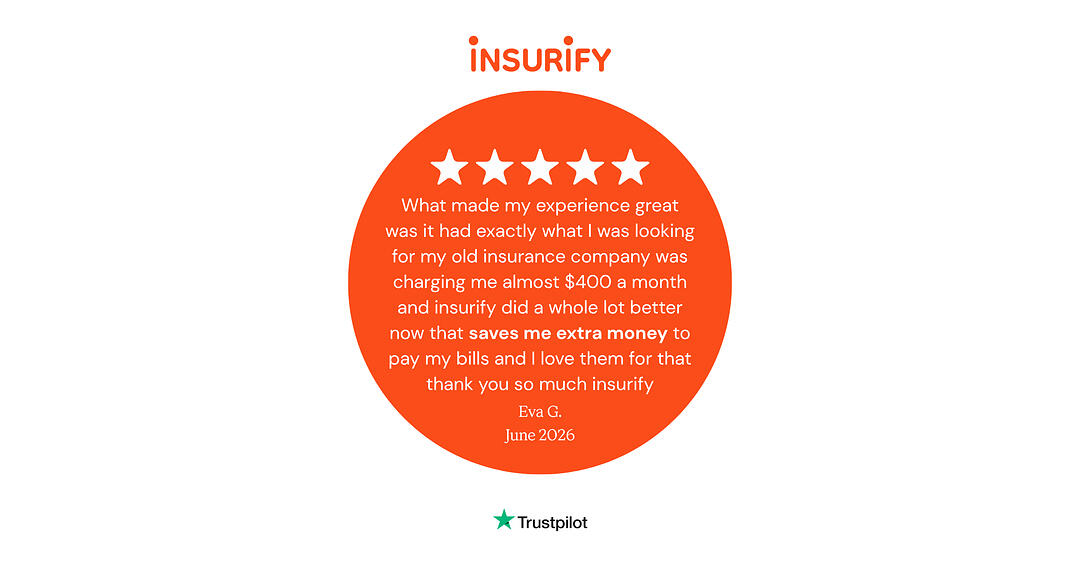
Insurify Exceeds 250 Million Auto Insurance Quotes Served
Insurify, the leading online insurance comparison platform, announced today that its total number of real-time auto insurance quotes served to American consumers has reached a landmark 250 million. With a quote database that's more than three times larger than the publicly reported volume of major competitors, Insurify empowers auto insurance shoppers to compare quotes and buy policies entirely online.
Since its launch in 2016, millions of drivers have turned to Insurify to find better coverage at a lower price. In the last year alone, Insurify users saved up to $1,100* on their auto insurance policy, annually.
"Reaching this landmark speaks to the trust insurance shoppers place in Insurify," said Snejina Zacharia, founder and co-CEO of Insurify. "This volume of quotes enables Insurify to provide insurance shoppers with the most accurate quotes possible, and provide data-driven consumer insights."
AI in Insurance
Palantir IR - News
Palantir Technologies Inc. (NASDAQ: PLTR) announced today an enterprise expansion agreement with GNP Seguros (Grupo Nacional Provincial), the largest insurer in Mexico and part of the prominent Grupo BAL consortium. This alliance marks a milestone for Palantir, as GNP Seguros becomes Palantir’s first publicly announced commercial customer in Latin America.
Palantir’s platforms are designed to help insurers improve customer service, augment the judgment of claims and underwriting professionals, and provide a scalable, secure, and governed foundation for enterprise AI.
Dun & Bradstreet Helps Insurers Deliver Productivity Gains in Claude
Dun & Bradstreet today announced it is bringing verified D&B business information and risk intelligence directly in Claude to transform how carriers and brokers manage the insurance underwriting lifecycle.
By connecting D&B's trusted Commercial Graph and predictive analytics to Claude via Model Context Protocol (MCP) server, users can compress underwriting tasks that would typically take weeks or days into minutes, freeing up teams from lower value, manual work. Together with Claude, insurance professionals can focus their attention where it adds the most value: applying judgment, assessing nuanced risk, and engaging brokers and clients.
"For decades, insurance companies have relied on Dun & Bradstreet's verified business data and analytics to help them improve risk selection and pricing and increase profitability," said Scott Spencer, General Manager, Finance & Credit at Dun & Bradstreet. "Now, Claude allows us to draw inference across our Commercial Graph to provide a more holistic understanding of the risks they are insuring. By making D&B's business information and risk intelligence accessible in Claude, not only are our customers able to consider opportunities faster, but the outputs are explainable, auditable, and consistent, allowing decision-makers to act with confidence."
Commentary/Opinion

Biggest Threat Yet to Captive Insurance Agents | Insurance Thought Leadership
Back in 2013, when Chunka Mui and I were doing some consulting work on innovation for the CEO of a top-five personal lines insurer, he was trying to rewire the compensation structure for his captive agents. He wanted to encourage them to focus more on growth and less on building a book of business and then servicing it ("coasting," in his words).
He noted that he wasn't trying to cut the total dollars paid to agents. He just wanted to take two percentage points out of the base commission and pay the money out as incentives.
"But every time I float the idea," he said, "the agents turn around and kick me in the crotch." (He used a more colorful word.)
Having kept an eye on the issue for more than a dozen years now, I believe that State Farm's announcement of a take-it-or-leave-it, incentive-driven compensation model for its 19,000 captive agents marks a turning point. Change always takes time, but I believe the captive agent business will be very different a few years from now.
Let's have a look.
A smart piece by David Gritz of InsurTech NY provides the backdrop, showing how the industry has been deemphasizing the traditional captive model for years. Noting that the trend predates the generative AI explosion by many years, he writes:
- "June 2020: Nationwide ends its captive agent program.
- "November 2021: Liberty Mutual transitions captive agents to independent agencies.
- "January 2023: Allstate signals a reduction in captive distribution.
- "June 2026: State Farm reduces benefits and commissions for captive agents. MORE
Paul Carroll, Editor-in-Chief Insurance Thought leadership
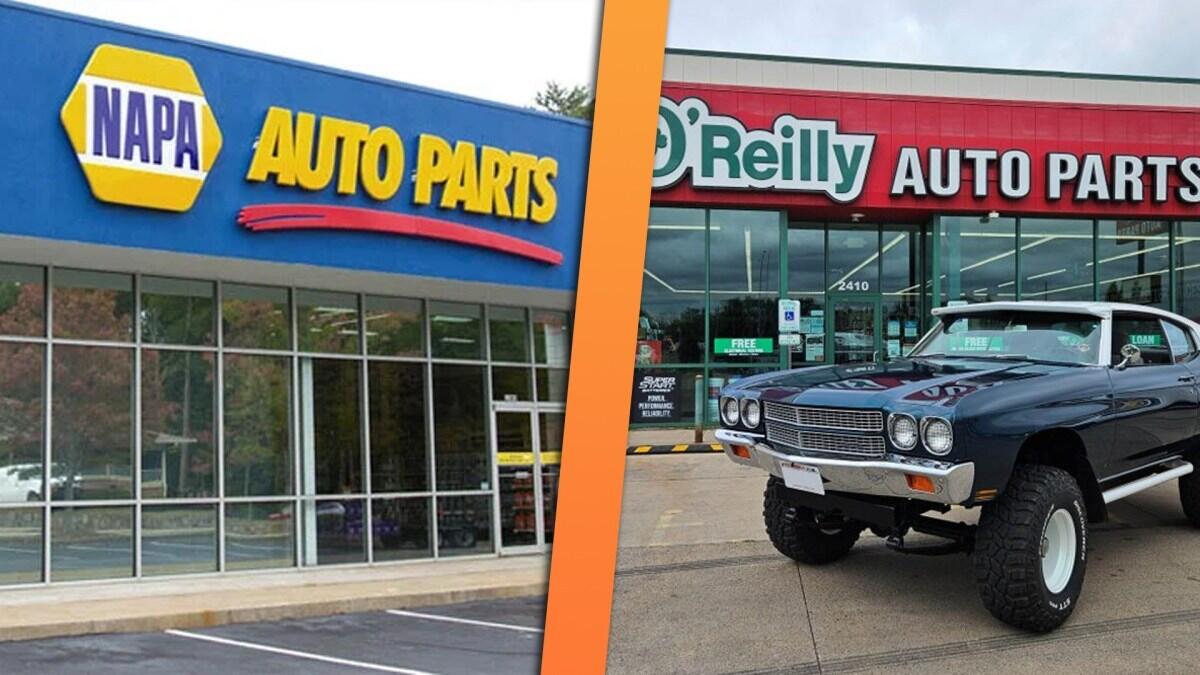
The $10 Billion Takeover That Could Turn the Auto Parts Business Upside Down, Explained
O'Reilly might buy NAPA, which would affect the aftermarket parts business in more ways than you might realize.
There are only four major auto parts retailers left in America, and word has it that two of them may merge. O’Reilly is reportedly looking at spending $10 billion to get NAPA under its umbrella. That would be a particularly interesting auto industry moment, because even though both brands are similarly known for being brick-and-mortar car parts places, O’Reilly and NAPA fundamentally do business very differently.
O’Reilly is a big, publicly traded company. It runs all its stores with a high level of corporate consistency. NAPA Auto Parts has a corporate/franchise hybrid model, so many locations have a little bit more of a private-store vibe. A lot of NAPA stores (about 4,500 of the 6,000-odd locations) are owned and operated by small business people, not the corpo mothership, which in NAPA’s case is Genuine Parts Company (GPC). NAPA parent GPC also runs a company called Motion that sells industrial parts to factories.
Regulation & Public Policy

Financial Services’ AI Dangers Highlighted by Regulator’s Review
Britain’s financial regulator has been urged to consider regulation of large language models such as ChatGPT, Claude and Gemini because of their growing influence on consumer financial decisions.
In a review commissioned by the Financial Conduct Authority and published on Monday, the watchdog’s executive director, Sheldon Mills, also highlighted how companies’ reliance on a handful of technology providers introduces potential system-wide risks.
Regulators globally have begun to focus more keenly on the impact of AI, from cyber and operational risks associated with frontier AI models such as Anthropic’s Mythos to the challenges posed by the agentic systems capable of acting with limited human intervention. CONTINUES
InsurTech/M&A/Finance💰/Collaboration
Duck Creek Acquires Send, Creating the Industry's Only Agentic Underwriting-to-Core Platform
Duck Creek Technologies, the intelligent core of insurance, today announced it has acquired Send Technology Solutions Ltd, a leading AI-native underwriting orchestration engine serving commercial, specialty, and complex risk markets with leading insurance customers across the globe. The investment creates the industry’s first and only agentic solution to unite core insurance operations and intelligent underwriting workflows across the policy lifecycle for multiple operating models.
Duck Creek serves hundreds of P&C insurers globally, including more than half of the top 20 global P&C carriers. Send is a leader in underwriting solutions for commercial, specialty, reinsurance, MGAs and delegated authority customers, supporting more than $26 billion in Gross Written Premium through its underwriting orchestration engine.

French insurtech Panora raises $5 mn for AI insurance broker automation
Panora secured $5 mn in seed funding to automate broker workflows, expand portal links and enter more European insurance markets
French insurtech startup Panora, an AI-powered platform for insurance brokers, has raised $5 mn in seed funding, according to Beinsure. Isai led the round, with Kima Ventures, 100in, 199 Ventures and Pennylane’s founders also taking part.
Panora is building a suite of AI-powered agents for insurance brokers: a highly regulated and operationally complex industry. The system offers a suite of assistants that automate tasks like prospecting, note-taking after calls, document collection, offer comparison, and compliance checks.
Fraud

GEICO's lawsuit accuses six Florida clinics of $5.2 million no-fault fraud
GEICO says six Miami-area clinics billed it more than $5.2 million for no-fault treatment that was unnecessary, unlawful, or never really provided.
The auto insurer filed suit on July 6, 2026, in federal court in the Southern District of Florida, naming six clinics along with their owners and the physicians it says served as medical directors. It is seeking damages, treble damages under federal racketeering law, and a ruling that it owes nothing on claims still pending.
The case turns on Florida's personal injury protection system, or PIP, which pays for medically necessary treatment after a crash. GEICO's core claim is that almost none of this treatment qualified.
According to the complaint, the clinics "falsely purported to operate a properly-licensed health care clinic" under Florida's Health Care Clinic Act, but were really used "as a vehicle to submit fraudulent and unlawful PIP insurance billing." GEICO says the conduct "began no later than 2021."