
News

How We’re Doing It: Customers, Agents Play Vital Roles in Commercial Auto Telematics Success
EXECUTIVE SUMMARY
Telematics has gained significant momentum in the U.S. commercial auto insurance market over the past few years among both InsurTech MGAs and insurance
Lessons from personal auto reveal that successful telematics programs are those that share value with customers. But understanding what's valuable in the commercial auto space is complicated by customers' varying needs, challenges and ecosystems.
Here, Great American's Pete Frey and the IoT Insurance Observatory's Matteo Carbone describe how Great American matches value propositions to customers by first painting a customer "canvas" that profiles each fleet segment, and then tailoring telematics programs to offer appropriate incentives, levels of fleet-adjacent services and loss control processes.
They also offer ways to grow the proportion of agents proactively offering telematics programs to customers—sitting at just about half today. The first step: lead with a compelling why, they write. FULL ARTICLE
Financial Results

Five years of premiums and profits – who actually converted growth into earnings?
Premium volume tells you how big a company's book is. Earnings tell you how well it's being run. The relationship between the two - how efficiently each premium dollar is converted into profit - is the central question for any investor trying to distinguish genuine underwriting strength from scale for its own sake.
But that comparison only holds when premiums are actually the business. For companies that earn most of their revenue from pharmacy benefits, investment products, or annuities, the net-earnings-to-premium ratio measures something else entirely.
This analysis uses five years of reported figures - 2021 through 2025 - across major US-listed insurers. Companies are first segmented by how premium-driven their revenue structure is, and then compared only within their own group. All figures are as reported in company financial statements. No adjustments have been applied.

Kin Surpasses $6 Million in Auto Gross Written Premium as Home Policies in Force Tops 250,000
Kin, the direct-to-consumer home and auto insurance company, today announces two significant growth milestones: $6 million in auto gross written premium (GWP) and more than 250,000 total home policies in force. Together, the results reflect how Kin's strategy of cross-selling auto policies to existing customers improves policyholder retention and renewal rates, while maximizing savings for homeowners.
"The most durable businesses are built on trust, not transactions," said Kin CEO Sean Harper. "What we're seeing in the early auto data reinforces that. When our home insurance customers choose to bundle and add auto, we know they stay longer, engage more deeply, and become more valuable over time — all without materially increasing customer acquisition costs. Reaching 250,000 home policies in force gives us a powerful foundation to scale that strategy efficiently, and we believe it positions Kin to compound growth and profitability as we expand auto into additional markets."
Research
Collision Repair's Technician Pipeline Fills Just 42% of Demand, TechForce Report Finds - Autobody News
The report projects that 73,354 new collision technicians are needed by 2029.
Collision repair shops are short on trained technicians, and new data shows how deep the problem runs: the training pipeline for collision and autobody programs fills just 42% of annual collision demand, according to TechForce Foundation's ninth annual Supply, Demand & Opportunity Report.
The report projects that the collision repair industry will need 73,354 new entrant technicians between 2025 and 2029. The report's projected average annual supply of 6,327 collision completions through 2029 would cover fewer than half of annual demand over that period, according to TechForce's IPEDS-based projections. Those projections draw on Bureau of Labor Statistics Occupational Outlook Handbook data and Integrated Postsecondary Education Data System completions figures.
WHAT THE NUMBERS SHOW FOR COLLISION REPAIR
The Bureau of Labor Statistics projects 14,600 annual openings for collision repair technicians through 2034. Against that figure, postsecondary collision programs produced 5,462 completions in academic year 2023-24, a 14.2% year-over-year gain that was the strongest growth rate of any sector in the report.
Announcements

Total Insight 2026: Metrics That Matter on Total Loss Claims
Discover how improving cycle time in total loss claims can enhance policyholder retention, drive higher auction returns, and reduce costs for insurance carriers.
Today more than 23% of all auto insurance claims are deemed a total loss, and more than 40% of policyholders switch carriers after a total loss claim – compared to just 8% after a repairable claim1. That adds up to over 2 million policyholders walking out the door every year because of how their total loss was handled – compared to just 1 million after a repairable claim.
A decade ago, when total losses represented 10%-15% of all claims, a singular focus on Net Salvage Return was a reasonable strategy. Today it is not. With total losses now over 23% of claim volume and driving the highest shopping and switching rates in auto insurance, any friction in a total loss claim is an invitation for a competitor to step in and win the policyholder.
The good news: Policyholder Retention and Net Salvage Return are not mutually exclusive. Both are driven by Cycle Time – particularly at a few key milestones in the total loss process.

Claro Launches AI &Automation Discovery to Accelerate Insurer AI Execution in 4 to 6 Weeks
Claro, a global technology provider delivering IT, connectivity, and digital innovation solutions, today announced the launch of AI & Automation Discovery, a new advisory service tailored for insurance organizations that helps leaders identify, prioritize, and activate high-value AI and automation opportunities in four to six weeks.
"Many insurers are under pressure to modernize, but turning AI interest into action requires clear priorities and cross-functional alignment," said Andres Mosquera, CEO of Claro. "We created AI & Automation Discovery, a fixed-scope advisory service, to help leaders quickly identify where AI can deliver the most value and build a practical roadmap for execution."
Claro's AI & Automation Discovery is a structured, vendor-neutral advisory service designed to help insurers prioritize AI and automation initiatives and align business and technology teams around the next steps. The fixed-fee engagement is typically delivered within four to six weeks and includes:
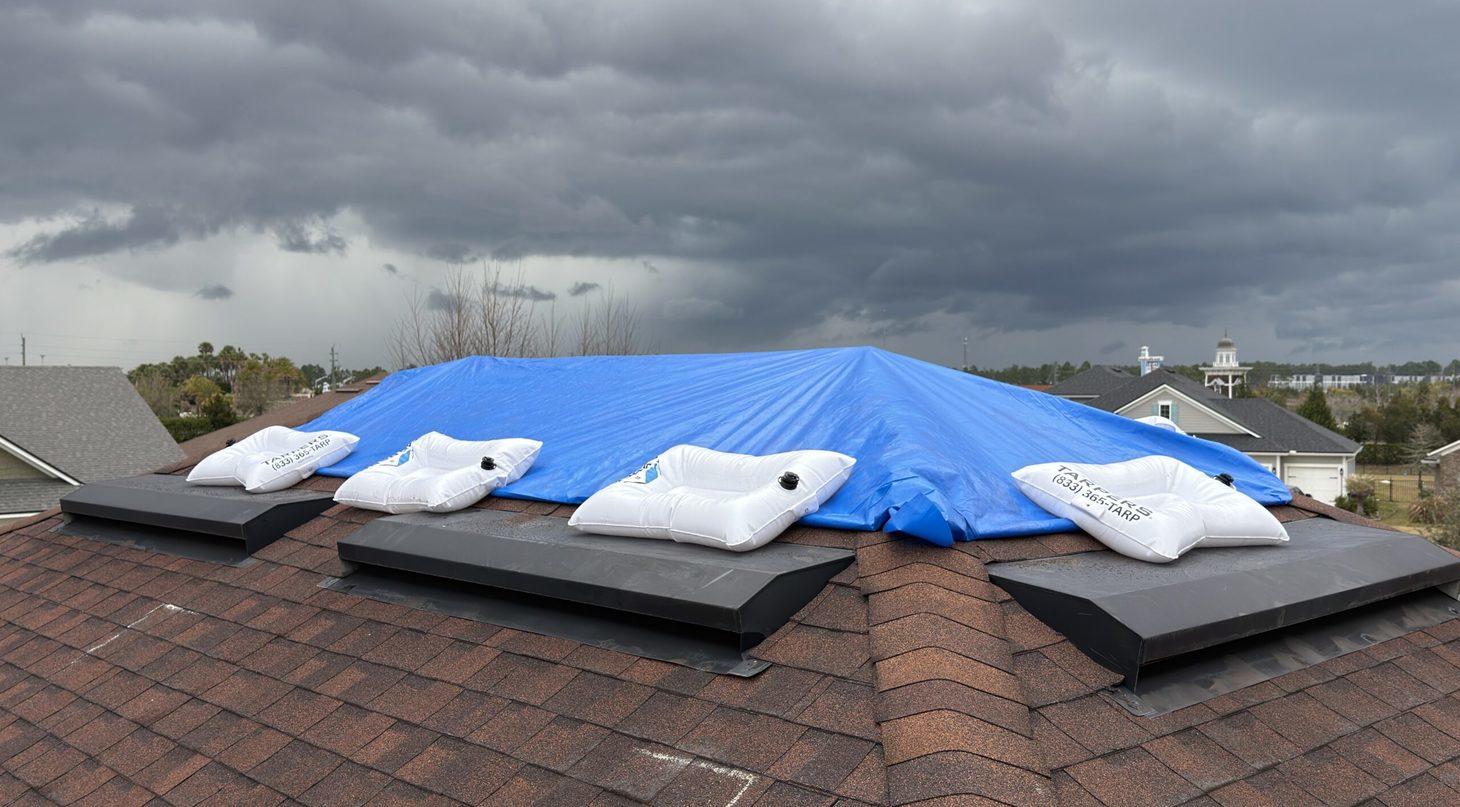
Florida Firms Introduce New Tarp and Flood-Protection Products
Two new products on the market could help reduce losses and property insurance claims in storm-prone parts of the Southeast and beyond, makers announced recently.
Flood Risk America, based in Lake Worth, Florida, said it has expanded its flood protection lineup with three new systems: Hinged flood gates, permanent flood doors, and fabric flood barriers.
The gates allow entry-point protection for properties without blocking daily access, the firm said in a news release.
The doors are designed to provide watertight protection when closed, but normal access in routine use.
The barriers are made of what the company calls Aqua Fabric, and can be moved into position by a single person, without heavy equipment. READ ON
AI in Insurance
Is AI Spying on Your Roof? How Insurers Use Tech to Raise Rates
It is common for insurance companies to inspect properties for damage in an attempt to mitigate future losses. But over the last few years, there has been a significant shift in exactly how those inspections are done.
In the past, a human inspector would look at the property in person. Today, insurers are replacing inspection agents with drones, satellites and artificial intelligence systems to review footage and determine whether a policy should be canceled.
The consequence for homeowners? Higher premiums, nonrenewals and coverage issues based on remote evaluations have increased.
How Are Insurers Using AI?
Insurers are currently using AI in a variety of ways, including claims settlement, risk assessment, risk mitigation and investigating covered homeowners insurance claims following a loss, according to the American Property Casualty Insurance Association’s response to a request for drafting an AI model law. Insurance companies are also using AI to model the potential for catastrophic weather events and assess the likelihood of a policyholder sustaining losses from catastrophes, such as hurricanes, wildfires and earthquakes.
Insurers are using these AI-driven underwriting models to save time and reduce expenses, according to Chip Merlin, founder and president of Merlin Law Group, a national insurance claim litigation firm that handles property insurance claims. But some companies are using different terminology to sidestep regulations, he wrote in an email. “Many insurers are intentionally avoiding the term ‘AI’ to avoid regulatory scrutiny, relying on external vendors rather than building their own software. Regulators are starting to make strides toward transparency and accountability … but the laws are still behind on this technology.”

AI Liability Is No Longer a Future Problem for Risk Managers
AI-related incidents rose approximately 50% year over year from 2022 to 2024, and exposure is building across multiple insurance lines, according to WTW's Willis Research Network.
Artificial intelligence has moved from operational experiment to embedded infrastructure across insurance and corporate risk functions, but governance, liability frameworks, and coverage structures have not kept pace, according to a new report from WTW’s Willis Research Network.
The report documents a surge in AI-related incidents, up roughly 50% year over year from 2022 to 2024, with 2025 incidents having already exceeded 2024’s total before that year concluded. The report warns that organizations are accumulating exposure across general liability, professional indemnity, cyber, EPLI, and D&O, often without policy language that explicitly addresses AI risks.
Silent AI Risk Spreading Across Lines
The report frames AI less as a standalone peril and more as a risk amplifier across existing coverage lines, a dynamic it compares explicitly to silent cyber exposure before 2019, when ambiguity in policy language narrowed quickly once claims and litigation materialized. WTW describes this as the “silent AI” problem: AI-related losses can sit embedded across multiple lines and many insureds simultaneously, invisible until a claim forces interpretation.
AI-related losses are already reaching insurers through multiple pathways, the report said. When AI causes bodily injury or property damage, in autonomous vehicles, industrial systems, or medical devices, courts typically analyze traditional negligence and product liability frameworks, focusing less on whether AI was involved than on whether reasonable care was exercised in deployment and supervision.

Insurers Must Plan for Tech’s Unintended Consequences
Insurance carriers are facing a familiar problem with increasingly significant implications: technology decisions made to solve one problem often create others.
Cloud adoption offers a good example. Many insurers moved workloads to cloud providers because the cloud was perceived to be cheaper. In many cases, it wasn’t.
That does not mean the move was wrong. Cloud environments can deliver important advantages in disaster recovery, business continuity, flexibility and scalability. But those benefits were not always the original goal. When the expected result is cost reduction and the actual result is a different operating model—with new dependencies, new governance requirements and new cost dynamics—the decision needs to be understood in a different light.
Every decision has consequences, which is clearly the point. A problem or opportunity is recognized, a plan is developed, resources are deployed and action is taken. In the postmortem phase, actual results can be compared with expected results, and a new set of decisions can be framed.
Simple enough in theory. In practice, however, the unexpected consequences can be highly consequential. In a worst-case scenario, the cure can be worse than the disease. A mentor once shared with me that surprise outcomes are generally bad because they reflect a failure to plan. Clearly there are surprise endings that turn out well—Teflon and Sticky Notes come to mind—but only after accepting that the original goal of those science projects had failed.
Rob McIsaac is the President and CEO of RPM Ventures

Exclude It, Harness It, Get Greedy: McGavick’s Take on Insurers’ AI Playbook
Executive Summary
Mike McGavick, the former CEO of XL, sees exciting possibilities ahead for AI to refocus the insurance industry on problems it is designed to solve. But today, the industry is falling short, he says.
During a keynote speech at the Casualty Actuarial Society Seminar on Reinsurance this week, McGavick was enthusiastic, not just about AI but also about the role of actuaries at the center of change, influencing trust in AI models. Still, he believes insurers aren’t living up to pronouncements they are making about their ability to harness AI today, nor are they fulfilling their central promises to efficiently transfer risks from society as they emerge. MORE
Fraud

AmTrust insurers sue New York law firm and surgeons over alleged fraud scheme
Insurers are fighting back. A trio of AmTrust carriers has filed a federal racketeering suit against a New York law firm, surgeons, and surgical centers.
The complaint, filed June 2, 2026, in the Eastern District of New York, comes from Wesco Insurance Company, Technology Insurance Company, and Associated Industries Insurance Company, all owned by AmTrust Financial Services. The three cover small and mid-sized businesses - the kind of policyholders who get sued when someone slips on a sidewalk.
That, according to the filing, was the weak point. The complaint alleges a coordinated "Fraud Scheme," its own capitalized term, designed to turn routine accidents into high-value lawsuits and pry settlements from insurers. The defendants, it says, used "standardized referral pipelines, templated medical records, and unnecessary surgical procedures to artificially inflate claim value."
The filing describes an assembly line: "Runners recruited claimants. Attorneys filed lawsuits. Gatekeeper Clinics generated treatment records. Radiology providers manufactured reports supporting surgical indication. Surgeons performed invasive procedures." Litigation funders bankrolled it, the complaint claims, in exchange for repayment from any settlement.