
Research

USA Business Insurance Releases New Analysis on Workplace Injuries by Industry
USA Business Insurance Services, Inc. today released a new analysis of the most common workplace injuries across retail, construction, manufacturing, transportation, health care and service businesses, using the latest U.S. Bureau of Labor Statistics data to help small business owners compare where injuries happen most often, which losses disrupt operations the longest and where fatal risk remains elevated.
The analysis found that private industry employers reported 2.5 million nonfatal workplace injuries and illnesses in 2024, with a total recordable case rate of 2.3 per 100 full-time workers. Sprains, strains and tears remained the leading days-away-from-work injury at 568,150 cases, while falls, slips and trips accounted for 479,480 such cases nationwide.
By sector, health care and social assistance recorded 553,800 nonfatal cases in 2024, followed by retail trade at 339,800 and manufacturing at 332,600. Transportation and warehousing posted one of the highest major-sector nonfatal injury rates at 4.4 cases per 100 full-time workers. Construction reported 167,100 nonfatal cases, but remained one of the most severe sectors on the fatal side, with 1,034 fatal work injuries in 2024.
AI in Insurance

Hippo Transforms Claims Workflow with AI, Unlocking Scale and Efficiency with Its Modern Tech Stack
Hippo Holdings (NYSE: HIPO) today announced a major milestone in its claim's transformation with the rollout of its scalable, AI-driven claims workflow. This initiative marks a foundational shift toward a more efficient, and responsive claims operation—led by a fully digital first notice of loss (FNOL) experience that blends advanced AI with human expertise and compassion to drive proactive communication and faster decisions for homeowners.
"We've reimagined our claims operation from intake through resolution, moving from legacy systems to a unified platform that enables faster workflows, clearer communication, and more consistent outcomes for homeowners at scale," said Peter Piotrowski, Chief Claims Officer at Hippo. "By embedding AI across the claims lifecycle, we're improving accuracy and freeing adjusters to focus on the most complex cases where empathy and judgment matter most, balancing technology with human care to deliver a better experience."
AI-Native Claims: From FNOL to Response
Central to this transformation is "Clara from Claims," a 24/7 conversational AI agent that enables a fully digital, always-on FNOL experience by capturing and structuring claim data in real time, flagging inconsistencies, and routing claims intelligently to accelerate resolution. With the introduction of Clara, Hippo expects more than 70% of claims to be filed digitally.
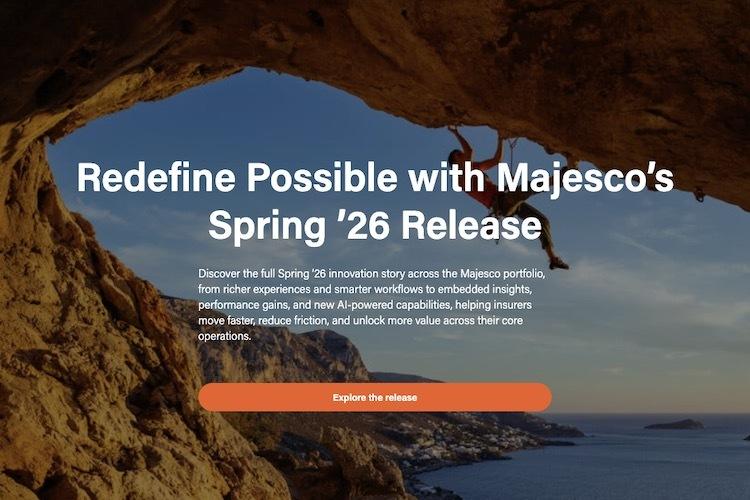
Majesco Launches Spring ’26 Release with AI, Workflow Enhancements | Insurance Innovation Reporter
Majesco (Morristown, N.J.) *has launched its **Spring ’26 Release*, introducing new capabilities designed to streamline workflows, enhance automation and expand AI-driven functionality across its insurance platform.
The release focuses on reducing operational friction by integrating task management, analytics and AI into core insurance processes, enabling insurers to manage policy, billing and claims workflows within a more connected system.
“Spring ’26 marks an important step forward for our customers as they navigate increasing complexity and rising expectations across their businesses,” comments Manish Shah, President and Chief Product Officer, Majesco. “This release advances Majesco’s vision for intelligent, connected, and AI-powered core operations built around intelligence on tap, human–agent teams that enable insurers to scale rapidly, operate with agility and resiliency, and generate business value faster than traditional companies by deeply integrating AI in business processes across the value chain.”
The platform introduces agentic AI capabilities designed to automate multi-step workflows and provide real-time insights within the flow of work, supporting underwriting, servicing and claims operations.
Cyber Risk
Same breach, different crisis: Industry decides the real cost of cybercrime
In today’s digitized world, no sector is safe from the worrying rise in cybercrime. Research from CrowdStrike found that 78% of companies were targeted by a ransomware attack in the past year, with IBM finding that ransomware costs for incidents disclosed by attackers sit at over $5 million.
And while cyber-attacks affect every industry, the nature of the exposure varies significantly from sector to sector. Healthcare organizations must protect sensitive patient records and maintain operational continuity, while manufacturers face risks tied to operational technology and supply chain disruption.
Retailers handle large volumes of customer payment data, making them prime targets for breaches, whilst financial institutions face intense regulatory scrutiny alongside the threat of sophisticated cybercrime. MORE
Commentary/Opinion

From Volatility to Value: How Carriers Can Build Durable Growth
Growth has returned to the boardroom agenda for insurers, but this time under far less forgiving conditions.
Executive Summary
EY Americas Insurance Sector Leader Jeff Gill argues that in today's structurally volatile insurance market, growth requires deliberate, disciplined choices rather than reliance on market cycles, with carriers treating risk insight, AI, cost discipline and partnerships as interconnected parts of a single growth system. Gill emphasizes using data and AI to deepen customer and risk understanding, reinvesting cost savings into modernization, reskilling and customer-focused innovation, and strategically leveraging capital and ecosystem partnerships to build durable, customer‑centric growth.
Softening property and casualty premiums, rising social inflation, tighter capital, regulatory pressure, market volatility and talent gaps mean carriers can no longer rely on market cycles or small fixes to drive results. In today’s environment, growth depends on making clear, intentional choices about competition, risk, customer experience and capital deployment. ARTICLE
Telematics, Driving & Insurance

Report: The Most-Used Apps Behind the Wheel - Cambridge Mobile Telematics
[Ed. Note: This is an exceptionally interesting and very well produced report. Information packed – full of surprises and insights.]
The apps that drivers admit they use and what this means for road safety
From editing spreadsheets to ordering burgers, drivers are using a surprising variety of apps behind the wheel. Based on a nationwide survey of over 1,700 drivers, this in-depth analysis highlights how digital behaviors behind the wheel are evolving, offering a unique year-over-year look at distracted driving, demographic gaps, and new red flags.
InsurTech/M&A/Finance💰/Collaboration

Honk and CurbsideSOS Combine to Accelerate Innovation in Roadside and Towing Services
[Ed. Note: This follows closely behind Agero's acquisition of Urgently, a competitor to HONK. The addtion of ex-GrubHub founders/execs and Frontenac PE to the HONK team should help accelerate innovation and competition. Auto insurers should take note for Roadside Assistance and Accident Management solutions ]
Honk Technologies (“Honk”), the technology-enabled service provider transforming roadside assistance and vehicle logistics, today announced the sale of its business to Frontenac, a Chicago-based private equity firm.
At the closing of this transaction, Honk completed a strategic add-on acquisition of CurbsideSOS, bringing together two companies focused on building the next generation of digital infrastructure for roadside assistance, accident management, and mobility services.
Going forward the combined business will be led and managed by former members of the Grubhub leadership team including, Adam DeWitt, CEO of Honk and former CEO of Grubhub, Matt Maloney, Chairman of Honk and founder of Grubhub, Eric Ferguson, COO of Honk and former COO of Grubhub, and Morgan Hughes, CFO of Honk and former CFO of Cambly and senior finance executive at Grubhub. Collectively, this team brings a proven track record of scaling complex logistics systems and a focus on operational excellence across large-scale organizations.
Maloney founded Grubhub and, together with DeWitt and Ferguson, built it into one of the largest logistics marketplaces in the world, pioneering technology that connected tens of millions of consumers with businesses and service providers to deliver products from order to doorstep in less than 40 minutes. This experience will help accelerate Honk’s mission to modernize roadside assistance and towing services through AI-powered optimized dispatch, real-time transparency, and a more connected provider network.
Roadside assistance is evolving from a manual, closed-network service into a real-time logistics layer because of increasing connectivity and customer expectations. This is especially important for insurance carriers, OEMs and fleets, who are under growing pressure to improve response times, control costs, increase visibility, and deliver a better customer experience across both roadside and claims-related events.
InsurTech funding rose in 2025 to $5.1 bn as Q4 capped a stronger year
Global InsurTech funding picked up in 2025 after three weak years. Total investment rose 19.5% year on year to $5.1 bn, the first annual gain since 2021. Q4 drove part of the shift, according to Gallagher Re.
Global InsurTech funding jumped 66.8%, rising from $1.01 bn in Q3 2025 to $1.68 bn in Q4 2025.
P&C posted the sharper recovery. Funding in that segment rose 34.9% from 2024’s trough to $3.49 bn in 2025. L&H moved the other way, with funding slipping modestly over the year.
Across both segments, investors kept backing standalone technology firms over businesses selling themselves as tech-enabled brokers and MGAs. The tilt wasn’t subtle.
The United States widened its lead in insurance technology. Its share of global InsurTech deals increased by 5.16 percentage points between 2024 and 2025, the largest gain recorded by any country.
AI also pulled in a huge slice of capital. Roughly two-thirds of annual InsurTech funding went to AI-focused companies, with more than $3.3 bn raised across almost 230 deals, according to Beinsure analysts.
Global InsurTech funding rose from $4.25 bn in 2024 to $5.08 bn in 2025. The market’s annual increase leaned heavily on a sharp rise in $100 mn-plus mega-rounds.
Claims
Wholesale Used-Vehicle Prices Rose 6.2% in March, With Implications for Total Loss Decisions -
Wholesale used-vehicle prices increased in March, with the year-over-year gain already outpacing what Cox Automotive projected the index would deliver by the end of the full year. This development may affect how many vehicles cross into total loss territory this spring and what collision repair shops see on their lifts in the months ahead.
The Manheim Used Vehicle Value Index, published April 7 by Cox Automotive, reflects a 6.2% year-over-year gain in wholesale used-vehicle prices on a mix-, mileage-, and seasonality-adjusted basis.
THE CONNECTION TO TOTAL LOSS FREQUENCY
The relationship between wholesale vehicle values and collision repair volume has been a consistent thread in industry data over the past two years.
CCC Intelligent Solutions' annual Crash Course 2026 report found total loss frequency rose to 23.1% of all claims in 2025 — a new record — and 23.9% for non-comprehensive losses. Vehicles between seven and 12 years old now represent nearly 41% of total loss valuations, up from 33.4% in 2020.
CCC's Q2 2025 Crash Course Report had identified declining used-vehicle values as a contributing factor to rising total loss frequency, which at that point had reached 22.6% of all claims through April 2025. That report also noted that used values were "beginning to rebound due to supply and demand dynamics."
When wholesale used-vehicle prices fell in July 2025, a corresponding analysis found that lower ACVs push insurers to the total loss threshold sooner, reducing the pool of repairable work available to collision shops. Rising values work in the opposite direction.

State Farm settlement over totaled car payouts receives preliminary approval
A federal judge has granted preliminary approval to a class action settlement resolving claims State Farm underpaid policyholders for total loss vehicle claims.
Plaintiff Rose Chadwick filed the class action lawsuit against State Farm in November 2021, alleging the insurance company underpaid policyholders who filed claims for total loss vehicles.
The plaintiff claimed State Farm systematically underpaid insureds for total loss claims, in breach of its insurance contracts and the implied covenant of good faith and fair dealing. Chadwick alleges the company did so by basing compensation on valuation reports that applied “typical negotiation adjustments” (TNA), which, she contends, are improper.
State Farm denies the allegations but agreed to settle the total loss claims class action lawsuit to avoid the burden, expense and uncertainty of ongoing litigation.
Under the terms of the State Farm settlement class action, the insurance company will pay $15,583,700 to resolve the claims.
Legal System Abuse/Social Inflation

Corporate Class Action Spending Projected to Hit $4.8 Billion as Nearly All Large Companies Face Regular Claims
Class action defense spending by companies is projected to reach $4.8 billion in 2026, marking the 11th consecutive year of record growth, according to Carlton Fields’ annual Class Action Survey reported by Risk & Insurance.
The big picture: The sustained growth reflects a fundamental shift in the litigation landscape. Nearly 92% of major companies now face class actions regularly — up from about half of companies 15 years ago — as plaintiffs’ attorneys expand their targets and companies struggle with declining insurance coverage and rising defense costs.
By the numbers:
- Defense spending increased 5.9% over 2025 levels, with class action defense now consuming 11.8% of corporate litigation budgets.
- 74.7% of companies are actively managing at least one class action matter, a record high.
- Labor and employment claims represent 29.6% of class action matters, followed by consumer fraud (22.4%) and data privacy/cybersecurity (11%).
- Insurance reimbursement plunged to just 17.2% of class action defense costs, down sharply from 48.2% the prior year.
- 81% of corporate counsel expect class actions stemming from generative AI use, though only 5.7% have faced one to date.
The takeaway: Companies face a perfect storm of rising litigation, eroding insurance coverage and diminishing protection from contractual safeguards which is forcing them to prioritize aggressive early case assessment and trusted outside counsel relationships.