
News
Auto Industry’s Hottest New Model: Selling Insurance
South Korea-based automaker Hyundai has announced plans to launch its own branded insurance carrier, joining Tesla, Honda, and GM, among others, in entering the car insurance business.
In a filing with the U.S. Patent and Trademark Office, Hyundai applied for a trademark called "Hyundai Secure+," which it said was for "insurance services; underwriting and administration of property and casualty insurance, including automobile insurance providing coverage for property damage and third-party liabilities."
The filing comes on the heels of a $9 million settlement Hyundai reached with attorneys general in 34 states that complained Hyundai and Kia sold millions of vehicles without industry-standard anti-theft devices. Insurers sued the companies over those claims and restricted coverage after a rash of break-ins and thefts.
Move is more than just legally motivated
Hyundai's motives for entering the insurance market, however, may be about more than that past settlement. Economics could also play a larger role. Insurance premiums have grown more than 40% since 2019, and companies now spend up to 20% of their premium revenue on marketing, advertising, and agents' commissions, executives point out.
"By bringing insurance in-house, auto companies can keep the marketing and commission costs down and/or share some of that with dealerships," Guillermo Francisco Cornejo, a former Hyundai Capital executive, told Insurify.
USAA Puts Money Back in Members’ Pockets with Ways to Save, Strengthen Budgets
Association is Reducing Auto Premiums, Offering No-Interest Government Shutdown Loans, and Returning a Historic $3.8 Billion to Members
At a time when family budgets are under pressure, USAA is taking proactive steps to lower rates for millions of members, put money back in their pockets through a range of financial rewards, and make significant investments to strengthen military families.
This year, we expect about half of USAA auto members will see reductions in their six-month premiums, ranging from small adjustments to a few hundred dollars in savings, depending on state and individual circumstances. Together with a range of other discounts and benefits, members can expect greater value that saves money and strengthens their financial resiliency.
“We know American families have been stretched by higher costs over the past few years,” said USAA President and CEO Juan C. Andrade. “When market conditions improve, our focus is simple: pass those improvements back to members and help them keep more of what they earn. In 2026, members will see stabilization in premiums — and for many, meaningful reductions. And we continue to provide relief when it matters most.”
USAA stands ready to support eligible members impacted by government shutdowns, helping them maintain financial stability through a period of uncertainty. Last year, impacted members benefited from nearly $450 million in no interest loans, payment extensions and fee waivers from USAA during the government shutdown. Additionally, the Association returned approximately $3.8 billion in financial rewards to members — the largest in its 103-year history.
Climate/Resilience/Sustainability

State bill would mandate insurance for homeowners who reduce wildfire risks
State legislation introduced Wednesday would require insurers to offer California homeowners insurance if they take steps to reduce wildfire risk on their properties.
A bill requiring insurers to offer coverage to California homeowners who make their property resistant to wildfires was introduced Wednesday in the Legislature.
SB 1076, by state Sen. Sasha Renée Pérez (D-Alhambra), would require insurers to offer and renew coverage for any home that meets wildfire-safety standards adopted by the insurance commissioner starting Jan. 1, 2028.
The Insurance Coverage for Fire-Safe Homes Act would allow the commissioner to impose a five-year ban on insurers from operating in the state’s auto and home markets if they don’t comply. An insurer would also be banned from the markets for five years if it decides to cease offering property insurance under the law.
However, the bill allows insurers to seek a temporary waiver from the mandate if they can show they have an over-concentration of risk in a geographic area.
Financial Results
Progressive's growth engine downshifts as auto insurance competition tightens
After two years of double-digit expansion, the industry giant's January numbers signal a new phase
The Progressive Corporation reported net premiums written of $6.7 billion for January 2026, a 4% increase from a year earlier, as the auto insurance giant's growth continued to cool from the double-digit pace that defined much of 2024 and 2025.
Net income for the month came in at $1.2 billion, or $1.98 per diluted share, compared to $1.1 billion, or $1.90 per share, in January 2025.
The combined ratio was 84.4%, up 0.3 points year over year but well inside the 96% ceiling that CEO Tricia Griffith has described as the threshold below which the company aims to "grow as fast as we can."
The deceleration in net premiums written has been steady. Progressive posted growth of 17% in the first quarter of 2025, easing to 12% in the second, 10% in the third, and 8% in the fourth, company filings showed. Full-year 2024 saw growth of roughly 21% across all lines.
Policies in force totaled 38.9 million as of January 31, a 10% increase from 35.3 million a year earlier. That growth rate has tapered from roughly 15% at mid-2025 and 18% at year-end 2024, when the company closed the year at 35.0 million policies.
Direct auto insurance policies grew 14% to 16.2 million, outpacing agency auto at 10%. Property, the slowest-growing segment, rose just 3% to 3.7 million.
Allstate books $175 million loss in January
Allstate Corporation reported an estimated $175 million in catastrophe losses for January 2026, primarily driven by Winter Storm Fern.
After tax, the estimated losses totaled $138 million.
The company also provided updated policy counts across its Allstate Protection segment as of January 31, 2026.
Total policies in force reached 38.26 million, representing a 2.2% increase compared to January 31, 2025, though essentially flat compared to December 31, 2025.
Auto policies in force totaled 25.48 million at the end of January, reflecting a 2.6% year-over-year increase but a slight 0.1% decline from the prior month. Homeowners’ policies reached 7.71 million, up 2.5% year over year and 0.2% sequentially. Other personal lines policies stood at 4.89 million, rising 0.6% from a year earlier but edging down 0.1% from December.
Lemonade reports 28% net loss improvement and 53% revenue growth for Q4’25 - Reinsurance News
Lemonade, an AI-powered digital insurance company, has announced its fourth quarter of 2025 financial results, reporting a net loss of $21.7 million, a 28% improvement compared to the $30.0 million loss seen in the same period last year.
Highlighting a period of significant growth and narrowing losses, Lemonade also reported a 31% increase in force premium (IFP), to $1.24 billion, as compared to Q4 2024. Customer count in Q4 2025 increased by 23% to 2,984,513 as compared to the fourth quarter of 2024.
The company saw its revenue increase 53% to $228 million year-over-year. A significant driver behind this growth was a strategic change to Lemonade’s reinsurance structure.
As of July 2025, the company reduced its quota share cession rate from 55% down to 20%, a shift allowed Lemonade to retain a much larger share of its premiums.
Gross Profit increased 73% year-over-year, to $111 million, due to revenue growth and an 11 percentage point year-over-year improvement in the Gross Loss Ratio to 52%.
Westfield Specialty GWP rises above $1.9bn for 2025
Westfield Specialty's gross written premium (GWP) reached $1.93bn at the end of 2025, with a Combined Ratio (CR) of 93.1% and underwriting income of $87.2mn, meaning that results came in considerably ahead of plan. The acquisition and retention of high-quality talent in the market have enabled Westfield Specialty to continue to deliver on its original underwriting strategy of building a broad diversified portfolio that is focused on underwriting profitability.
The $1.93bn GWP splits relatively evenly across regions, with 55% of GWP coming from the US business and 45% from Westfield Specialty's International operation, headquartered in London. The US Specialty businesses produced $948mn in GWP, its Surety business produced $105mn in GWP and International businesses delivered $874mn in GWP.
Jack Kuhn, President of Westfield Specialty, said: "Westfield Specialty's success in 2025 was driven by our ability to attract and retain the best talent in the market, supporting our philosophy of empowering underwriters to pursue new risks and broaden our portfolio.
Research
2,800 Teen Deaths. 3x the Risk. Why the First Year Behind the Wheel is the Most Dangerous
The driver's license photo may be slightly awkward, but the milestone is unforgettable. For families, a newly licensed teen means independence, busy schedules — and a new set of responsibilities.
Motor vehicle crashes remain one of the leading causes of death for U.S. teens, according to the Centers for Disease Control and Prevention (CDC). Data from the National Highway Traffic Safety Administration (NHTSA) shows drivers ages 16–19 are nearly three times more likely to be involved in a fatal crash than drivers 20 and older, per mile driven.
The statistics are serious — but they're also manageable.
"With the right preparation, teen driving doesn't have to feel overwhelming," said Susan Irace, Manager, Divisional Claims at Mercury Insurance. "Experience is what young drivers are building. Parents can help shorten that learning curve with structure, technology and smart coverage decisions."
Why the First Year Matters
Federal safety data shows crash risk is highest in a teen's first year of independent driving. Night driving, teen passengers and distracted driving increase that risk — while seat belts, graduated licensing laws and supervised practice significantly reduce it.
In 2023, more than 2,800 teens ages 13–19 were killed in motor vehicle crashes nationwide, according to the CDC. The encouraging news: teen crash rates have declined over time thanks to safer vehicles, graduated driver licensing programs and greater awareness of distracted driving.
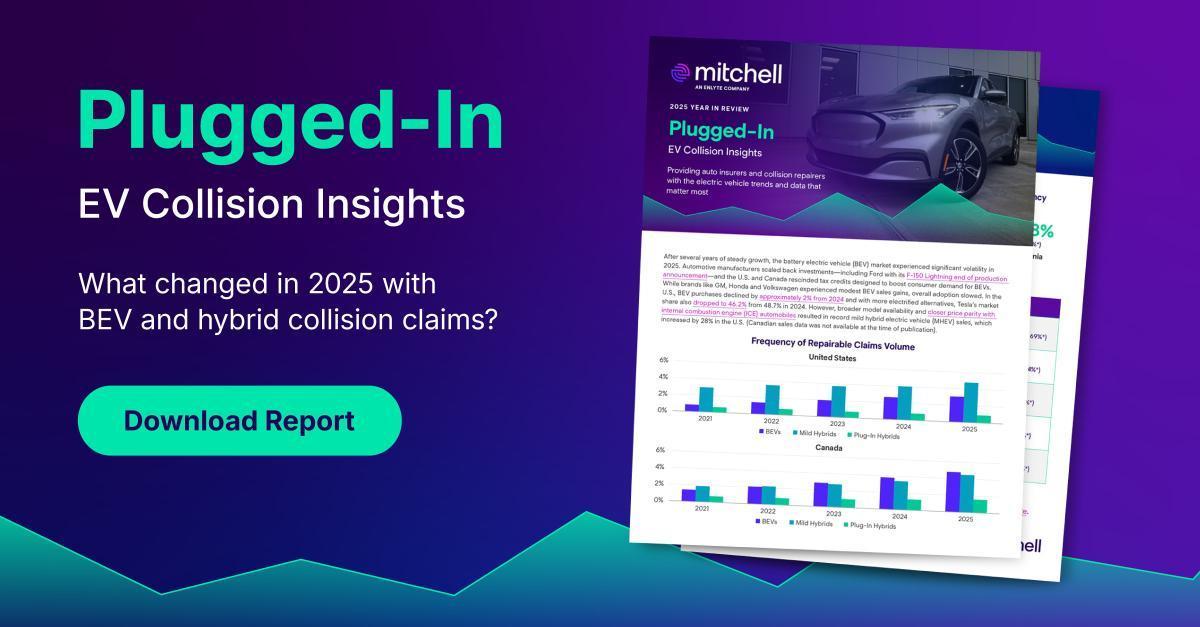
Plugged-In: EV Collision Insights 2025 Year in Review | Mitchell
After several years of steady growth, the battery electric vehicle (BEV) market experienced significant volatility in 2025.
Automotive manufacturers scaled back investments—including Ford with its F-150 Lightning end of production announcement—and the U.S. and Canada rescinded tax credits designed to boost consumer demand for BEVs. While brands like GM, Honda and Volkswagen experienced modest BEV sales gains, overall adoption slowed. In the U.S., BEV purchases declined by approximately 2% from 2024 and with more electrified alternatives, Tesla’s market share also dropped to 46.2% from 48.7% in 2024.
Ryan Mandell, Vice President, Strategy & Market Intelligence, Mitchell/Enlyte
AI in Insurance

NAIC group nearly set to kick off pilot test to evaluate insurers' use of AI -
State insurance regulators moved closer Tuesday to launching a multistate pilot of a new artificial intelligence evaluation tool this spring.A National Association of Insurance Commissioners group moved closer Tuesday to launching a multistate pilot of a new artificial intelligence system evaluation tool this spring.
The Big Data and Artificial Intelligence Working Group addressed industry feedback during the call. Industry trade groups are critical of the effort.
The AI system evaluation tool is expected to enter a pilot phase in the coming weeks, with Colorado, Maryland, Louisiana, Virginia, Connecticut, Pennsylvania, Wisconsin, Florida, Rhode Island, Iowa and Vermont participating.
Insurance companies have steadily expanded their use of artificial intelligence over the past decade, moving from basic automation to more sophisticated applications throughout the insurance value chain. More recently, generative AI and advanced automation have reshaped how insurers engage with customers and manage internal operations.
Through it all, NAIC regulators have struggled to establish guardrails to preserve fairness, transparency and consumer protection. The working group proposed the AI Systems Evaluation Tool over the summer. Regulators are not required to use it, but it is another option when performing market conduct exams, regulators have said.
Protection Gaps
96% of customers found Rental Reimbursement valuable once they needed it.
We all know that the moment after an accident can be overwhelming for customers. What we sometimes forget is how much a simple coverage decision—made months or years earlier—can shape that experience. It’s why I wasn’t surprised, but still encouraged, to see that 96% of customers found rental reimbursement valuable once they needed it. It’s a powerful testament to proactive guidance.
Linkedin post from Vanessa Wilkin, Vice President | Replacement & Leisure Division | Enterprise Mobility | Global Partnerships & Customer Experience
Webinars/Podcasts/Interviews

What You Haven't Heard About AI in the Collision Industry: CIECA Webinar | Thursday, March 12, 2:00 PM
[Ed. Note: Recommended]
What You Haven't Heard About AI in the Collision Industry
During the one-hour live broadcast, Bill Brower, Senior Vice President of North America Claims and Global Industry Relations at Solera, and Mark Fincher, Vice President, Product Management at CCC Intelligent Solutions, will discuss how artificial intelligence (AI) is currently being used in the collision industry and share predictions for the future.
During the free webinar, the speakers will address:
- AI Operational Use & Common Misconceptions
- AI in Damage Assessment
- AI in the Customer Experience
- CIECA’s role in AI
- Predictions for the Future
Thursday, March 12, 2:00 PM - 3:00 PM
Online
Anyone can view and join.