
News
Winter Storm Chan Set To Dump Snow, Ice On Northeast | Weather.com
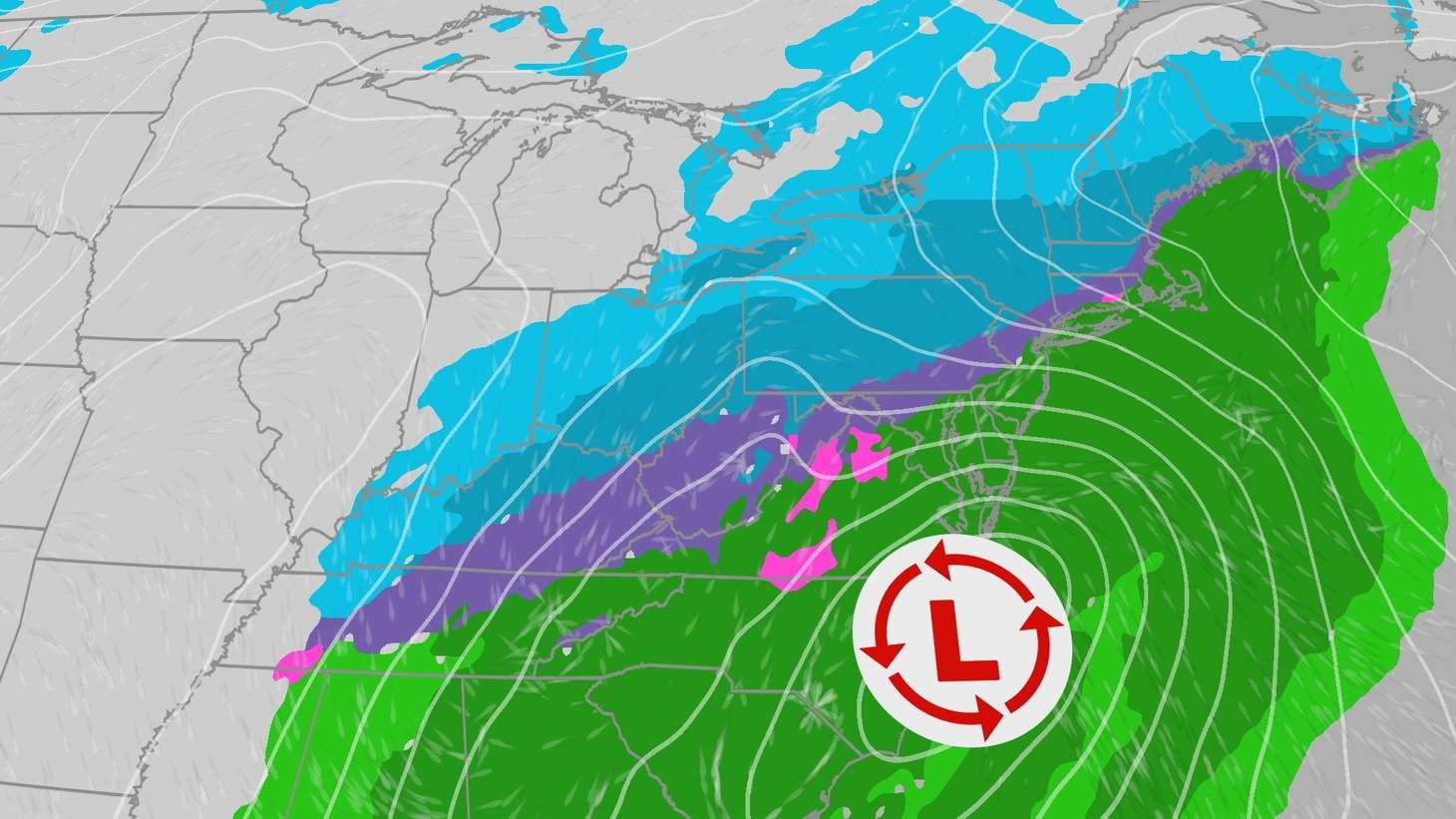
Back-to-back winter storms will bring more snow to the Midwest and Great Lakes Monday after accumulating snow this weekend. Winter Storm Chan will intensify off the East Coast, bringing the potential for snow and ice to the Northeast Tuesday into Wednesday. I-95 cities need to monitor closely, especially Boston.
A new winter storm, Winter Storm Chan, will bring more snow to the Midwest and Great Lakes after Winter Storm Bellamy continues to impact holiday travel. Then Chan will set its sight for the Northeast, potentially bringing widespread icing and significant snow to the region Tuesday into Wednesday morning.
After Years of Hikes, Auto Insurers Are Now Cutting Rates in Several States
Major insurers are filing for rate cuts in California, Florida, and Louisiana after steep increases. For shops, the underlying dynamics are worth watching.
After years of double-digit rate increases that pushed auto insurance costs to record highs, insurers in several states are now filing for rate reductions. In California, Florida, and Louisiana, major carriers have announced cuts ranging from 6% to 15%, citing factors including improved loss ratios, fewer accidents, and reduced litigation costs. For collision repairers, the trend is worth watching because insurer profitability and claims dynamics have a direct impact on shop volume and reimbursement negotiations.
The shift comes after auto insurance emerged as the leading contributor to inflation nationwide in 2024. That year, the average annual premium reached $2,543, up 26% from 2023, according to Bankrate. Insurers had implemented steep rate increases following years of climbing claims costs, supply chain disruptions, and rising repair expenses. Premiums have continued to rise in 2025, reaching an average of $2,697 for full coverage, but the pace of increases has slowed significantly — a sign that the market may be stabilizing after years of turbulence.
Hertz’s controversy and the future of automotive inspections
The issue isn't the technology for precise vehicle inspection; it's how it’s utilized.
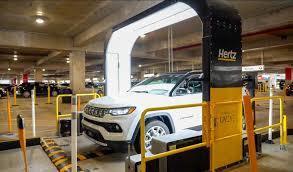
The recent controversy surrounding Hertz, where customers have been charged hundreds of dollars for minor, sometimes invisible, damage to rental vehicles, has sparked a public outcry.
The issue stems from the company’s use of advanced imaging and AI to meticulously document a vehicle’s condition upon return, a process that has been criticized for a lack of transparency and its flagging of issues that previously might have been considered “normal wear and tear.”
While the backlash is understandable, the underlying technology itself represents a significant step forward for the automotive industry, one that must be adopted with a crucial element: balance.
Brad Kokesh is president and COO of TraXtion. All opinions are the author’s own.
Research

MIT study finds AI can already replace 11.7% of U.S. workforce
KEY POINTS
- Massachusetts Institute of Technology released a study that found that artificial intelligence can already replace 11.7% of the U.S. labor market.
- The study was conducted using a labor simulation tool called the Iceberg Index, which was created by MIT and Oak Ridge National Laboratory.
- For lawmakers preparing billion-dollar reskilling and training investments, the index offers a detailed map of where disruption is forming down to the zip code.
Commentary/Opinion

Why Reciprocal Insurance Exchanges Are Back in Fashion
Reciprocal insurance exchanges have been increasingly popular in recent years, with third-party investor interest in the fee-for-service businesses that manage RIEs and waning property insurance capacity in catastrophe-prone regions supporting the resurgence.
Third-party investors “are not exposed to the insurers’ underwriting and investment performance but rather derive steady fee income from operating the attorney-in-fact” of a reciprocal exchange, observes Rick Cheney, senior analyst at ALIRT and author of the late-October report, “Overview of Reciprocal Insurance Exchanges and Recent Market Trends.”
ALIRT’s new report explains that RIEs are unincorporated insurance entities owned by policyholders, or “subscribers.” Distinct from stock or mutual insurers, RIE policyholders share directly in profits and losses and appoint an “attorney-in-fact” (AIF) to manage operations.
Telematics, Driving & Insurance
Aviva to close down DLG’s By Miles - Insurance Post
After acquiring Direct Line Group earlier this year, Aviva is closing down pay-per-mile insurtech By Miles, Post can reveal
In a message sent to customers, and seen by Insurance Post, By Miles said it will stop offering renewal quotes to customers on 6 January 2026.
Azuga Releases New Whitepaper Demonstrating How Dashcam-Based Video Telematics Can Help Carriers Reduce Losses and Improve Commercial Auto Profitability
Azuga, a Bridgestone company and a leader in fleet management, video telematics and safety solutions, published its new whitepaper, *The Case for Dashcam-based Commercial Auto Insurance.
Drawing on data from thousands of fleets and deep experience with insurers, the paper examines how connected dashcams are helping insurers address rising claim costs, fraud, and growing pressure around liability and litigation and why more carriers are turning to video to gain clarity and control in today’s challenging market.
“Better visibility leads to better decisions. With clear, reliable video, insurers and fleets gain the confidence they need to manage risk more effectively.” - Thomas Erdman, Executive Vice President, Azuga
The commercial auto industry continues to face significant volatility: claim severity trends remain elevated, nuclear verdicts are reshaping settlement strategies, and staged accidents are increasingly targeting commercial vehicles. The whitepaper outlines how dashcam programs, when supported by video insights and driver-safety tools, can offer insurance carriers a clearer, more accurate view of fleet risk, helping improve both operational efficiency and underwriting outcomes.
AI in Insurance
Allianz to cut 1,500-1,800 travel insurance jobs as AI accelerates: Report
With AI continuing to reshape processes across businesses worldwide, insurance giant Allianz is planning to reduce its workforce by between 1,500 and 1,800 positions within its travel insurance operations over the next 12 to 18 months, according to sources familiar with the plans. The reductions will predominantly affect call centre operations across the division.
Allianz Partners, the travel insurance unit undertaking the restructuring, currently employs 22,600 people across its global operations, with approximately 14,000 engaged in handling customer inquiries and claims processing via telephone.
The company said that it is "actively examining how technological change will affect all employees," noting that such changes could "also impact roles that are currently heavily reliant on manual processes."
Redefining the Claims Process With Agentic AI-Powered Workflows
Generative, deep learning, machine learning, LLMs, prompt engineering, agentic, autonomous. All the AI buzzwords saturating everyday conversations make it difficult to decipher what forms of AI there are, how capabilities differ, and what it means for different industries.
For P&C, the rise of Generative AI sparked rapid acceleration of R&D across everything from underwriting and marketing to billing and claims operations. But as tools kept coming, the limitations of GenAI became clear when it came to handling specificity, adjusting to edge cases, or taking action outside of analyzing and regenerating existing data.
Early use cases of AI in P&C looked like simple automation of manual tasks like summarizing adjuster notes, drafting emails, or flagging potential fraud based on patterns it was trained to identify. The evolution of AI-powered insurance tools has already changed how underwriting, communications, and claims are handled across every line of business.
But like most technology, the next iteration was already in development, and it’s here. Agentic AI marks a new evolution in automation, capable of tackling complex challenges, taking autonomous action, and simplifying intricate processes like building and deploying workflows. These systems don’t just generate content like their predecessors. Agentic has the power to completely transform the way we work, helping us to make decisions, adapt to changing conditions, and execute tasks—all within the parameters we provide it.
Where Agentic AI differs from GenAI
GenAI has a critical role in claims. It excels at instant analysis and content generation, and can follow natural language prompts for summarization, data validation, and similar tasks in seconds. This saves adjusters and admins countless hours over the lifecycle of a claim.
But Agentic AI takes action. It can make decisions, adapt to evolving claim details, and operate autonomously to reach defined outcomes, alerting adjusters only when human input is required. This shifts workflows from reactive to proactive. It creates a system that anticipates and initiates work in real-time without requiring constant prompting.
What Makes Claims Workflows an Ideal Use Case For Agentic AI
Even as technology advances across insurance operations, claims remain the defining moment of truth for carriers. Yet many claims teams continue to rely on siloed systems, manual triage, and fragmented workflows due to a lack of resources to automate operations or a lack of understanding of where to start.
Agentic AI can change that narrative. It can:
- Execute multistep workflows independently. From gathering evidence to coordinating service providers and payments, Agentic AI can manage routine claims from start to finish entirely touchless.
- Collaborate with adjusters in real-time. For complex claims, Agentic AI can assist human adjusters with providing relevant policy clauses or exclusions, suggesting negotiation strategies, or simulating potential outcomes to inform decision-making.
- Coordinate catastrophe responses. During large-scale natural disasters, Agentic AI systems can track changes, identify at-risk properties, initiate early claims notifications, and begin outreach before claims are formally filed. Automate subrogation workflows. By identifying recovery opportunities, predicting liability, and initiating subrogation files, Agentic AI improves accuracy and recovery rates without costing carriers more.
What Claims Leaders Should Consider. As Agentic AI becomes a practical reality, claims leaders should:
- Redefine human roles - As AI agents take over repetitive tasks, human adjusters evolve into strategic problem solvers focused on high value decisions.
- Prioritize control - Agentic AI opens up a new segment of opportunities, but it requires precise, methodical guardrails in high-value use cases like claims. Agentic AI tools that are configurable, coachable, and compliant with any set of rules or parameters provided are the ones that will be the most powerful in claims.
- Scale thoughtfully - Start by adopting Agentic AI for specific use cases and scale based on measurable impact.
For claims organizations, the shift from GenAI to Agentic AI isn’t just technical; it’s operational. It’s a movement towards claims that don’t only anticipate, but act and continuously improve, delivering faster resolutions and more resilient operations.
2026 Outlook/Predictions

2025: OUR PUBLISHED ARTICLES
Links to all articles co-authored by Alan Demers and Stephen Applebaum
Embedded Insurance Approaches Tipping Point
Race to the Bottom - Destructive Cycle in P&C Insurance Ecosystem
AI Could Break the Garter Hype Cycle
OPEN LETTER TO ILLINOIS SECRETARY OF STATE
Insurance Ecosystem: Navigating a New and Unfamiliar World
Hulk Hogan and Wrestling with Image in the Insurance Ecosystem
Rear View Mirror Reveals Direction of The P&C Ecosystem
(Re)defining Empathy in Insurance
AI CAN FIX EVERYTHING IN INSURANCE
RISING UNCERTAINTY: RISK & OPPORTUNITY FOR INSURANCE RESILIENCE
Trust, Personalization and Transparency
P&C INSURANCE: MIND THE GAP(S)
P&C INSURANCE CLAIMS: THE TIME HAS COME

2026 Insurance Industry Outlook: Key Trends & Insights for Future Growth - West Monroe
INSURANCE TRENDS IN 2026
- CYBER THREATS TEST INSURERS’ OWN DEFENSE Carriers face the dual challenge of underwriting more cyber policies while defending their own systems against increasingly sophisticated AI-enabled attacks that threaten operations and trust.
- CUSTOMER EXPECTATIONS PROMPT INSURERS TO EVOLVE PRODUCTS IN REAL TIME Demand for personalized, flexible products is pushing** insurers to deliver dynamic offerings that adjust with customers’ lives and integrate seamlessly across digital ecosystems.
- INSURERS ARE REBUILDING TECHNOLOGY THAT CAN CHANGE AS FAST AS THE MARKET After years of failed overhauls, carriers are embracing modular, composable systems that evolve with market shifts—reducing risk while speeding innovation.
- WEATHER, SOCIAL, AND AI RISKS ARE BREAKING OLD ACTUARIAL RULES Converging risks—from catastrophic weather to social inflation and AI liability—are forcing insurers to rethink pricing models and turn data into foresight.
- M&A IS LEVERAGED TO BUY TECH, NOT TERRITORY Consolidation is accelerating as digitally advanced carriers acquire legacy-burdened competitors, using technology capability—not geography—as the new growth currency.
InsurTech/M&A/Finance💰/Collaboration
North American insurance deal activity grows in Q3, even as total value drops | S&P Global
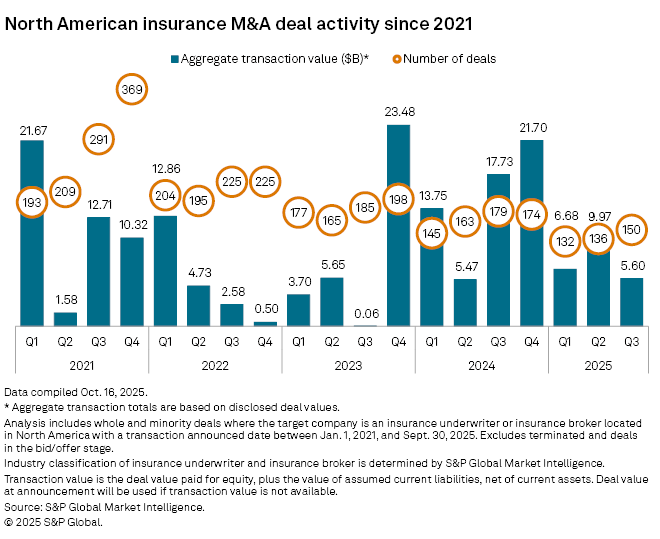
The number of North American insurance deals increased in the third quarter of 2025 compared to the first two quarters of the year, even as the industry's aggregate transaction value fell.
Insurance underwriters and brokers were involved in 150 third-quarter deals totaling $5.60 billion in aggregate, compared to 136 transactions totaling $9.97 billion in the second quarter and 132 transactions totaling $6.68 billion in the first quarter, according to an analysis by S&P Global Market Intelligence.
Insurance M&A trends contrasted with the the broader US and Canadian markets, where transaction value increased but deal totals decreased.
Overall, North American M&A deals announced from July through September were collectively valued at $608.39 billion, up nearly 50% from the second quarter, according to S&P Global Market Intelligence data. The aggregate deal value was higher even as the number of transactions edged down by a bit more than 1%.