
Cyber Risk

Allstate: Impersonation scams are surging
In impersonation scams, fraudsters pose as trusted people or organizations, like banks or law enforcement agencies, and trick people into sending them money.
Impersonation scams have accounted for nearly 60% of the scam cases Allstate has handled so far this year.
In impersonation scams, fraudsters pose as trusted people or organizations, like banks or law enforcement agencies, and trick people into sending them money.
"Scammers make fraud look real by pretending to be someone you trust and pressuring you to act before you have time to think," said Caroline Slane, senior vice president or business operations with Allstate Identity Protection, in a statement. "During the holiday rush, pause and verify an unexpected request before sending money. Allstate is focused on helping customers recognize warning signs sooner, protect their finances and recover from fraud."

Cowbell Launches AI Liability Insurance for U.S. Businesses
Cowbell introduces standalone AI liability insurance covering agentic AI risks, including unauthorized actions, runaway costs, and third-party claims.
- Built for agentic AI, the new coverage addresses first- and third-party losses when AI agents act without human approval, go rogue, or independently produce harmful outputs
- Designed for agentic AI, the policy addresses a business’s own covered losses and third-party claims through a specific “AI Incident” coverage trigger.
- Underwriting incorporates three AI-specific Cowbell Factors™ assessing AI observability, autonomy, and governance, alongside other risk signals.
- Coverage extends beyond incident response and liability to runaway AI usage costs, LLMjacking, and algorithmic discrimination claims.
“SMEs are giving AI greater responsibility for how their businesses operate,” said Trent Cooksley, Co-founder and Chief Operating Officer of Cowbell. “The financial consequences can reach across the business, from money lost in a transaction to interrupted operations and customer claims. We designed Cowbell AI Liability Insurance to help businesses manage those risks as they put AI to work.”
Commentary/Opinion

The Flaw in 'Human-in-the-Loop'
The notion that there must always be a "human in the loop" has become de rigueur in any discussion of AI implementation in business. The cynical side of me suspects that part of the reason is to reassure everyone that AI won't lead to mass layoffs, but there are also plenty of practical reasons to have humans check the work of AIs.
Or maybe not. At least not for long.
A recent article in Harvard Business Review argues that human supervisors quickly become numb and simply approve the recommendations of the AI as it becomes increasingly accurate. And I think the author has a point, based on what I've seen of human/AI interactions in semi-autonomous cars.
There needs to be a better way.
Let's have a look.READ ON
News

Is a Kalshi-style weather contract insurance? Look to insurable interest
A contract that pays a retailer whenever a snowstorm shuts 20% of businesses in its area sounds like a federal swap.
A contract that pays the same retailer for its own lost sales sounds a lot like insurance, which states can regulate. That is the line drawn by Daniel Schwarcz, Fredrikson & Byron professor of law at the University of Minnesota Law School in Minneapolis and a former consumer representative to the National Association of Insurance Commissioners.
The distinction is starting to attract attention as prediction-market operator Kalshi fights state regulators in federal courts over whether its event contracts are swaps under the Commodity Exchange Act. Swaps on exchanges like Kalshi fall under the exclusive jurisdiction of the Commodity Futures Trading Commission (CFTC). The question is important to the industry because insurers have already begun using the exchange as risk capacity, including one that hedged a potential $3 million coaching bonus through Kalshi.
On September 25, the Sixth Circuit ruled against Kalshi in its suits against Ohio and Tennessee gaming regulators.
AI in Insurance

HUB INTERNATIONAL'S VIU BY HUB LAUNCHES FIRST-OF-ITS-KIND HOME AND AUTO INSURANCE SHOPPING PLUGIN IN CHATGPT
Consumers interact with the VIU by HUB Personal Insurance plugin in ChatGPT, or upload a photo of their declarations page, then compare quotes from many carriers
VIU by HUB, an omnichannel insurance brokerage platform backed by Hub International Holdings, Inc. ("HUB"), a leading global insurance brokerage and financial services firm, today launched the VIU by HUB Personal Insurance plugin in ChatGPT, giving consumers a way to find home and auto insurance within a ChatGPT conversation, with follow up from a licensed advisor. The plugin is available now in 48 states. It is a first-of-its-kind plugin in ChatGPT to offer both home and auto insurance shopping from a top insurance broker.
"The VIU by HUB Personal Insurance plugin advances HUB's broader digital strategy to evolve the mainstream consumer insurance experience across our digital portfolio," said Marc Cohen, President and CEO of HUB International. "It adds convenience for clients, brings us closer to the moment a client's coverage needs arise and expands HUB's addressable marke

Fortegra Advances AI-Powered Application Development with insureMO's Atomic APIs and Agentic Engineering
insureMO, a global insurance middle office platform provider, announces that Fortegra, a global specialty insurer headquartered in Florida, is leveraging insureMO's Atomic APIs and Agentic Engineering to develop insurance applications. By combining internal engineering expertise with reusable insurance capabilities, Fortegra can respond faster to the needs of its managing general agent (MGA) partners.
The approach connects Fortegra's investment in AI-enabled engineering teams with insureMO's headless insurance technology platform. This allows Fortegra to build differentiated submissions, underwriting and customer experiences on a shared foundation of insurance services.
Financial Results

Insurtech Lemonade Posts $43.7M Loss for Q3
Insurtech Lemonade reported a third quarter 2026 net loss of about $43.7 million compared with a loss of about $37.5 million during the same time in 2025.
For the nine months ended Sept. 30, Lemonade has posted a net loss of $122.9 million compared with a net loss of $143.8 million a year ago.
In a letter to shareholders, Lemonade characterized its latest quarterly results as “excellent,” with positive topline growth. In force premium (IFP) grew for the 12th straight quarter, up 34%, to $1.55 billion.
Claims
Vanguard Claims Acquires Gibson & Associates Professional Claims Management
Vanguard Claims Administration, LLC ("Vanguard") has acquired the business of Gibson & Associates Professional Claims Management, Inc. ("Gibson"), a Springfield, Missouri-based third-party administrator with a 25-year history in the Lloyd's and domestic markets. The transaction closed on Oct. 30, 2026
The combination strengthens Vanguard's capabilities across general liability, professional liability, auto liability, REO, investor-owned property, outdoor activity liability, and construction defect claims. Financial terms were not disclosed.
"BJ and the Gibson team have earned a strong reputation for the way they take care of their clients and their people," said Brian Gilliam, President and CEO of Vanguard Claims. "We're excited to welcome them. Their experience in multi-line liability strengthens what we can offer, and our clients will benefit from the combination of Gibson's expertise and Vanguard's national platform."
InsurTech/M&A/Finance💰/Collaboration

InsurTech Growth Accelerates as Global Reinsurance Capital Reaches Record Levels
Global reinsurance capital reaches $688 bn as InsurTech companies target AI liability, parametric insurance and automated underwriting to drive premium growth
Record reinsurance capacity and softening insurance rates are creating new growth opportunities for InsurTech companies, particularly those developing AI liability coverage, parametric insurance and automated distribution platforms.
Navigating the global reinsurance market has felt like running into a relentless headwind. It was a classic hard cycle: capacity was fiercely defended, and primary carriers could hit their top-line growth targets simply by riding the wave of double-digit rate increases.
According to Gallagher Re, global dedicated reinsurance capital reached $648 bn at year-end 2025 before increasing to a record $688 bn in the first half of 2026. The expansion reflects continued growth in traditional reinsurance capital and insurance-linked securities (ILS).
Research
Home Insurers Are Back on Offense, MediaAlpha’s Inaugural
MediaAlpha, Inc. (NYSE: MAX), the insurance industry’s leading programmatic customer acquisition platform, today released The State of Home Insurance: What Insurers’ Ad Spending Reveals About the Industry.
Drawing on first-party spending and search data from its marketplace, the report finds that insurers advertising on MediaAlpha’s marketplace in both 2025 and 2026 increased their home insurance ad spending 84% in January–September 2026 over the same period in 2025, and now advertise in about twice as many state markets each month on average as they did in 2023.
“What carriers spend to acquire customers shows where they see opportunity, often well before it shows up in policy counts,” said MediaAlpha CEO and Co-founder, Steve Yi. “By analyzing our data on what we view as the three key forces shaping carrier ad spend behavior – growth, climate, and regulations – we can demonstrate how they are competing and prioritizing ad spend and, ideally, help the market understand as well.”

State Farm Leads Corporate Insight’s 2026 P&C Digital Experience Benchmark for Fourth Straight Year as Allstate and USAA Tie for Second
- GEICO climbs four places to fourth, leaving the top four insurers within three points of each other, as policyholders handle more tasks on their own and app users show growing interest in virtual assistants
Corporate Insight (CI), the leading provider of competitive intelligence and customer experience research to the financial services, insurance and healthcare industries, today announced the release of its 2026 P&C Digital Experience Benchmark, which evaluates the websites and mobile apps of 18 leading personal lines insurers on functionality, design, navigation and usability.
"Both USAA and GEICO gained five points in this year's benchmark, showing that firms are competing and investing in digital experiences," said Jake Littman, insurance research manager at Corporate Insight. "With scores this close, an insurer planning its next digital investment needs to know which everyday tasks policyholders value most and where competitors have already improved them, because one well-executed update can turn an average digital experience into a leading one."
Telematics, Driving & Insurance
Progressive Insurance® Unifies Commercial Telematics with New Snapshot Pro℠ Program
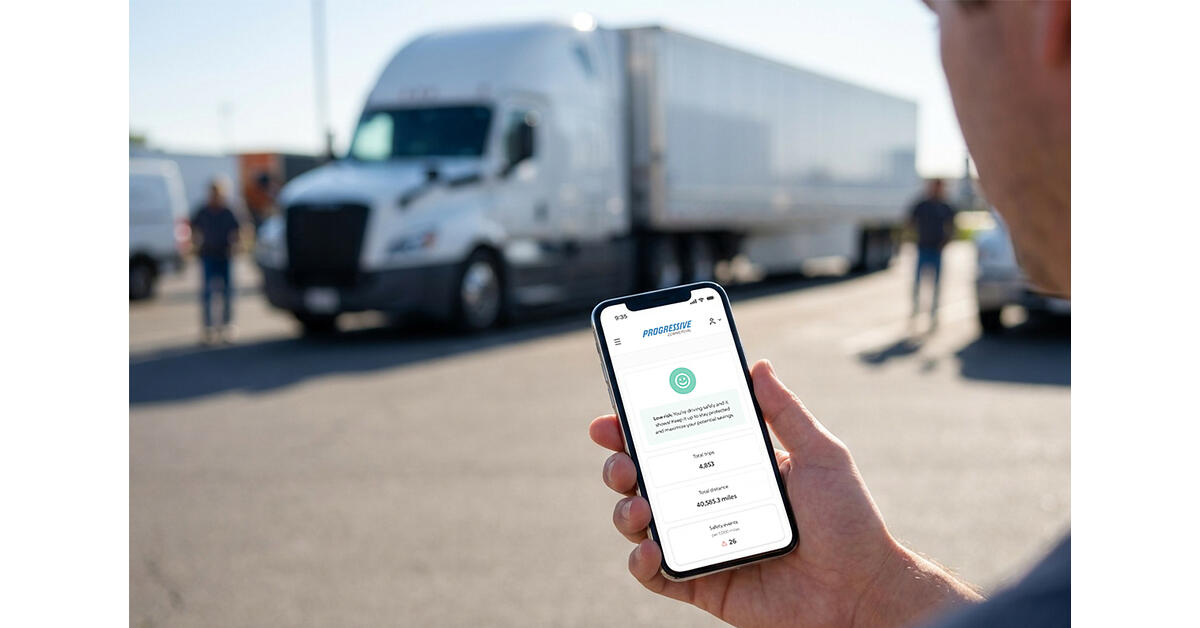
Progressive, the #1 commercial auto insurer and a leader in usage-based insurance (UBI), completed its rollout of Snapshot Pro, a new unified telematics program that offers greater visibility into driving operations and insights, more device options and potential insurance savings at renewal, based on driving behavior.
"Businesses are looking for practical tools that help them operate more efficiently, manage costs and foster safe driving behavior," said Luke Harmer, Progressive Commercial Lines Telematics Product Leader. "By simplifying participation and bringing driving insights together through the Driving Dashboard, Snapshot Pro makes it easier for businesses to incorporate telematics into how they manage their vehicles, while identifying opportunities to save."
BMW and Audi drivers rated worst for dangerous braking, data
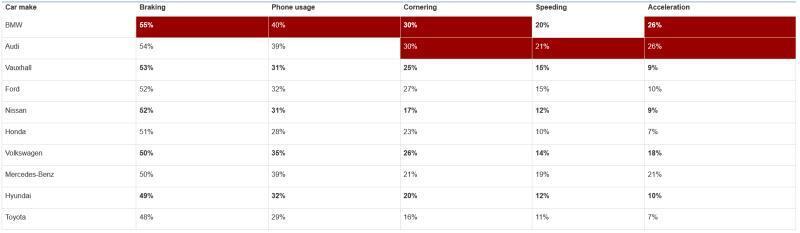
More than half of BMW and Audi drivers scored 'Poor' or worse for harsh braking, according to new data from Marshmallow Car Insurance.
Marshmallow Move, the insurer's telematics service, analysed over 10 million trips over a three-month period.
Different behaviours were scored out of 100 and grouped into six ratings: Dangerous, Very Poor, Poor, Average, Good, and Excellent.
BMW drivers scored Poor or worse 55% of the time for harsh braking. This is well below the score for speeding, where they only scored Poor or worse 20% of the time. It was also above the total average harsh braking score of 51%.
Audi drivers scored Poor or worse 54% of the time for harsh braking.
Nearly 1 in 4 (24%) BMW drivers had a "Dangerous" braking score, with only Audi having a higher percentage (25%). Audi and BMW drivers worst for harsh braking
By vehicle make, BMW drivers recorded the lowest braking scores in Marshmllow Car Insurance's Harsh Braking Report.