
News

Nuclear Verdicts Against Companies Hit Record High in 2025, Topping $25.6 Billion
Corporate defendants faced their highest volume of massive jury verdicts since 2009 last year, according to Marathon Strategies’ annual report on litigation trends, reported Risk & Insurance.
The big picture: Nuclear verdicts have expanded dramatically since 2020 in frequency, total value and severity, spreading across a widening range of industries. Marathon attributes the surge to corporate mistrust, social pessimism, erosion of tort reform and shifting jury demographics, particularly among Millennial jurors who show less trust in companies.
By the numbers:
- 190 lawsuits against corporate defendants produced verdicts of $10 million or more in 2025, a 40.7% jump over 2024.
- Combined value of those verdicts topped $25.6 billion in 2025.
- Thermonuclear verdicts exceeding $100 million topped 40 cases for the second straight year, with four surpassing $1 billion.
- 68 industries were hit with a nuclear verdict in 2025, up from 55 in 2024 and 48 in 2023.
- Since 2020, nuclear verdicts have grown 476% in number and 422% in total sum.
The takeaway: Nuclear verdicts against corporations reached their highest level in 16 years despite an active wave of state tort reform efforts.
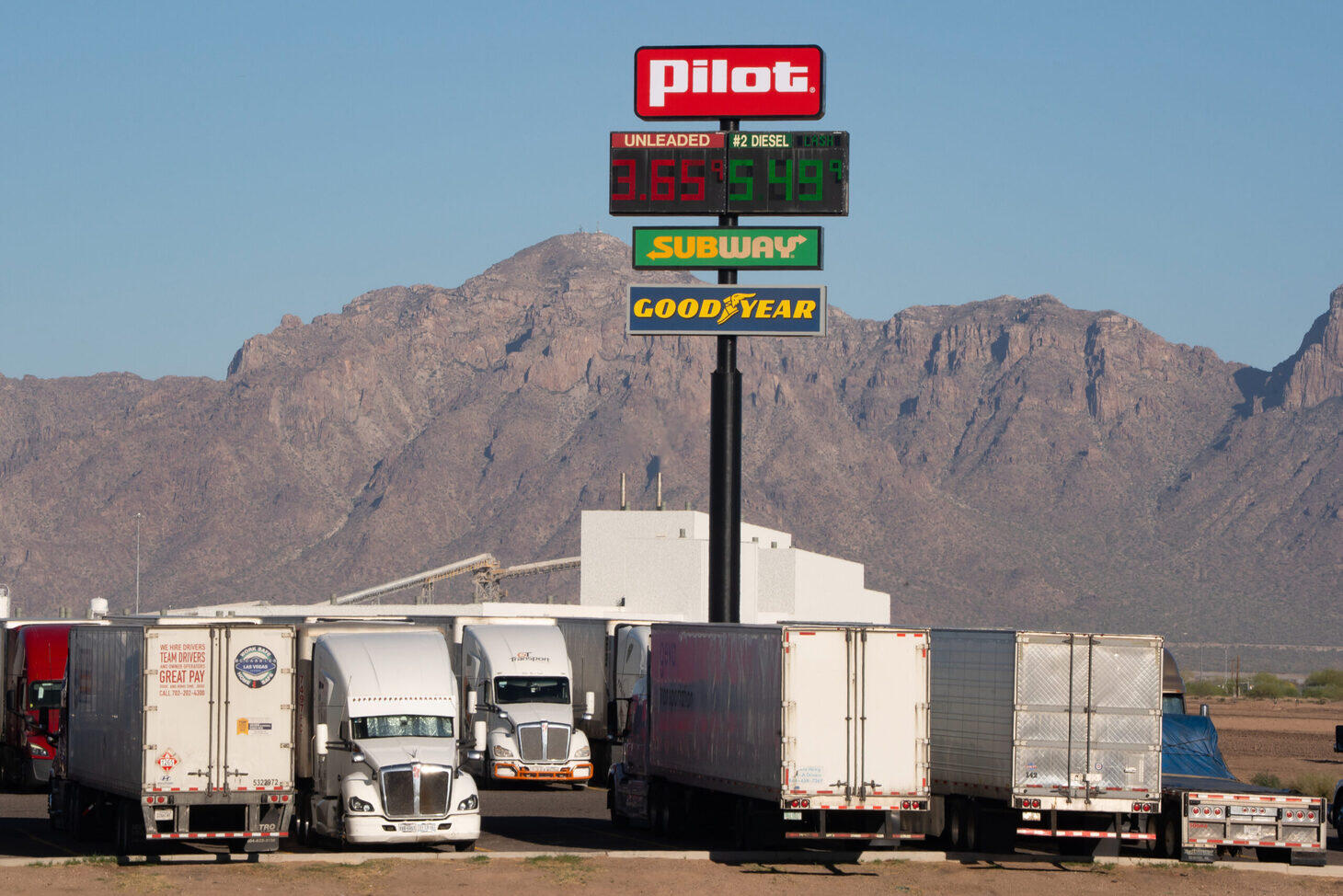
A Landmark Supreme Court Ruling Is Upending How America Moves Its Goods
A US Supreme Court decision in May changed the stakes for freight brokers like Ilg, opening them to lawsuits if a driver for a contracted carrier gets into a collision.
The ruling leaves plenty of uncertainty about when a broker ultimately might be held responsible. But last month, a jury in Texas offered a glimpse at just how costly the new landscape could become: It recommended $604 million in damages against one of the country’s largest freight brokers and two other defendants.
While the legal process will likely drag on for more than a year, the size of the potential penalty is already reshaping the roughly $16 billion brokerage industry — and changing who gets to haul America’s freight. Brokers are shrinking their carrier networks, insurance premiums are soaring for some firms and investors have wiped billions of dollars from the value of publicly traded brokers as they grapple with the new legal risk. MORE
Casualty insurance is moving towards property-level analytical maturity: Moody's
Moody’s, a global provider of credit ratings, research and risk analytics, assesses that casualty insurance is at an earlier stage of analytical
Moody’s, a global provider of credit ratings, research and risk analytics, assesses that casualty insurance is at an earlier stage of analytical development than property catastrophe insurance, but is beginning to show some of the characteristics of a maturing analytical market.
The US commercial casualty market represents approximately $300 billion in annual premium, making it one of the largest segments of commercial insurance. Yet the data standards, modelling frameworks and market-wide practices used to measure casualty accumulation are not as established as those used in property catastrophe insurance.
According to Moody’s, the casualty market is broadly at a stage comparable with where property catastrophe insurance was in the mid-1990s. This is a market-level observation rather than a judgement on individual insurers: sophisticated approaches already exist, but adoption across the market remains uneven.
Climate/Resilience/Sustainability
Lala triggers Hawaii's first-ever reef insurance payout
Hurricane Lala triggered the first-ever payout from Hawaii's parametric coral reef insurance policy.
Nonprofit group The Nature Conservancy purchased the first coral reef insurance policy in the United States in 2022 from Munich Re. It covers coral reefs across Hawaii's main islands against damage from hurricanes and tropical storms. The policy reportedly covers an area of 314,976 square miles and provides up to $2 million in payouts over a one-year policy period, with a maximum of $1 million per storm and a minimum payment of $200,000.
The policy uses predetermined weather parameters to trigger these claims. The payment amount is determined based on the storm's characteristics and location, allowing funds to be released without waiting for a traditional damage assessment.

Connected Property Intelligence And The Future Of Insurance Claims
Modern claims organizations can benefit from a different model—one where property intelligence is connected across the claim life cycle.
Property claims are getting harder at the exact moment customers expect them to get faster. Catastrophic (CAT) events create instant surge demand, claim severity is up in many regions, and experienced adjusters are harder to find. Yet many claims workflows still depend on manual inspections and disconnected systems.
Policyholders, meanwhile, expect the same speed and transparency from their insurer that they get everywhere else. Many don't understand why a property claim takes weeks when other complex transactions happen in minutes.
This won't be solved by bolting on another tool. Instead, I believe the answer is to connect the tools and the data so an adjuster isn't doing manual integration in their own head. If it takes five logins and 15 tabs to settle one roof claim, that's not modernization.
Research

Verisk: Labor Costs Drive 4% Total Reconstruction Cost Increase
Continued wage growth across major trades reflected ongoing skilled labor shortages, capacity limitations and a demand for specialized construction services.
Total reconstruction costs, including materials and retail labor, increased 4% from July 2025 to July 2026, according to the Verisk third quarter report, “360Value Quarterly Reconstruction Cost Analysis.” This marks a slight deceleration from 4.2% from July 2024 to July 2025. In the second quarter of 2026, costs increased 1.2%. For residential reconstruction, total costs increased by 3.8% from July 2025 to July 2026 and 1.2% from April 2026 to July 2026. Residential reconstruction costs increased year over year in all states, with Kansas experiencing the largest increase of 5.3%, followed by Michigan and Oklahoma at 5.1%.
Certain states saw significantly lower cost increases, with Utah seeing the largest drop in cost rankings, falling 18 places with a 2.8% increase. South Dakota fell 16 spots with a 3.5% increase and New York dropped from 31st to 44th with a 2.9% increase.

Claims Severity Gap Between Repairable BEVs and ICE Vehicles Hits Record Low
Mitchell, a leader in the development of innovative auto physical damage technology solutions, today released its latest Plugged-In: EV Collision Insights report.
This quarter's report reveals that the gap in average claims severity between repairable battery electric vehicles (BEVs) and internal combustion engine (ICE) automobiles has reached its lowest level on record in both the U.S. and Canada.
With a gap of just $729 in the U.S. last quarter, average repairable severity for BEVs was $5,684 compared to $4,955 for ICE alternatives. In Canada, the gap was $1,234 CAD with BEV severity of $6,645 CAD versus $5,411 CAD for gasoline-powered automobiles. Although BEVs remain more costly to repair, Mitchell's latest data suggests that higher total loss frequency and a maturing electric vehicle fleet is bringing repair expenses across powertrain options closer to parity.
"The shrinking BEV repair cost premium is an important development for insurers and collision repairers, particularly as the electric vehicle car parc ages," said Ryan Mandell, Mitchell's vice president of strategy and market intelligence. "At the same time, ongoing trade and geopolitical uncertainty could put renewed pressure on replacement part costs and availability, with BEVs particularly exposed because of their greater reliance on OEM components."
Commentary/Opinion

Why the insurance claims payout process could deter AI adoption
While many insurers are moving to adopt artificial intelligence across various aspects of their businesses, Andrew Jernigan, head of insurance at Pliant, said claims payouts are being overlooked.
Jernigan told InsuranceNewsNet this could limit effective adoption of AI and could ultimately have a negative impact on customer service levels.
“What people expect with insurance is getting the money that they’re owed,” Jernigan said. “And so, that old process that AI isn’t involved with, that large language learning models can’t tap into, that is one of the strongest barriers for insurance to be transformed.”
He said insurers risk decreased service levels and even “losing customers” if they’re unable to offer the modern, fast payouts consumers expect.
“AI is essential. It’s the one technology that’s going to transform insurance and insurtech in this next season of the industry. So I believe it’s a massive risk to not address changes in payment structures and the adoption of modern technology with that.”
Insurers' Real Barrier to Operational Efficiency
The insurance industry is facing a hard question: Is the way we work actually working?
For many, the answer is no.
Disconnected workflows remain one of the biggest pain points across insurance operations. Quotes bounce between departments. Claims pile up in inboxes. Approvals disappear into email threads. Every manual handoff creates friction, slows resolution times, and chips away at customer and broker relationships.
Guidewire, Duck Creek, and other core systems have made real strides, but the deeper issue is that integrations fall apart because the underlying workflows are outdated, inefficient, poorly documented, and full of exceptions that no one has mapped out.
The fix is not simply adding new people or platforms; it's streamlining and standardizing workflows first and then using that enhanced foundation as the platform for making informed workforce and technology decisions.
James P. Ballot and Diane Brassard
Predict & Prevent

Predict & Prevent® Podcast Episode 31: How Big Data and AI Are Reshaping Insurance Oversight
Balancing Innovation and Oversight: Insurance Regulation in the Age of AI with Wisconsin Commissioner Nathan Houdek.
Insurance regulation and technological innovation are often portrayed as opposing forces, but Wisconsin Insurance Commissioner Nathan Houdek sees them as complementary.
In a recent episode of the Predict & Prevent podcast from The Institutes, Commissioner Houdek joined guest host Frank Paul Tomasello, Executive Director of The Institutes Griffith Education Foundation for a wide-ranging conversation about how data, artificial intelligence, and collaborative public-private programs are reshaping how the insurance industry approaches risk.
People

Klear.ai Welcomes Veteran P&C Claims Executive Jonathan Gerdes to the Klear.ai Team
Klear.ai, a provider of claims administration, policy administration, risk and analytics solutions, today announced that Jonathan Gerdes, a seasoned property and casualty claims executive, has joined the Klear.ai team.
Jonathan brings decades of leadership experience across carriers, third-party administrators, self-insured organizations and captive insurance programs. His background includes casualty and workers' compensation claims, claims operations leadership, team development and performance improvement across complex insurance environments.
"Jonathan brings exceptional industry knowledge and a practical understanding of the challenges claims organizations face every day," said Brijesh Kumar, Founder and CEO of Klear.ai. "His experience will be invaluable as we continue strengthening our platform, expanding our market presence and helping clients achieve better outcomes through technology, analytics and AI."
Recommended Events

ITC Vegas | Horizon of Possibilities
ITC Vegas September 29, 2026 - October 1, 2026
The largest insurance innovation event in the world - Predict, Prepare, Progress
From the shore, the ocean can appear calm. Yet, under the surface, tectonic plates shift, pressure builds, and currents redirect—long before we detect movement. That’s insurance right now. Climate, technology, regulation, and human behavior are reshaping risk in real time. Change isn’t coming; it’s already here. The real question is how we move forward.
We set our sights on the horizon and turn insight into action.
‘Connected’ proudly sponsors ITC Vegas 2026. Rate Discounts available for ‘Connected’ followers, please contact Alan Demers