
News

NAIC summer 2026: President flags work on private credit, AI, homeowners
Regulators are adapting to emerging risks in the US insurance market, as demonstrated by their scrutiny of insurers' use of private credit and AI, and seeking deeper insights into homeowners insurance trends, according to Virginia Insurance Commissioner Scott White, president of the National Association of Insurance Commissioners.
At the NAIC’s summer national meeting, White highlighted the insurance regulator's efforts to address private equity's growing influence on insurers, including creating standards for assessing investment risks and closer examination of credit ratings.

One in three claimants say their coverage fell short, survey finds
One in three home and auto policyholders who have filed a claim say their coverage fell short of expectations. Fourteen percent say no part of their claim was covered, according to a new survey from VIU by HUB, an embedded insurance brokerage platform backed by Hub International. The findings point to a coverage review gap that brokers are well-positioned to close.
The survey was conducted online by The Harris Poll in June among 1,663 US adults with home or auto policies. It also found that 41 percent of policyholders have made no change to their home or auto coverage in more than a year. Twenty percent have not made any change since purchasing.
Climate/Resilience/Sustainability

Swiss Re and SAS Target Secondary Perils in Insurance
Swiss Re partners with SAS to integrate CatNet hazard data into SAS Insurance Life Cycle Accelerator, helping insurers to better manage risk
Operating as part of the SAS Strategic Technology Partner Programme, Swiss Re, a global reinsurer, is combining its CatNet catastrophe risk database with analytics software firm SAS’s Insurance Life Cycle Accelerator.
This integration allows primary property and casualty (P&C) insurers to ingest predictive hazard insights via secure application programming interfaces (APIs) and automated geocoding microservices without requiring manual data manipulation.
Stu Bradley, Senior VP for Risk, Fraud and Compliance Solutions at SAS, says: “Insurers cannot rely solely on historical loss data to understand risk. “The combination of SAS’s AI and actuarial modelling capabilities with Swiss Re’s catastrophe intelligence will enable insurers to make faster, more transparent and more resilient underwriting and pricing decisions.”
Research

2026 U.S. Small Commercial Insurance Study - JD Power
- Overall satisfaction with small commercial insurers rises, driven by improvements in digital capabilities and price
- Largest gains in customer satisfaction focused among micro businesses with fewer than five employees
- Specialized understanding of business needs drives higher levels of satisfaction
“The fact that fewer businesses are experiencing insurer-initiated rate increases is certainly helping to improve customer satisfaction, but the real story here is the trend toward significantly improved satisfaction with insurers’ digital channels,” said Stephen Crewdson, managing director of global insurance intelligence at JD Power. “Insurers have spent heavily on improved digital tools that make it easier for customers to engage and manage their polices any time, day or night, and those efforts are paying off in the form of higher levels of overall satisfaction. The trend is most significant among the smallest small businesses, which are now able to access a level of service that was not previously available to them.”
How Emerging Technologies are Changing Insurance and Liability Risk
Last year, our Future of Risk series explored how today's greatest business risks no longer exist in isolation. Cyber threats, workforce disruption, supply chain volatility, business continuity, and executive liability have become increasingly interconnected, creating systemic exposures organizations need to plan for holistically. Those risks haven't gone away, but a new force is intensifying each of them.
Across Brown & Brown's 2026 Market Trends Report, one theme surfaced repeatedly: emerging technologies are reshaping industries faster than businesses, regulators, and insurers can adapt. From AI and automation to advanced aviation and digital entertainment technologies, we are seeing a broad shift toward increasingly autonomous, data-driven, and interconnected systems.

AI-Related Lawsuits Drive Sharp Rise In Securities Class Action Filings - Risk & Insurance : Risk & Insurance
Securities class action filings jumped 30% in the first half of 2026 from the second half of 2025, with AI-related cases and mega-dollar-loss litigation driving the increase, according to Cornerstone Research and Stanford Law School’s Securities Class Action Clearinghouse, reported Risk & Insurance.
AI-related litigation has become a dominant force in securities class actions, driving losses that far outpace the number of cases involved.
- Securities class action filings totaled 121 in the first half, up sharply from 93 in H2 2025, and up 6% from 114 in H1 2025.
- AI filings: 15 cases in H1 2026, on pace to nearly double 2025’s full-year total of 16 when annualized.
- Technology sector: Filings reached 24, up from nine in H2 2025 and double the historical semiannual average.
Worth noting: No AI-related filings involved autonomous vehicles in H1 2026, a shift from prior years, while cryptocurrency filings fell to their lowest annualized pace since 2019.
AI in Insurance
Retail P&C most vulnerable to AI disruption within insurance sector: Moody’s
While artificial intelligence (AI) is delivering tangible gains for property and casualty (P&C) insurers, retail P&C distribution is the area most vulnerable to near-term disruption due to its high transaction volumes, routine processes and the commoditized nature of its services, according to Moody’s Ratings.
Moody’s outlined that AI holds the promise of significant long-term benefits for banks, insurers and asset managers, although measurable gains remain modest so far.
The report examines how AI introduces costs, creates divergence and reshapes risk across the financial institution space.
Specifically for the insurance sector, Moody’s noted that AI is delivering some gains in underwriting, pricing, claims management and capital and reserving analysis.
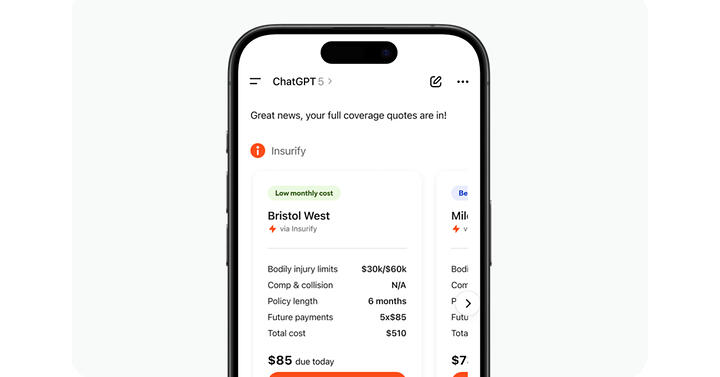
Insurify Expands ChatGPT Plugin with Real-Time Personalized Quotes and In-Chat Shopping
Insurify, America's top-rated online insurance agent and comparison platform, has released a major upgrade to its groundbreaking ChatGPT plugin, expanding the experience beyond rate estimates and insurer comparisons to deliver a more complete personalized shopping experience. Users can now get secure real-time personalized car insurance quotes, receive instant AI-powered answers to their coverage questions, and take the next step toward purchasing coverage, without leaving their chat.
Car insurance shoppers answer a few questions about themselves, their vehicles, and their coverage needs, and Insurify's plugin uses the shared information to serve up real-time quotes inside the ChatGPT conversation. Shoppers can ask questions about the insurance process – "How much coverage do I need?" or "How long will it take to get my ID card?" – choose a quote, and, depending on the carrier, either go to the insurer's website or complete their purchase through Insurify's own agency.

Meta's $14 Billion AI Data Center Faces Insurance Risk
Meta Platforms Inc. (META, Financials), the social media and artificial intelligence company, faces a new risk around its $14 billion Texas data-center project with BlackRock.
The joint venture is developing a 1-gigawatt campus in El Paso, with BlackRock holding an 80% stake and Meta retaining 20%.
According to the Financial Times, only part of the project is fully insured, potentially leaving the venture exposed to billions of dollars in losses if the campus suffers a major event.
The project reportedly carries up to $427 million in all-risk property coverage during construction, rising to $450 million once operational. It also has $645 million of terrorism coverage and up to $218 million for rent losses caused by construction delays.
The key question is whether Meta's AI data centers generate enough long-term returns to justify both the spending and the risks attached to financing them.
Claims

MSIG USA’s Morrison: Technology, AI Are Transforming the Insurance Claims Landscape
Ron Morrison, chief claims officer, MSIG USA, discusses how AI, data analytics and workforce transformation are reshaping insurance claims, helping insurers improve decision-making, efficiency and customer outcomes.
State News

State data shows decreasing home insurance premiums in 51 Florida counties
According to Florida's Insurance Commissioner, new data show decreasing property insurance premiums in the first six months of 2026 in 51 counties,
The July 2026 Property Insurance Stability Report from January 2026 to July 2026 showed the following average premiums:
- Palm Beach County: $6,412 to $6,323, which is a decrease of 1.4%
- Martin County: $5,993 to $5,899, which is a decrease of 1.6%
- St. Lucie County: $3,522 to $3,491, which is a decrease of 0.9%
- Indian River County: $4,453 to $4,334, which is a decrease of 2.7%
- Okeechobee County: $3,754 to $3,730, which is a decrease of 0.6%
Legal System Abuse/Social Inflation

Managing Litigation Risk in Nuclear Verdict Era
Litigation is one of the most volatile and least standardized components of indemnity leakage. Venue outcomes vary widely, plaintiff bar strategy has grown more sophisticated, and jury behavior remains inherently unpredictable. This is exactly why litigation is often the hardest leakage driver for claims organizations to bring under control in day-to-day operations.
According to a 2026 CLM Litigation Management Study, auto and trucking has overtaken general liability as carriers' single largest litigation spending driver. It now accounts for 33% of total litigation spending, up from 24% in 2023. At the same time, data from Marathon Strategies' May 2025 analysis puts the median nuclear verdict against corporate defendants at $51 million, up from a $44 million median. Even mid-severity claims now carry thermonuclear tail risk in adverse venues.
The CLM 2026 data also show that settlement — not trial — remains the dominant path to resolution. A mean of 87% of non-workers' comp litigated claims settle, against a verdict rate of just 2.9%, indicating that settlement quality, not just avoiding trial, is the true performance lever.
Peter Venetis is associate vice president of claims at ValueMomentum
Podcast Sponsor

Audio Version - 'Connected: The Podcast' --- Sponsored by Pulse Podcasts
The ‘Connected’ Podcast by Alan Demers and in dedication of Stephen Applebaum, is a condensed audio version of the day's ‘Connected' newsletter, a daily scan of all the happenings in the world of Insurance & InsurTech News.
Pulse Podcasts: Introduce a new way for your audience to hear your voice! We are a podcast creation service that helps businesses turn their written content, like blog posts and news articles, into beautiful podcasts. Our platform writes the script, records the voices, and mixes the audio to create engaging content for your audience. It's affordable and has super-fast turnaround!
LISTEN AND SUBSCRIBE BELOW